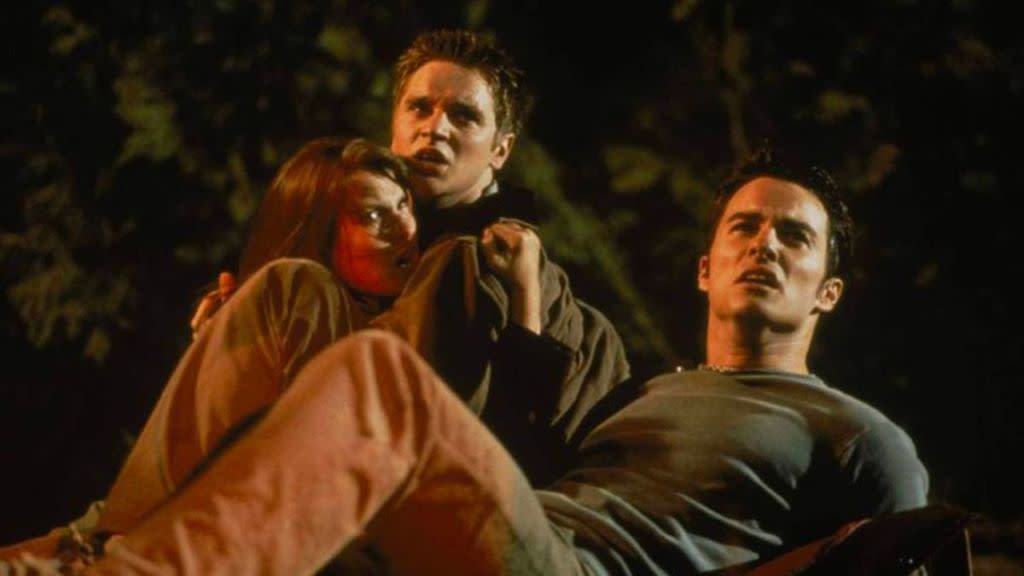
Final Destination (2000) is directed by James Wong, who also wrote the script alongside Glen Morgan and Jeffrey Reddick. It stars Devon Sawa, Ali Larter, Kerr Smith, Kristen Cloke, Seann William Scott, Amanda Detmer, Chad Donella, Daniel Roebuck, Roger Guenveur Smith, and Tony Todd. The film follows Alex Browning (Sawa), a high school senior about to embark on a trip to Paris with his French class. Seconds after boarding the plane, Alex has a startling premonition that the aircraft will explode minutes after takeoff and kill everyone on board. Alex freaks out, and due to the chaos, he is removed from the plane alongside one of his teachers and five classmates. After realizing Alex’s premonition was real, the survivors struggle to understand what happened but try their best to move on. When they begin to die one by one under mysterious circumstances, Alex becomes convinced that “death” is attempting to correct its mistake and kill off the plane crash survivors in the order they were initially meant to die. Seen by the police as the prime suspect, Alex scrambles to find a way to save his friends (and himself) before it’s too late.
The young, flavor-of-the-week performers inject their somewhat stock characters with varying levels of charisma, but the crappy dialogue holds them back from being truly effective. Thankfully, the more naturally talented cast members (Sawa, Larter, Scott) provide enough gravitas when it truly counts. None of the characters are particularly well-written and mostly just come across as archetypes we’ve seen hundreds of times before. However, they ultimately work because the script uses these archetypes in subversive ways. For example, Kerr Smith’s character, Carter, is maybe the most over-the-top cruel version of the classic bully archetype, and someone we expect to die very early on. Instead, the script uses our expectations against us and eventually gives the character an unexpected change of heart. This shift may feel like a jarring third-act character shift for some people, but for me, it works as a realistic display of how high-school bullies often quickly shift gears after getting a taste of the real world. Even Seann William Scott’s character, Billy, who’s nothing more than the cliche dorky/awkward character, feels unique because instead of loving books and school, he loves hockey and boobies. It nails the rare, authentic idea that one’s interests don’t necessarily make them nerdy/dorky; it has more to do with how they interact socially.
The film’s premise, which sees death as a proactive force capable of executing complex, Rube Goldberg-style kills, is an ingenious take on the slasher movie formula that holds up as a unique take on the genre 25 years later. Even in the most relentless slasher films, there are usually a handful of moments where the characters feel safe, or, at the very least, the threat of death seems unlikely. Because death is presented as an invisible, almost elemental force that is ever-present, the feeling of danger never fades.
The film is easily the most serious in the franchise. I think taking the sequels in a more darkly comedic direction was the right choice long-term, but taking a dead-serious approach to kick things off feels like a smart way to establish what’s so terrifying about the franchise before it starts taking a more “wink and nod” approach to the material. The serious, bleak tone and constant ruminations on the nature of death result in the film being somewhat of a depressing experience, especially when considering the overarching theme that death is inescapable. A few subtle self-aware jokes stick the landing, but they’re mostly relegated to the first act, disappearing completely once things get dark, which is when they’re needed most.
Because the film’s ending was famously reshot after a series of disastrous test screenings, some aspects of the story feel unfulfilled. For example, there are multiple flirtatious scenes between Alex and Clear (Larter), but other than one throwaway, last-minute line that implies the two eventually date, there’s almost zero catharsis to their absurd amount of romantic tension. Along with some lazy writing that results in confusing questions and silly plot holes, the editing feels amateurish. The movie is undoubtedly a cult classic, but its consistent technical blunders and mixed bag characters hold me back from considering it a plain old “classic.”
Overall, 25 years after its initial release, Final Destination still works as one of the most innovative and uniquely terrifying takes on the slasher genre. Even though it features its fair share of genre cliches, an equal number of smart subversions work to balance things out. Unfortunately, the film’s cumulative effect is held back by its laughable, sometimes nonsensical, pseudo-intellectual dialogue and lazily produced technical elements. Thankfully, it’s still well-paced, creepy, and fun. I’d never call it a good movie, but I also consider it a must-watch if you’re a horror fan. C+

 The Movie Matt