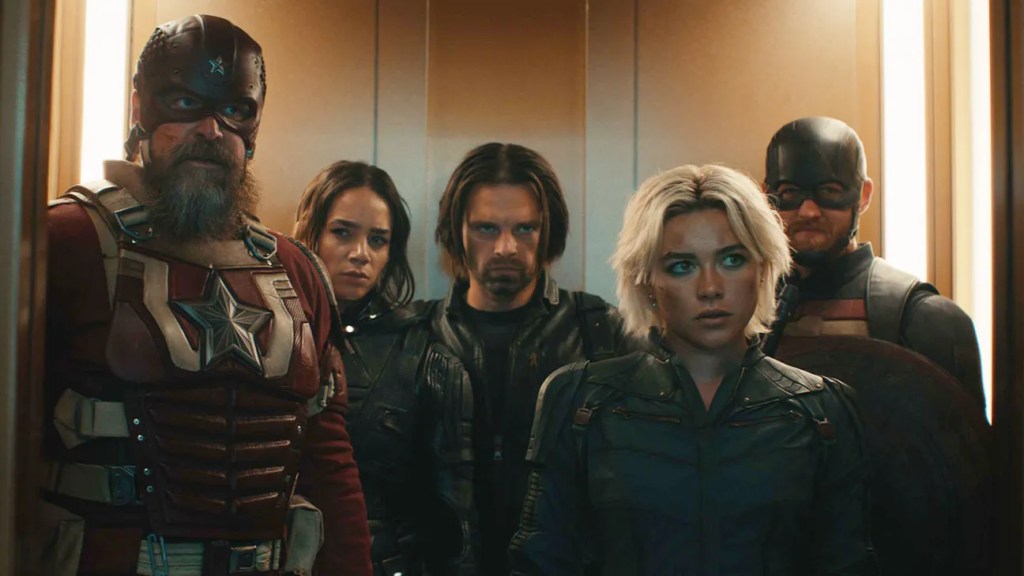
Thunderbolts* (2025) is directed by Jake Schreier and written by Eric Pearson & Joanna Calo. It stars Florence Pugh, Lewis Pullman, Sebastian Stan, David Harbour, Wyatt Russell, Hannah John-Kamen, Julia Louis-Dreyfus, Geraldine Viswanathan, Olga Kurylenko, Wendell Pierce, Violet McGraw, and Alexa Swinton. The film follows Yelena Belova (Pugh) after she accepts one final mission from Valentina Allegra de Fontaine (Louis-Dreyfus). When the mission goes sideways, Yelena is forced to team up with a ragtag group of mercenaries that includes John Walker aka U.S. Agent (Russell), Ava Starr aka Ghost (John-Kamen), and Antonia Dreykov aka Taskmaster. Framed for crimes they did not commit, the group enlists the help of Yelena’s father, Red Guardian (Harbour), and more importantly, Bucky Barnes (Stan). On a quest to clear their names, the ragtag team faces off against Sentry (Pullman), a mostly benevolent superhero who harbors an unstable dark side.
Like some of the MCU’s most beloved team-up films, Thunderbolts* heavily relies on the chemistry between its central characters. Thankfully, the film features a cast of highly talented actors who consistently elevate the otherwise forgettable dialogue. Pugh’s natural talents help her portray Yelena as a character we’re happy to follow throughout the film, so it’s easy to forget how comically similar she is to her sister/mentor, Scarlett Johansson’s Black Widow. She fights the same, has a similar attitude, and even sports an identical haircut. If you’ve ever referred to her as the “blonde Black Widow,” I don’t blame you. If it wasn’t for Pugh, I guarantee audiences would’ve felt a tad betrayed by the fact that Yelena is nothing more than a cheap replacement for a character we already love.
Wyatt Russell and David Harbour are used as effective comedic relief, but each provides a unique brand of humor. Harbour again brings a lot of zany, irreverent humor to the table as Red Guardian (basically the untrained, Russian version of Captain America), but he’s also the film’s emotional core. Because the character is consistently unhinged, his carefree, unserious behavior never undermines the life-and-death stakes. As for John Walker, he’s similar to Steve Rogers in that much of the humor surrounding the character is sourced from how dead-seriously he interacts with the world around him. The difference is that while Steve Rogers can’t detect a joke, John Walker can’t take a joke. For such a serious, tough guy who’s willing to kill someone at the drop of a hat, his ego is as fragile as they come. Wyatt Russell toes the line between cold-blooded killer and sensitive man-child in an endlessly entertaining way. He’s a small fish in terms of MCU characters, but I wouldn’t be surprised to see him appear in the franchise more regularly from here on out.
Hannah John-Kamen’s performance as Ghost is far superior to her initial portrayal of the character in Ant-Man and the Wasp (2018). The script provides her with the kind of serious yet occasionally snarky personality given to most female characters in the MCU, but it’s a personality nonetheless. During her first appearance, the character was soulless. Now, her characterization is a tad cliche, but at least it provides life.
As for Sebastian Stan and Lewis Pullman, I’m slightly disappointed with their characters. Bucky Barnes, the team’s supposed leader, is oddly sidelined throughout the film. He gets his various moments to shine, but he’s largely inconsequential to the story. Everything he achieves could easily be done by one of the other characters. Granted, he doesn’t feel out of place here, but it’s clear that the writers don’t know how to advance the character meaningfully.
Lewis Pullman’s portrayal of Sentry feels like a welcome addition to the MCU’s superhuman roster. Still, I wish the script had leaned further into what makes the character unique, especially his alter ego, Robert Reynolds. Unlike so many MCU heroes, Robert is the epitome of a loser. He’s lazy, cowardly, and was even previously addicted to meth. This would be an interesting aspect of the character to explore, but it’s a detail that’s mostly glossed over outside of how it connects to the story’s overarching themes of mental health. I wanted to see Bob adjust to being a hero on a human level. Instead, the closest thing we get is a cliche sequence where he’s unable to control his devastating powers.
The back-and-forth between these broken, impulsive, and often immature characters sets the film apart in the MCU, even compared to other team-up movies like Guardians of the Galaxy or The Avengers. We’ve seen this kind of rag-tag team-up formula before, but never with such morally flexible characters. Although the film is rated PG-13, I was happy to discover that Thunderbolts* pushes its material closer to R than any previous MCU release. This naturally adds a level of maturity that the MCU has lacked in recent years, creating stakes that are typically rare to find in even the franchise’s climactic “event films.”
Compared to recent MCU releases, this comes the closest to recapturing the magic that previously made audiences fall in love with the franchise. Other than some occasionally spotty CGI, the special effects are mostly seamless, but I’m genuinely impressed by the pacing/editing. Director Jake Schreier is seemingly the first MCU director to realize that their film’s climactic battle sequence doesn’t have to take up the entire third act. It doesn’t matter how many buildings collapse or how many innocent civilians die, because the audience has seen it all countless times before. Thankfully, although predictable as always, the climax doesn’t overstay its welcome. Instead of action (which is still very present), the third act intelligently prioritizes its characters.
Overall, this is easily Marvel’s best release since Deadpool & Wolverine (2024), but unlike that film, it feels like an honest return to the balanced tone and compelling characters that made the MCU the behemoth it is today. That being said, it’s not perfect. The MCU’s consistent tone and visuals feel inherently dull after 36 movies, and the script in general is far too on-the-nose (especially when it relates to themes of mental health). It’s no masterpiece, but it’s a step (maybe even two) in the right direction. If you’re even halfway still invested in the MCU, check this out; it’s a pleasant surprise. B

 The Movie Matt