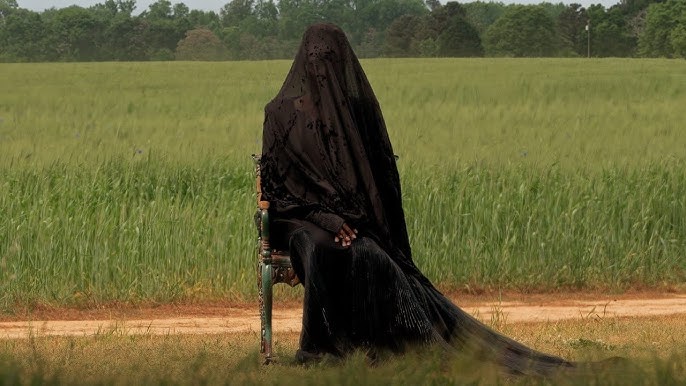
The Woman in the Yard (2025) is directed by Jaume Collet-Serra and written by Sam Stefanak. It stars Danielle Deadwyler, Okwui Okpokwasili, Peyton Jackson, Estella Kahiha, and Russell Hornsby. The film follows Ramona (Deadwyler), a grieving mother forced to pick up the pieces after her beloved husband (Hornsby) dies in a tragic car accident. Living on the isolated farm that was once their dream home, Romana and her two children soon find their house besieged by a mysterious woman dressed in black (Okpokwasili). Waiting menacingly in their yard, she repeatedly warns, “Today’s the day…” Together, the family is forced to solve the mystery of the woman’s arrival before it’s too late.
For a film with such a contained setting and a limited number of characters, casting a capable lead performer is essential. Thankfully, The Woman in the Yard nails this with the inclusion of Danielle Deadwyler. She’s a fantastic performer who exudes emotion and elevates nearly every role she tackles, even if it’s a lackluster one like Ramona. She provides the proper emotional swings Romana requires, but the character is nothing more than the “struggling single mother” archetype we’ve seen countless times before. It’s a true half-and-half situation – Deadwyler is great, but Ramona is not.
Okwui Okpokwasili is uniquely creepy in her role as the titular woman in the yard, but if you’ve seen the trailers, you’ve pretty much seen all she has to offer. Beyond her chilling delivery of “Today’s the day…,” the script doesn’t provide her with anything scary to do. She’s a creepy presence, but once it’s clear that’s all she’ll be, her threat level feels diminished. The script also makes the confusing choice to, upon introduction, undermine how evil the character is by having her ask, “How did I get here?” This immediately implies that the character isn’t acting upon their own free will and therefore may not be as evil as the characters believe. It also suggests that her arrival is inevitable, which means that the characters may have done something to invoke her. What’s happening seems unavoidable, resulting in Ramona and her kids having zero agency. All they can do is wait around until the woman finally decides to reveal her intentions. Nothing they do or say matters, making investment in these characters almost impossible. This idea of the woman being a supernatural force might be scarier for some viewers, but how it’s executed makes me believe that a more grounded direction would have been infinitely more satisfying.
The film’s depiction of familial drama is mainly weak, surface-level sludge. Nearly a third of the runtime is dedicated to cliché flashbacks of Ramona’s dead husband, but they fail to add anything on an emotional level. We get it—she really loved her husband—but Deadwyler’s performance alone is more than enough to convey this to the audience. These flashbacks are the epitome of “beating a dead horse.” It also doesn’t help that Ramona’s teenage son, Taylor (Jackson), is written to be one of the most annoying versions of the archetype. Jackson’s performance isn’t great, but he’s a young actor, and this script does him absolutely zero favors. This relationship is supposed to highlight the often rocky, back-and-forth dynamic between mothers and sons – one is defiant, the other is overbearing. The thing is, I can’t blame Ramona for being such an overbearing parent when her son is this absurdly meat-headed. I’d feel sympathetic for Taylor and his lack of independence, but he’s honestly the type of person who shouldn’t be making independent decisions in the first place.
Overall, this is a weak, disappointing horror experience with little to offer beyond an intriguing premise. The stupid, frustrating characters are often tough to connect with, which causes the story’s pathos to fall flat. The handful of “reveals” throughout the film are nothing more than yawn-worthy, and its allegorical take on suicidal thoughts/behavior is predictable and therefore kind of a dud. Deadwyler proves herself to be a skilled lead performer once again, but it’s not nearly enough to save the film from falling into obscurity. I thought it had potential going in, but it’s unfortunately just another example of Blumhouse at their most corporate and soulless. C-

 The Movie Matt