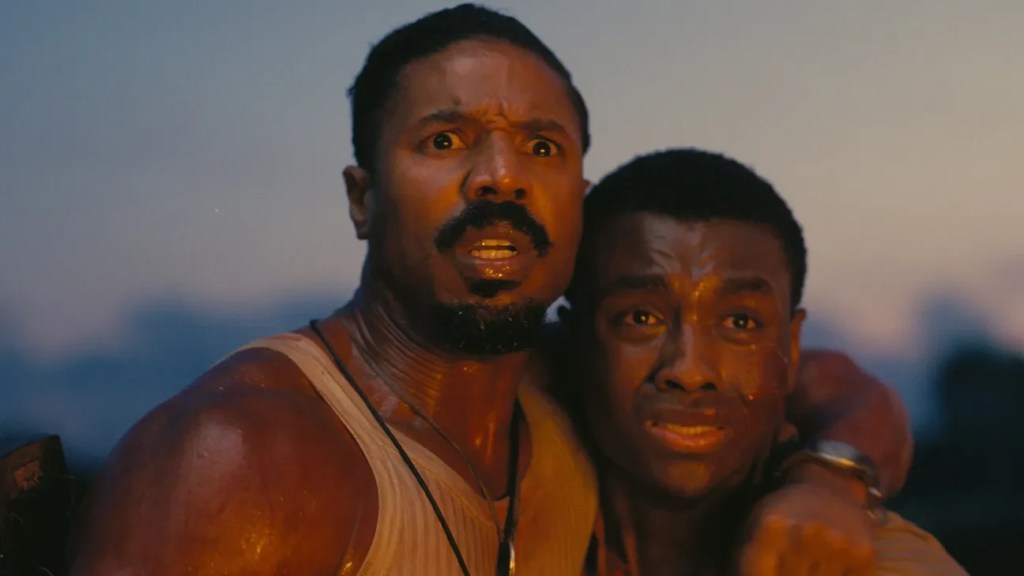
Sinners (2025) is written & directed by Ryan Coogler. It stars Michael B. Jordan, Miles Caton, Hailee Steinfeld, Jack O’Connell, Wunmi Mosaku, Jayme Lawson, Delroy Lindo, Li Jun Li, Yao, Sam Malone, Omar Benson Miller, Gralen Bryant Banks, and Buddy Guy. The film follows Smoke and Stack (both played by Jordan), twin brothers and former gang members who decide to open a juke joint in their southern hometown. As the opening night comes to a close, the remaining guests find themselves trapped by a group of vampires searching for Sammie (Caton), a local preacher’s son whose musical talents hold the ability to “pierce the veil between life and death.” Outnumbered and outgunned, the group desperately tries to survive until sunrise despite the bleak odds.
As both Smoke and Stack, Michael B. Jordan delivers his best performance(s) to date. One could argue that his performances throughout the Creed franchise are superior, but that would be an unfair comparison. Sinners is a tried-and-true genre film, while Creed is an all-encompassing character study. Smoke and Stack aren’t very complex compared to Adonis Creed, but they’re still far more interesting than a majority of horror movie protagonists. Coogler’s script intelligently spends the first act fleshing out the various relationships of both major and minor characters. The dynamics are nothing particularly new, but they are well-developed and present. Most films of this kind rush straight to the inevitable mayhem and forget to establish characters the viewer cares about. The characters in Sinners aren’t groundbreaking, but it’s clear that they were written with an uncommon level of care. Sometimes that’s more than enough.
Because each character is so well-established, it’s tough to predict who will meet an untimely demise vs. who will survive until sunrise. A good portion of the arcs alluded to in the first act are cut surprisingly short, but up until they resolve, they work as effective red herrings. We’ve seen these kinds of hero arcs before, but rarely at the same time. It’s clear how these characters will act if they make it to the end, but it’s continuously uncertain which of them actually will.
Besides Jordan, Miles Caton is the easy standout in what’s actually an uncommonly great cast. He perfectly balances this typical and often grating son-of-a-preacher character by blessing him with a rebellious musical spark. He’s a somewhat weak presence who the stronger characters are continuously trying to protect, but he succeeds in being someone we actually want them to protect. His physical weakness early on is a clear flaw, but a flaw that makes him human – it’s not his entire characterization. Delroy Lindo as an aging, alcoholic musician provides the film’s non-stop second half with some much-needed comedic relief, while Wumi Mosaku as Stack’s former love interest adds a truly badass female presence. Jack O’Connell plays against type and nails his role as the vampires’ Irish leader, Remmick. The film smartly draws the parallel that, though not as bad, certain white nationalities also faced bigotry upon arriving in America. The film naturally has its fair share of racial and civil rights subtext, but ultimately never forgets that the true battle is always one waged between good and evil. Even though the initial the group of vampires is white, putting them on a similar (but not equal) level to the black characters in terms of experienced intolerance makes it clear that evil has little to do with the color of one’s skin – maybe it has more to do with the people/ideas we choose to surround ourselves with. The only character I was a bit mixed on was Hailee Steinfeld as Smoke and Stack’s childhood friend, the only white person allowed in their juke. I felt they could’ve done a lot more with her character thematically. In the grand scheme of things, she never truly feels important. Instead, she just feels like a tool used to execute one of the film’s bigger twists, which was completely spoiled in the trailers anyway.
Speaking of the trailers, I’m completely appalled. There have been numerous rumors since the film’s release that a majority of studios have been desperately hoping it fails. Ryan Coogler signed a massive deal that promised him a certain percentage of the film’s box office before it even turns a profit. The film has been a success in every measurable category, but trade publications such as Variety have famously published articles that are less than positive, while historically praising less financially successful films in the genre. It’s clear that studios do not want to set a precedent for future directorial deals similar to Coogler’s. I suspect that even Warner Bros, the distributor of this film, regretted the deal. That would explain the marketing campaign, which spoils basically every major surprise the film has to offer.
Despite the fact that the initial viewing experience would have been significantly improved if not for the marketing, the movie stands on its own as an experience that can be appreciated time and again. The script is dense with compelling themes, but not a single one feels preachy or pretentious. It justifies numerous different interpretations of its themes, resulting in a film that can be watched repeatedly, revealing something new each time. This thematic heft is effective in its own right, but what’s really impressive is that the film also delivers the pure genre thrills its core audience expects. Once the action starts to kick in, the film feels heavily inspired by Robert Rodriguez’s From Dusk Till Dawn (1996). It’s a tad derivative, but ultimately works because it’s elevated in nearly every way. It doesn’t provide as much zany fun as that film, but is instead something that can actually be taken seriously. I enjoy the bloody madness of both films, but I’m always going to prefer the one with characters I actually care about, and that’s Sinners.
Although some people will unfortunately miss it, what ultimately ties the film together is an extended epilogue that plays shortly after the first set of credits. Although the initial ending is fairly straightforward, the epilogue allows the viewer to exit the film on a note that recontextualizes the themes in a way that is intellectually compelling in the best sense. I didn’t know exactly what to make of it, but it sparked the kinds of thought-provoking questions that film buffs like myself crave. My only small issue with the script is the inclusion of a climactic shootout that’s undeniably awesome, but also feels out of place thematically. Sure, it’s awesome to see our hero mow down a bunch of KKK members, but how does it really connect to the main story or overarching themes?
Overall, this is easily one of the best films of the year so far. It’s one of the rare genre films that delivers on its premise while also providing enough themes to pack a typical Oscar-bait film. As a result, it will likely appeal to anyone who doesn’t outright dislike horror movies. It’s well-shot, emotionally effective, scary, and mature. I don’t think it’s the masterpiece that some audiences are hailing it as, but it is one of the better genre films I’ve seen in a while. What else could a person want out of modern vampire film? B+

 The Movie Matt