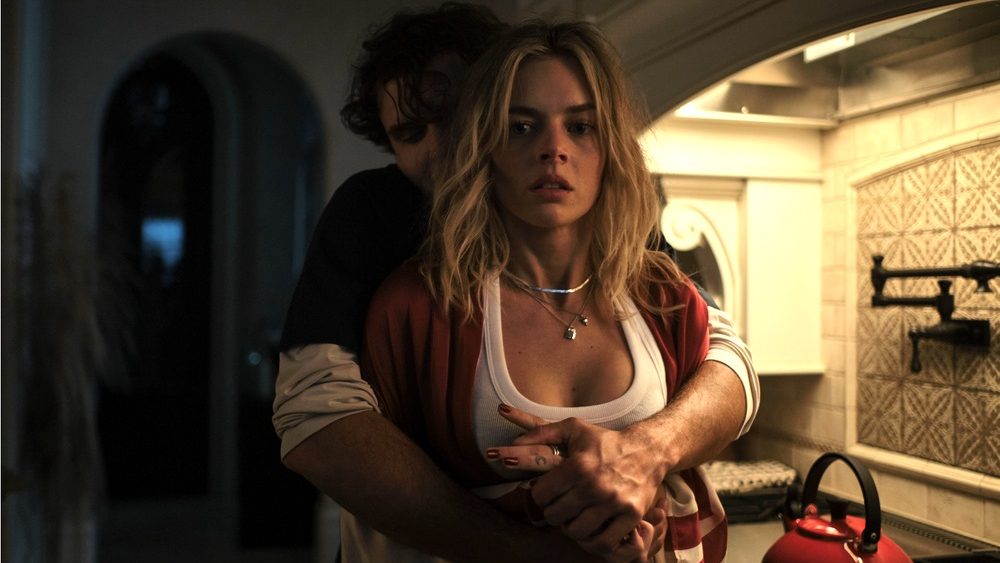
Borderline (2025) is written and directed by Jimmy Warden. It stars Samara Weaving, Ray Nicholson, Eric Dane, Jimmie Fails, Alba Baptista, Patrick Cox, Yasmeen Kelders, Catherine Lough Haggquist, Terence Kelly, and April Cameron. The film follows Sofia (Weaving), a famous pop star whose seemingly boring night is upended when Paul (Nicholson), an obsessed fan, breaks into her mansion and forces her to live out his twisted marriage fantasy. With the help of her estranged boyfriend, Rhodes (Fails), and trusted bodyguard, Bell (Dane), Sofia desperately attempts to escape Paul’s clutches before it’s too late.
Although none of the performances are by any means Oscar-worthy, the cast is a big improvement from the mediocre ensembles these kinds of straight-to-streaming movies typically offer. As usual, Samara Weaving is a blast. She’s played this kind of damsel in distress turned badass final girl multiple times before, but this performance ultimately works because she’s not afraid of leaning into the character’s silly, diva-esque nature. This could’ve easily made the character unlikable, but the script is careful to never portray her as mean-hearted or stupid. It honestly kind of blows my mind that Weaving hasn’t gotten more big roles, but she will; mark my words.
Ray Nicholson essentially just plays a slightly more mentally unhinged version of what he delivered earlier this year in Novocaine, but it feels somewhat new because he’s actually the star of the show this time around. Despite the fact that Paul isn’t a very original or interesting character, Nicholson proves that he’s a capable and charismatic leading man. He’s not perfect, and I have doubts about his range as an actor, but as of right now, I’m definitely still interested in seeing whatever he decides to do next.
Even though I wasn’t initially expecting it, Eric Dane’s performance as Bell is actually one of the film’s best. The script provides the character with a compelling backstory but also puts a lot of the more serious drama squarely on his shoulders. This allows Weaving to be the more fun half of the story’s heroic duo, while Dane gets to be the more serious and stoic half. They’re complementary in the best way. If one of them were missing, the other would start to feel like drag. Balance, brother. Balance is key.
I appreciate the fact that, regardless of whether I enjoyed it, there’s a sense that the film is at least trying to do something new/unique. That being said, the big stylistic swings the movie takes only momentarily distract from the fact that it’s actually a very basic and predictable addition to the kidnapper horror subgenre. Like so many horror-comedies, the comedy and horror only work to diminish each other. Great horror-comedies use the unlike tones to keep the audience guessing. An extremely important element of both laughs and scares is unpredictability. Too many writers and directors seem to think the genre requires every scene to be simultaneously funny and scary, but that’s simply not the case (90% of the time). In reality, great horror-comedies apply whichever tone a particular moment requires, but rarely both at the same time. I’m not saying it’s impossible, but just take a second and think about how absurd it is that these filmmakers think they can scare us and make us laugh at the same time. Those tones are on two very different sides of the emotional spectrum – it’s like saying you’re elated and depressed at the same time.
Paul and his two dimwitted accomplices are a perfect example of how the film’s horror and comedic elements often fail to gel. These three are supposed to be characters we fear to a certain extent, but they’re basically portrayed as the three stooges with mental health issues. How can we fear characters who are also the butt of a joke? This would all feel fitting if the film were solely a comedy, but I guess the studio had to reach their steaming horror movie quota. Even in the film’s handful of violent sequences, the music and tone basically scream at the viewer, “Isn’t violence fun!?!?!?! Are you having fun?!?!?!?! Have fun!!!!” Horror violence is only fun when the viewer holds a certain disdain for the victims. If we like the victims, their deaths should be impactful and horrifying. Watching characters die who don’t deserve it isn’t fun, but trying to force that fun through music and flashy cuts feels like the definition of “bad taste.” Speaking of elements that put a bad taste in my mouth, I have to point out how many times the characters break into pointless, random musical numbers. They’re not funny and don’t tell us anything about the story or characters, so why feature them at all? Whether you like musical numbers or not, it’s undeniable that their inclusion makes absolutely no sense.
Overall, this is a silly, serviceably entertaining B-movie that features some fun performances and a real dedication to trying new things (even if most of them don’t work out). Unfortunately, the film is a tonal disaster that also features a handful of risky creative choices that ultimately just feel goofy. If you think it looks good, give it a shot. There’s a chance its niche appeal will be right up your alley, but for me, that’s definitely not the case. You won’t hear me spouting hate about the film, but you also won’t hear me talk about it ever again. C

 The Movie Matt