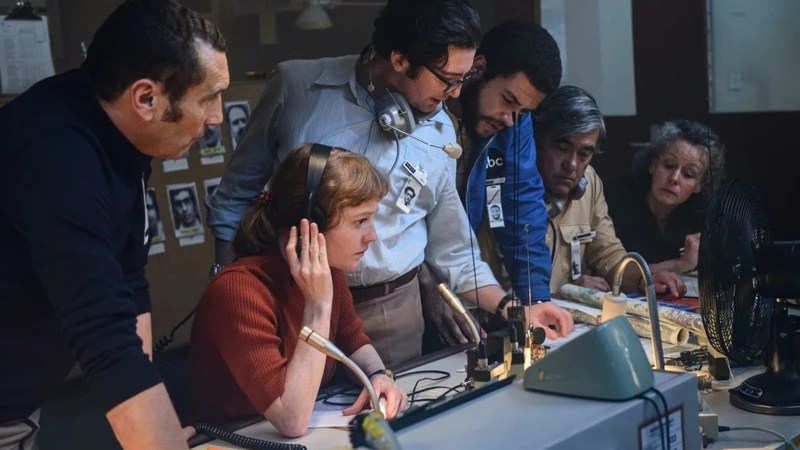
September 5 (2024) is directed by Tim Fehlbaum. It stars John Magaro, Peter Sarsgaard, Ben Chaplin, Leonie Benesch, Zinedine Soualem, Georgina Rich, Corey Johnson, Marcus Rutherford, Daniel Adeosun, Benjamin Walker, and Ferdinand Dorfler. The film is set during the 1972 Munich Olympics hostage crisis and follows the ABC News sports crew after they discover they’re the only people close enough to cover the crisis live. As the hostage situation intensifies, the news crew begins to question whose story they’re truly telling—theirs, the hostages’, or the terrorists’?
The lead cast gives top-notch performances that toe the line perfectly between realistic and dramatically compelling. These are likable, smart people thrust into a situation where the best courses of action are unclear. This naturally creates tension between various characters who all have the same goal but go about achieving it in different ways. The thing is, the script intelligently amplifies this feeling by adding another layer of tension. Instead of only focusing on the obvious tensions between Israelis and Palestinians, the film also explores the relatively fresh wounds of the Holocaust and how another tragedy involving the deaths of innocent Jews on German soil was a nightmare scenario that only served to hinder the healing process of both nations.
The script intelligently avoids ham-fisted political messaging that draws parallels to modern-day tensions between Israel and Palestine. Instead, it focuses squarely on recreating these events as authentically as possible. Yes, some complex underlying themes would have been nice here, but it ultimately works as a straightforward retelling of actual events. Along with avoiding many of the tropes these kinds of thrillers typically contain, the script constantly challenges our main characters with thorny moral dilemmas that test their long-held beliefs in compelling ways. The only issue is that the characters we follow rarely feel like they’re actually in any real danger. I’m not saying the script should have taken liberties with the real-life facts, but it would have been nice to implement the perspective of at least one character or group of characters who are in immediate danger (police, hostages, or even terrorists).
The editing is fast-paced and kinetic—precisely what it should be. However, the gritty, dimly lit visuals are nothing new for this kind of thriller. In fact, it’s probably the most uninspired direction they could have taken. If they were going for realism, I hate to break it to them, but reality doesn’t usually look this grey.
Although the last 15-20 minutes work as an effective gut punch regardless of whether you’re familiar with the real-life events, the experience will feel a tad predictable if you have prior knowledge going in. Thankfully, the film leads to a final frame that’s genuinely thought-provoking and ties things together thematically despite the fact that the movie is pretty surface-level most of the time.
Overall, this is a well-made recreation of one of history’s most tragic terrorist attacks, featuring an uncommonly strong script and impressive performances from the ensemble cast. I can’t see it having much rewatch value for most viewers, but if you’re unfamiliar with these events or just want a straight-up, no-frills true story, you can’t really go wrong with September 5. Personally, I appreciate the film’s existence partly because it works as a wonderful companion to Steven Spielberg’s Munich (2005). I recommend watching them back-to-back (maybe not on the same night, which might be emotionally taxing) starting with September 5. B

 The Movie Matt