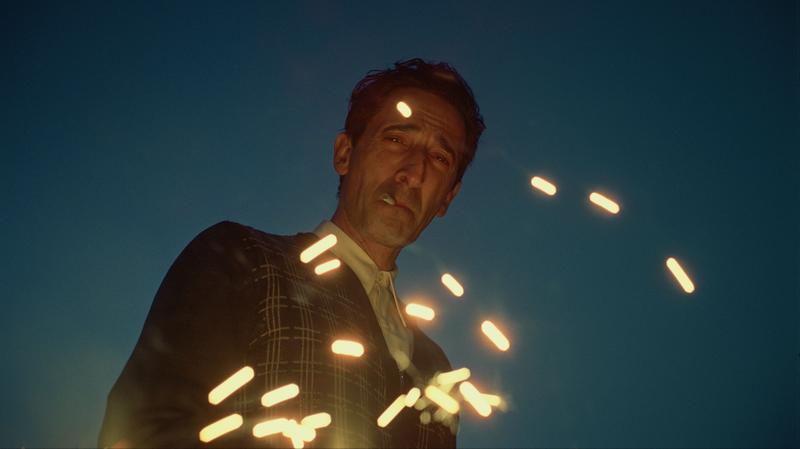
The Brutalist (2024) is directed by Brady Corbet and stars Adrien Brody, Guy Pearce, Felicity Jones, Jow Alwyn, Raffey Cassidy, Stacy Martin, Isaach De Bankole, Alessandro Nivola, Michael Epp, Amma Laird, Jonathan Hyde, and Peter Polycarpou. Beginning in 1947, the film follows the decades-spanning journey of Hungarian architect, Laszlo Toth (Brody), and his seemingly altruistic relationship with Harrison Lee Van Buren Sr. (Pearce) – a wealthy industrialist who hires Laszlo to construct a grandiose monument to his late mother. As he tackles the most ambitious project of his career, Laszlo experiences the glorious highs of the American dream but also struggles with the absence of his beloved wife, Erzsebet (Jones), and orphaned niece, Zsofia (Cassidy). When this leads to a heroin dependence that slowly diminishes the quality of his work, Laszlo finds that his partnership with Van Buren isn’t nearly as magnanimous as he originally thought.
Unsurprisingly, the film is mainly dialogue-focused. This puts the weight of the majority of its success squarely on the shoulders of its lead performers. Thankfully, the cast is in top form – especially the three leads. For the most part, Brody’s performance stands toe-to-toe with his Oscar-winning turn as Wladyslaw Szpilman in The Pianist (2002). These are somewhat similar characters, but the few distinctions do just enough to allow Brody to take his performance in new directions. For example, Laszlo’s thoughts, feelings, motivations, etc. are much more abstract/open to interpretation than Szpilman’s. In other words, Laszlo’s actions often work to establish/support the film’s themes as opposed to simply push the plot forward. This forces Brody to communicate not just what the character is feeling in a vacuum, but also what these experiences mean in a more collective/historical/meta way.
Pearce finds the perfect balance between authentic and terrifying. He masterfully pulls off Van Buren’s wealthy yet educated charm, but easily transitions when the character begins to display an aura of immature superiority. Although the character is a benevolent presence for the majority of the film, it’s clear from the beginning that he holds some kind of dark side. The thing is, the script constantly makes the viewer question whether or not their distrust of Van Buren is warranted – something that Laszlo also struggles with. More generally, this also represents the distrust that native-born citizens often have for immigrants as well as the distrust immigrants have for “unconditional” help/charity. By the time we see the endpoint of his arc, it’s shocking yet completely obvious in hindsight. The almost 4-hour runtime allows the film to develop its characters much slower and more subtly than audiences are typically used to. This results in characters that are tough to fully understand upon first viewing, but still compelling enough to justify a second watch. Even if the viewer only catches/understands half of it, it’ll still be a more thematically fulfilling experience than 90% of movies released this year.
Before Felicity Jones’ character arrives about halfway through the film, I felt as if the story was missing a very necessary emotional pillar, but it soon became clear that this was the intent. Her influence/presence signals a change in Laszlo that sees him becoming more emotional/reactive to the way people treat him, but more importantly, she acts as a much-needed voice for the audience. All great characters should be flawed, but the flaws should be balanced by characters who display opposite traits. The script understands that an individual’s flaws (especially their most defining) often can’t be overcome alone. There’s nothing particularly wrong with a character who overcomes things on their own, but it’s far more realistic when propelled by an exterior force.
Although this is by far the longest movie I’ve seen in recent memory, the runtime feels justified. As mentioned previously, this allows the character arcs to be uncommonly subtle. It may sound boring, but the combination of Oscar-worthy performances, sharply written dialogue, and beautiful cinematography keeps the viewer locked in throughout. I was also sure that the 15-minute intermission would feel like nothing more than a gimmick, but I have to admit, I was dead wrong. Instead of feeling like a random pause halfway through, it works as the perfect way for the viewer to catch their breath and reset their attention. Likewise, each half has a distinct beginning, middle, and end, yet avoids feeling like two separate films.
Overall, this easily earns its praise as one of the best films of 2024 as well as the front-runner for Best Picture. Looking at how much the movie does right when considering the scale of its ambitions, it’s a truly impressive piece of filmmaking. That being said, this is a fitting example of what many casual filmgoers will undoubtedly refer to as “Oscar bait.” It’s slow, subtle, and interested in exploring complex themes/emotions as opposed to flashy setpieces. People who solely desire action, twists, etc. are destined to be bored out of their minds. As for anyone with more mature/complex tastes, The Brutalist is sure to make its mark. I loved almost everything about it, the only thing missing was a sense of excitement. I see myself revisiting it, just not anytime soon. B+

 The Movie Matt