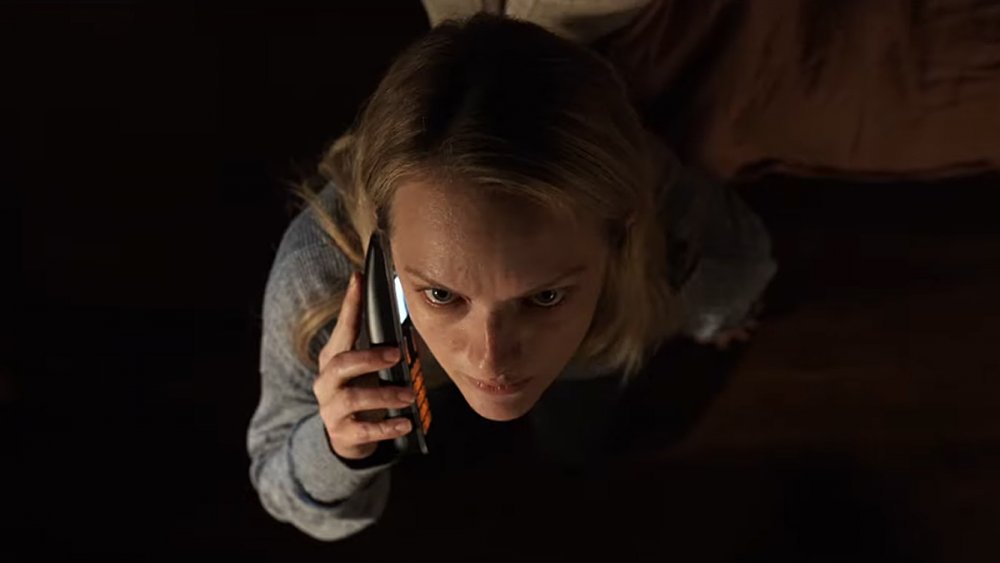
The Invisible Man (2020) is directed by Leigh Whannell and stars Elisabeth Moss, Aldis Hodge, Harriet Dyer, Oliver Jackson-Cohen, Storm Reid, Michael Dorman, Benedict Hardie, and Renee Lim. This is writer/director Leigh Whannel’s (Saw, Insidious, Upgrade) loose remake of the classic 1933 Universal monster movie and follows Cecillia (Moss), a woman who begins the film by escaping the almost prison-like estate of her extremely abusive tech-billionaire boyfriend, Adrian (Jackson-Cohen). After two weeks of looking over her shoulder convinced that Adrian will track her down, Cecillia is informed that he has passed due to an apparent suicide. In his will, he leaves her 5 million dollars with the only caveat being that she avoids trouble with the law. When a handful of strange occurrences involving a seemingly invisible presence cause Cecilia to come across as mentally unstable, she becomes convinced that Adrian is very much alive and attempting to make her life a living hell with the use of a high-tech invisibility suit he invented in secrecy. As the presence frames her for continuously darker crimes, Cecilia finds herself in a race again time to prove her innocence before it’s too late.
As a lead character who’s gaslighted harder than anyone I’ve ever seen, Elisabeth Moss provides the proper feeling of mental deterioration. In each of her scenes, she subtly advances that character’s mental deterioration in a way that feels natural. Yes, the theme of abuse victims being gaslighted is extremely on the nose, but it ultimately works because it’s a theme that feels like a natural match for the material. Cecilia’s situation would be terrifying for any gender, but even more so for a female. Instead of feeling like an eye-rolling, message-driven creative choice, it feels like something that’s necessary in terms of amplifying tension. It’s frightening enough to see something no one else can, but it’s even scarier when the more you try to tell people, the more you play into the “mentally unhinged” ex-girlfriend stereotype.
The small supporting cast that includes Aldis Hodge, Harriet Dyer, Oliver Jackson-Cohen, and Storm Reid all give strong performances, they just don’t particularly stand out. Jackson-Cohen is effectively creepy as Cecillia’s subtly maniacal ex-boyfriend, but the nature of the story doesn’t provide the character with a lot of screen time. He’s good, just a tad underused. The film is carried mostly on Moss’ shoulders, and because she does such a great job, these somewhat basic but well-acted characters are noticeably more satisfying/compelling than the typical supporting characters the genre has to offer.
Although the film features its fair share of what would otherwise be boring sequences in which our main characters walk tentatively through an empty house in the middle of the night, they work because the film takes full advantage of the fact that the threat is someone we can’t see. Whannell frames these shots by using negative space to constantly imply the presence of the Invisible Man whether he’s there or not. This infuses nearly every waking moment with a sense of inherent tension but also leads to a handful of one-of-a-kind sequences in which characters are forced to fight an invisible enemy. This could’ve easily felt like something was missing visually, but Whannell stages these sequences in ways that once again take full advantage of the premise by leaning into what would make this kind of threat unique.
As a director, Whannell’s approach to the material is top-notch, but it wouldn’t work as well as it does if not for his wonderfully written script that features more than one well-executed twists/turns. The film works wonderfully on a thematic level but is equally effective in terms of surface-level entertainment. If a person wants the ignore the themes completely (which would be tough considering how natural they feel), I’m confident they’ll find the experience just as fulfilling.
Overall, this is easily one of the best horror remakes to be released in the 20th century and succeeds in being one of the few films of its era to unapologetically explore themes such as abusive relationships and the gaslighting of its victims in a way that never feels heavy-handed and therefore patronizing to the 90 percent of the audience who already knows this stuff is an issue. On the other hand, it also works as a straightforward horror experience that consistently finds unique ways in which to unsettle the viewer. With this film, Leigh Whannell undoubtedly proves that he’s equally talented as his Saw (2004) co-director James Wan, and establishes himself as one of Hollywood’s most exciting genre filmmakers. Other than the fact that its themes are somewhat on-the-nose (even if well-integrated) and the ending lacks a proper scare for viewers to dwell on as they leave, the only issue that holds the movie back is the fact that the constant gaslighting Cecilia experiences, although fitting and effectively terrifying, is occasionally so pervasive that it quits providing tension and instead feels almost satirical – something the movie is clearly not going for. Other than that, this is modern “monster movie” filmmaking at its best and one hell of a wild ride. B+

 The Movie Matt