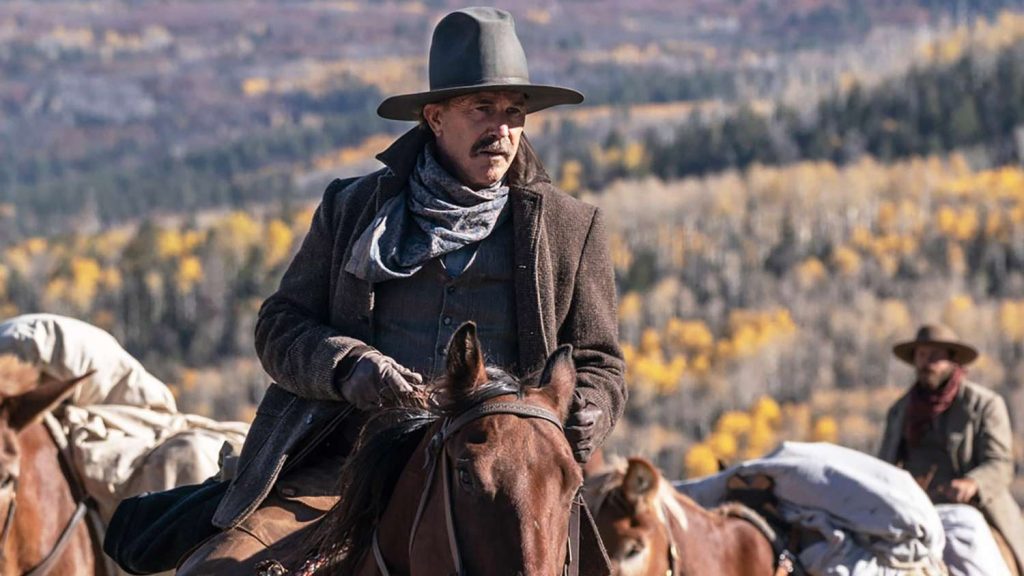
Horizon: An American Saga – Chapter 1 (2024) is directed by Kevin Costner and stars Sienna Miller, Kevin Costner, Sam Worthington, Jenna Malone, Owen Crow Shoe, Tatanka Means, Ella Hunt, Tom Guinee, Danny Huston, Michael Rooker, Abbey Lee, Etienne Kellici, Georgia MacPhail, Will Patton, Tom Payne, Colin Cunningham, Scott Haze, Luke Wilson, Isabelle Fuhrman, Jeff Fahey, Jamie Campbell Bower, and Jon Beavers. This is the first chapter in Kevin Costner’s planned 4-part saga, which follows various individuals as they attempt to settle in the American West. Jumping back and forth between different points of view, each character’s journey eventually points them toward Horizon, an up-and-coming settlement that for many is the perfect representation of the American dream.
The film features a sprawling cast of characters and although none of the performances are particularly bad, they’re often uninspired. With the number of characters this movie has, there should be at least one who stands out. These are very grounded personalities who require more development than the script allows. The film also often forgets about certain plotlines for so long that by the time we cut back, it’s tough to remember what happened previously. For a film that’s three hours long, it does embarrassingly little to propel the various character arcs.
For a film that prides itself on its various points of view, I was disappointed to find that the Native American perspective is somewhat minimal. We have at least 5 different perspectives from the settlers, but only one from the indigenous. Even then, the one perspective we get doesn’t show anything particularly insightful or unexpected. Maybe a shift in focus is something Costner intends to include in further installments, but even if that’s the case, it points to the film’s biggest issue: It fails to work as a standalone experience.
This does feel like an epic setup for a larger story, but that’s the problem. Setup is all this movie has to offer. It takes the first-act structure (typically the most boring part of a film) and extends it across an entire movie. Even in planned sagas, each installment should more or less work as a standalone experience. Even if the sequels improve this story retroactively, it’s never going to be a film I’ll desire to revisit.
The locations are unsurprisingly stunning, but what the film truly gets right is a feeling of vast, wide-open spaces. This is done by consistently displaying how small these people truly are in comparison to the nature that surrounds them. Unfortunately, the visuals are one of the few things the movie gets right. Costner’s direction feels far too pretentious because he constantly attempts to force sentimentality instead of letting it occur naturally. Because these moments aren’t properly built up, they fall flat behind a gratingly nostalgic score that sounds desperate to pull at the viewer’s heartstrings (but ultimately fails).
Overall, this is an admirable attempt by Costner to revive the Western epic but fails due to a few key reasons. The script struggles to overcome the fact that the entire film is essentially one long first act, but the bigger issue is Costner’s inconsistent direction. Drama and nostalgia often fail to gel and the dialogue is consistently boring, confusing, and drawn-out. On top of an anticlimactic and confusing ending that strangely shows a clip reel of the next installment, it’s a tough experience to recommend. It’s not quite forgettable but without the rest of the story, it’s pretty disappointing. C

 The Movie Matt