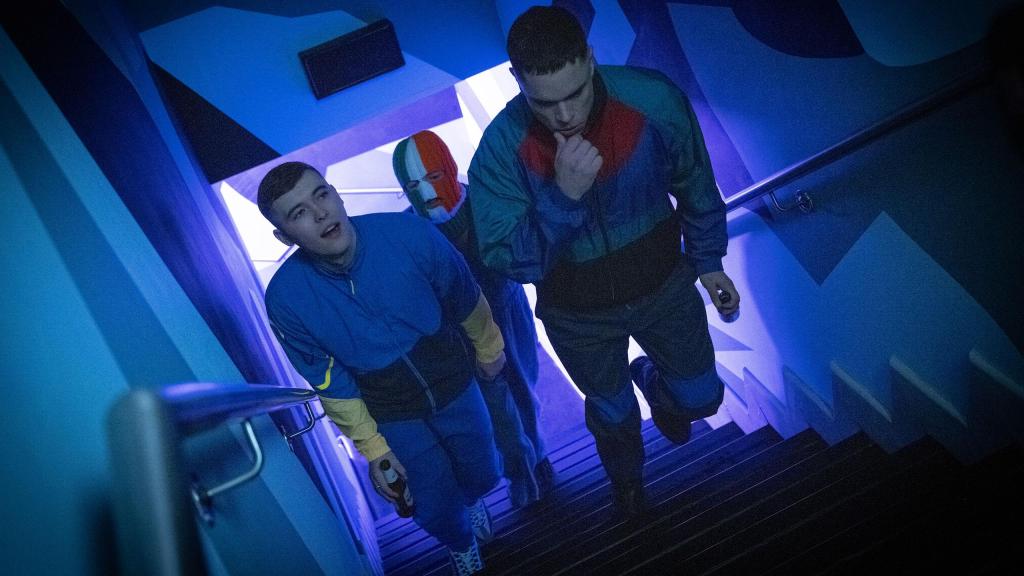
Kneecap (2024) is directed by Rich Peppiatt and stars Moglai Bap, Mo Chara, DJ Provai, Michael Fassbender, Josie Walker, Simone Kirby, Jessica Reynolds, Fionnuala Flaherty, Adam Best, Matthew Sharpe, Cathal Mercer, and Donagh Deeney. Like 8 Mile (2002), this is the half-true story of the titular Irish rap group, Kneecap. Taking place in 2019 Belfast, the story follows Naoise (Bap) and Liam (Chara), two college-aged delinquents and part-time rappers who spend most of their time dealing/doing psychedelic drugs and partying at the local clubs. When primary school music teacher and Gaelic Irish interpreter JJ (Provai) acquires a notebook of the duo’s lyrics, he’s floored by their unapologetic use of the local language — one he’s passionate about preserving. Taking the two under his wing, he convinces them to share their lyrics with the world. When their popularity sores to heights they never expected, their profane lyrics and unapologetic drug use come under fire by the British government – one that has refused to legally recognize the Gaelic language. With a rebel’s heart, the three musicians stop at nothing to make themselves heard, but not without a little help from their friends…
For guys who I’m assuming haven’t had much traditional training as actors, the three real-life members of Kneecap all give wonderful performances. Standing toe to toe with A-list performers such as Michael Fassbender, it’s clear that these are talented artists beyond the specific medium they’re known for. Liam and Naoise’s reckless attitudes aren’t particularly likable in the traditional sense and their rampant drug use will inevitably turn off certain viewers. The thing is, their sharp sense of humor and admirable underdog qualities make them exciting to follow even if you don’t 100% agree with their morals. It helps that these two delinquents are balanced by JJ’s character – a more mature and traditionally relatable presence. Throughout the film, JJ teaches the two friends to be more responsible while they teach him to let loose and take more risks. It’s a simple but effective dynamic that leads to some extremely entertaining interactions.
The supporting cast is also great, but what’s impressive about their characters is that the script provides them all with clear and satisfying arcs. Throughout the film, these characters connect in unexpected ways that add a compelling amount of conflict to what would otherwise be just another typical rags-to-riches musician story. The tonal approach also feels heavily inspired by Trainspotting (1996) in the sense that the story is told through a series of hyperactive edits and sef-aware voiceovers. I’m not usually a huge fan of voiceovers considering that they often just feel like a lazy way to deliver exposition. That being said, Kneecap’s use of the device feels like it Improves the film’s overall effect – especially its comedy. When the character’s themselves are able to comment on the story in tandem with the audience, it adds self-aware insights that allow us to forgive them for or even laugh at their unintelligent/immature actions.
One of the elements that makes the film feel so unique is its unwavering commitment to displaying authentic Irish culture. The thing is, this isn’t the same Irish culture that has been endlessly explored in the majority of Hollywood films. It’s not shy about showing the grimy aspects of day-to-day life; but unlike most Belfast-set films, it’s clear that this film is intent on showing the unbreakable community that a place like this inevitably produces. Setting the story during the 2019 fight to legally recognize the Gaelic Irish language is an intelligent decision by the writers that allows the film to transcend its otherwise character-centric approach. We’d care about the characters either way, but the experience feels a lot more meaningful if their journey is in service of something bigger than themselves.
The film is unapologetically brutal in response to the idea of Britain/British colonization but is smart to never call for further violent conflict. The group’s art may often come across as mean-spirited and offensive, but it’s what they see as the only truly effective form of non-violent protest. If you tell someone they can’t protest violently, that’s understandable. When you tell someone they also can’t protest non-violently, you’re essentially just telling them they can’t protest at all (which is precisely the time to protest). We see both the positives and negatives of spiteful, non-violent protest, but it’s always clear that it’s a more effective path than violence.
Overall, this is one of the best musical biopics I’ve seen in a long time and succeeds at bringing the viewer into an entirely new world. It’s effective on both a comedic and dramatic level and features complex characters that are a joy to follow from beginning to end. Like the themes of the film state, great art is born from a great need. Who knew an underdog story about Gaelic Irish rappers was what I needed? B+

 The Movie Matt