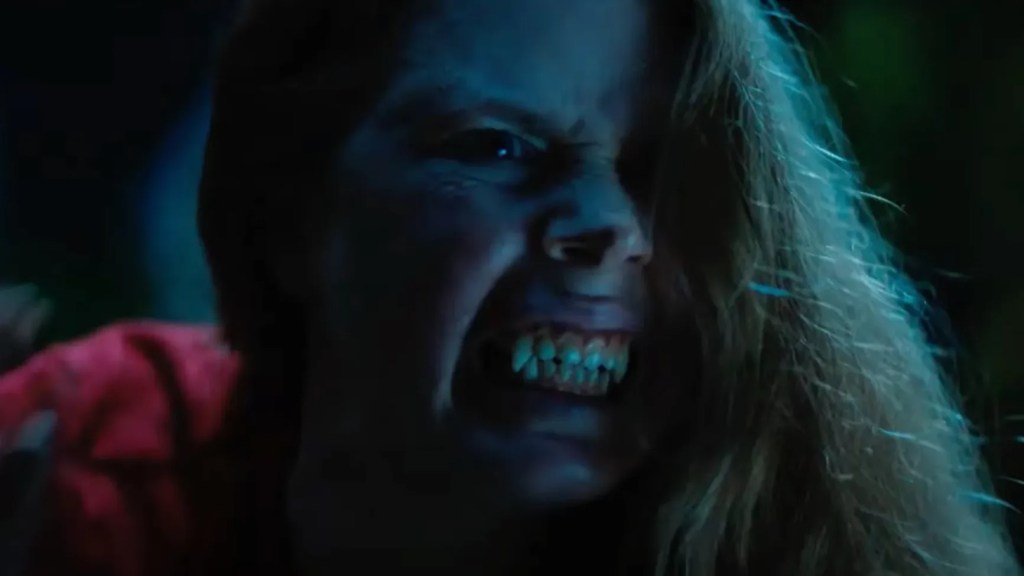
Nightbitch (2024) is directed by Marielle Heller and stars Amy Adams, Scoot McNairy, Arleigh Snowden, Emmett Snowden, Zoe Chao, Mary Holland, Archana Rajan, Ella Thomas, and Stacey Swift. The film follows an unnamed mother (Adams) who finds herself transforming into a dog when the various pressures of stay-at-home parenting begin to boil over. Although previously frustrated with the fact that motherhood forced her to abandon her career as an artist, her newfound animalistic desires allow her to focus solely on her responsibilities as a mother and therefore a newfound lease on life. When her dog-like behaviors inevitably become too much to control, the mother realizes that her anxieties stem from much more than just her parental duties. To stop the transformation, she sets out to fix what’s most likely the true cause of her pain: her marriage.
This movie is often all over the place and is a great example of a “mixed bag” experience. That being said, it’s thankfully elevated by Amy Adams’ strong central performance. The script takes a mostly sardonic approach to the material and Adams delivers the otherwise pretentious dialogue with veteran grace. The character is often gratingly unhappy for the first half of the film, but it’s forgivable considering that this behavior supports the characters’ newfound emotional freedom in the second half. She’s not always particularly likable, but there’s always a clear reason she’s acting that way.
Scoot McNairy likewise gives a great performance as the oblivious but ultimately good-hearted husband. Unfortunately, the character is again a tad grating due to how he’s written. For a large portion of the film, the couple just passive-aggressively take shots at one another about how they’re not pulling their weight in the relationship. This effectively clarifies their issues, but it’s not particularly enjoyable to watch. I think this is because the film’s previously mentioned sardonic brand of comedy fails to gel with its more traditionally dramatic moments. It sets you up for an experience that will make you chuckle, but it fails to move between its shifting tones with any kind of grace. When a serious moment happens, the viewer expects a punchline that never comes and therefore feels emotionally confused. I also don’t think that displaying the trials of motherhood by taking shots at male obliviousness is a very nuanced choice. Yes, the character gets some redemption in the film’s final moments, but by then it feels too little late. It’s as if the film thinks that a man seeing the error of his ways and apologizing is some kind of mind-blowing and unexpected twist. Really?
The film is filled with various themes relating to motherhood, marriage, and instinctual living, but it’s also extremely unfocused. These are all interesting themes, but they never receive enough focus individually to come across as fully formed/explored. It achieves a somewhat effective love story in its final moments, but it feels like it has at best a shoddy connection to the themes it builds throughout the majority of its runtime. The premise of changing into a dog feels like an afterthought by the third act and makes the viewer wonder why it was even included to begin with. The only thing this element seems to say about motherhood is that its pressures will eventually turn you into a feral animal. I suppose it admittedly goes a tad further and argues that giving into one’s animal instinct can make your life simpler on an emotional level. The thing is, this theme is contradicted in the final act and therefore feels pointless.
Regardless of its thematic confusion, the film does effectively explore the realistic sacrifices of being a parent – more specifically a mom. It gets things right by displaying that the pain of motherhood stems more from the things a person gives up/sacrifices as opposed to the responsibilities of motherhood themselves. I was initially thrown off by the fact that this character seems so fed up with her toddler even though he acts like an angel, but once it becomes clear where the pain stems from, this behavior makes a lot more sense.
Overall, this a thematically dense film that is well-acted and unpredictable but nevertheless disappointing. I think this is because it tries to do so much that it fails to fully commit to anything. In other words, It’s a beautiful puzzle with half the pieces missing. It’s too shoddily constructed to recommend to most audiences, but any current or former mothers are sure to find a strong connection to the material. It has a lot of technical issues, but my biggest problem is that I couldn’t connect to it emotionally (and it’s not surprising. I’m no mother.) It’s not quite forgettable, but I don’t see myself revisiting it anytime soon if ever. C+

 The Movie Matt