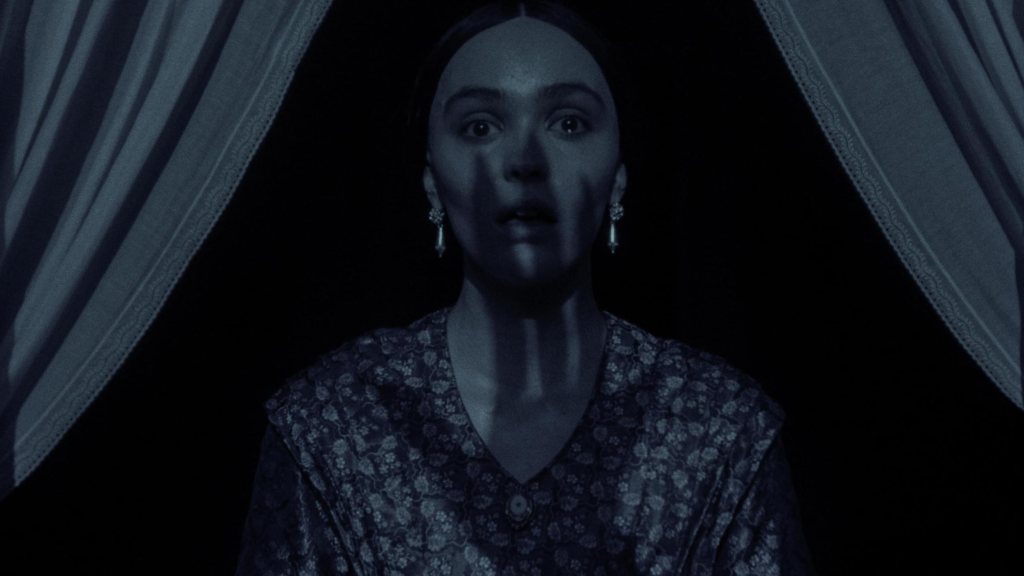
Nosferatu (2024) is directed by Robert Eggers and stars Lily-Rose Depp, Nicholas Hoult, Bill Skarsgard, Aaron Taylor-Johnson, Willem Dafoe, Emma Corrin, Ralph Ineson, and Simon McBurney. The film is a modern remake of F.W. Murnau’s 1922 classic and likewise tells the story of its titular vampire, Nosferatu (Skarsgard). When real estate agent Thomas Hutter (Hoult) embarks on a journey to meet with the reclusive Count Orlock (Skarsgard) at his remote castle, Thomas’ supernaturally inclined bride, Ellen (Rose-Depp), begins seeing visions of a terrible evil taking hold of her family. With the help of her friends, the Hardings (Taylor-Johnson & Corrin), a local Doctor (Ineson), and a seemingly mad professor with ties to the occult (Dafoe), Ellen fights to see the safe return of her husband and find a way stop Orlock/Nosferatu’s incoming reign of terror.
The film features a small group of well-drawn characters portrayed wonderfully by the A-list cast. Lily-Rose Depp takes on her first true lead role and mostly does a great job. Her facial movements are wonderfully expressive and she nails the character’s physicality during possession sequences. That being said, there are at least one or two scenes where her performance feels a bit too jarringly theatrical for my taste. She shows the typical pitfalls of a newer actress, but for the most part, shows more promise than reason to worry.
After two great performances earlier this year in The Order and Juror #2, Nicholas Hoult is again fantastic as Thomas Hutter, the film’s traditional male hero. His emotive yet subdued presence elevates a character who is admittedly a bit plain on paper. The character also feels true to the source material and mirrors the type of protagonist that used to feature in the kinds of classic films Eggers seems keen on emulating.
Aaron Taylor-Johnson’s turn as the Hutter’s wealthy friend who doubts the existence of vampires was a pleasant surprise (but really shouldn’t have been considering how good he continues to be compared to early in his career). He provides the story with a strong secondary character arc that supports the film’s gothic storytelling ambitions. He’s heavily rumored to be one of the frontrunners to be cast as the next James Bond; if he keeps showing this level of emotional range with his performances, he’ll be tough to ignore. I’m personally extremely excited to see what does in the upcoming 28 Years Later (2025).
Willem Defoe is at his zany best when he teams up with Robert Eggers and that’s no different here. He plays essentially who most viewers will recognize as film’s the Van Helsing adjacent character who is written with the typical “shunned scientist who was right the entire time” archetype. Dafoe plays the character with ease but almost feels too comfortable in a role of this kind. After his turn as a similar character in last year’s Poor Things (2023), this doesn’t feel particularly special. He’s great and it’s a tad nitpicky to complain, but I just wish Eggers chose him for a more atypical role or directed him to take his performance a tad further like something in either the previously mentioned Poor Things or the duo’s past collaborations in The Lighthouse (2019) or The Northman (2022).
Skarsgard as the titular creature of the night can described only as a word that so many people throw around far too loosely nowadays: “transformative.” More so than his performance as Pennywise the Clown in the It films, he transforms his being in almost every way. His voice is unrecognizable and he once again proves himself to be one of the great modern performers in terms of physicality. The thing is, unlike legends such as Ray Park, Andy Serkis, and Doug Jones, Skarsgard has also proven himself multiple times to have range outside these kinds of transformative roles. This context of his range only makes these off-the-wall turns that much more impressive. A lot of the credit, as well, has to go to the wonderfully chilling prosthetics and era-accurate costume design. For example, the choice to give Orlock an almost distractingly bushy mustache will be a lot for some viewers, but I thought it worked. That being said, what works about this character the most is how Eggers allows us to see just enough of Orlock to keep us wanting more and slowly reveals more of his design with each scene. Sometimes hiding the creature can become frustrating to the viewer, but if it’s done correctly like it is here, it ramps up the tension significantly.
Eggers’ strict commitment to period realism is still prevalent here, but it’s looser than his previous efforts in the sense he seems more intent on emulating but also improving the experience of a classic silent film. The film is so effective at telling its story visually that occasionally its attempts at spoken exposition feel like they just ruin what would otherwise be a perfect level of subjectivity.
This film is a visual feast that is almost a perfect experience for the eyes. My one warning/recommendation is that if you do choose to see this in theaters (which you should; it’s the type of movie that should be financially supported so we get more of them), find the best screening option you can. It’s an often dark film (as it should be) that uses what light it has very intentionally and if the the theater you’re in has even a slightly dimmed bulb in their projector, it will hurt the experience more significantly than other films.
The only general issue with the film is that on a story level, although Egger’s few updates are important and improve the experience, it can’t escape the fact that it’s a story that has been told in countless different iterations over the past century. The film is beautiful to look at, but this alone doesn’t justify the almost two-and-a-half-hour runtime. Because I knew where the film was going pretty much beat for beat, I couldn’t help but begin checking my watch after the first half hour. In my mind, it might be the quintessential version of this story and for that reason I expect it to grow on me over time, but my initial emotional reaction is that of “been there, done that.”
Overall, this is yet another wonderfully made film by Robert Eggers that once again lives and dies by his unflinching creative vision. As a faithful retelling of the Nosferatu/Dracula tale, this is a roaring success that perfectly honors that classic while improving on it in all the necessary ways. That being said, it can’t escape the fact that it feels much too similar to the experience of watching yet another iteration of Charles Dickens’s A Christmas Carol. If you’re unfamiliar with the story, you’re in for a wonderful throwback. Everyone else will find this to be a great film, it just won’t stick out as the best of the year. My emotional reaction is to give the film a B grade, but I always try to prioritize my objective feelings over my subjective ones. When I look at the film objectively, it’s easily a step up from the typical horror fare – even in a strong year for the genre. B+

 The Movie Matt