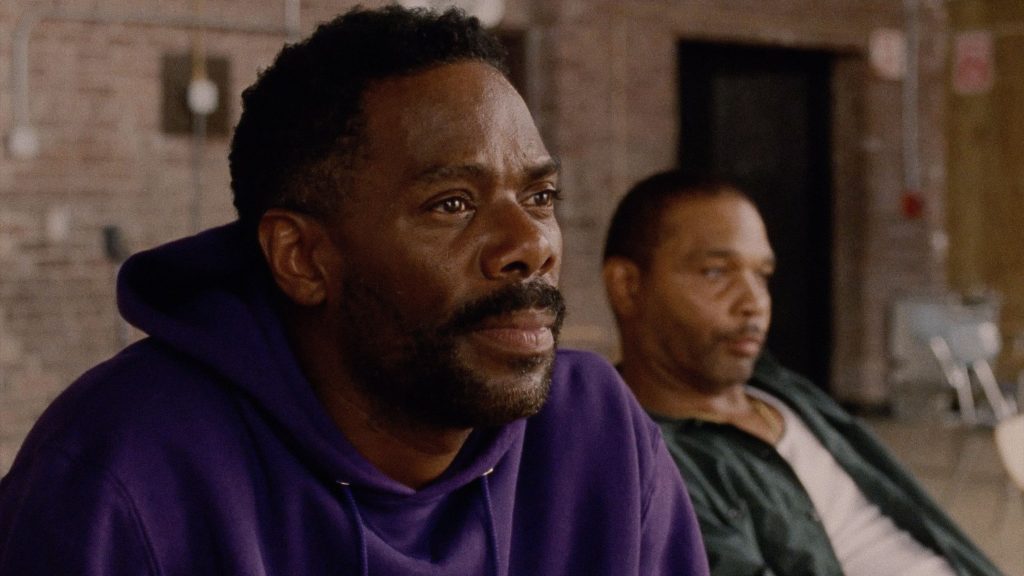
Sing Sing (2024) is directed by Greg Kwedar and stars Colman Domingo, Clarence Maclin, Sean San Jose, Paul Raci, David Giraudy, Patrick Griffin, Mosi Eagle, James Williams, and Sean Dino Johnson. The film takes place in New York State at the Sing Sing correctional facility and follows John “Divine G” Whitfield (Domingo), a talented playwright charged with a crime he did not commit who finds community in a group of other incarcerated artists/actors. Looking for newcomers to act in their latest production, Divine G recruits a talented but less-than-confident former drug dealer (Maclin) whose presence quickly challenges the group’s creative sensibilities. Through the power of transformative art, the prisoners help one another rediscover their humanity and begin working toward becoming the men they’ve always dreamed of.
Excluding Domingo (who’s fantastic in the lead role), the cast is comprised almost entirely of formerly incarcerated actors who experienced a prison acting program similar to what the movie depicts. Although I was initially nervous that this kind of casing would feel a tad gimmicky, I’m pleasantly surprised to report that these guys are as talented if not more than any mainstream actor working in Hollywood. Clarence Maclin as the story’s hardened drug dealer character who is convinced to break free from his shell is heartbreaking. It’s the kind of character whose journey we expect to end in tragedy, but the script seems aware of this and properly subverts these expectations. A tragic moment the audience sees coming is rarely as tragic as something they don’t. So, if they see a tragic moment coming, the most effective subversion is to deliver a heartwarming/uplifting moment instead.
The other supporting performance I was impressed by is Sean San Jose as “Mike Mike,” Divine G’s right-hand man and best friend. Not only does his general vibe feel completely authentic to the character, but he also gives one of the film’s most emotionally effective monologues.
I think what makes these characters so compelling, among other things, is the realistic depiction of these men struggling to hone their skills in traditionally non-masculine mediums while being trapped in one of the most toxically masculine places on Earth – a men’s prison. The thing is, the process of acting isn’t portrayed as something only a specific kind of flamboyant person can succeed at because they are naturally gifted; It’s portrayed as a way to overcome the pain of who these men are/were. In other words, It’s about the process, not necessarily the result. “Trust the process” – the film’s biggest theme. This theme helps create an environment that allows the viewer to revel in each character’s successes no matter how insignificant they may seem. Like real life, things don’t change overnight. Real progress usually comes in the form of multiple small achievements and Sing Sing gets this right without sacrificing traditional entertainment value.
This theme of “trusting the process” is nuanced in the sense that it applies not only to acting but to the justice system itself. Certain characters throughout the film express disillusion with the system and eventually stop trying to “play the game” entirely. The thing is, just like acting, it’s an imperfect system that asks people to try and try again until they get the result they desire. This is a strong parallel, but I’m a bit torn about the implied message that the justice system will always come through for people in the end. Look, I’ve never experienced the system myself, but from what I’ve heard, it’s much less effective than the movie would have you believe.
Sing Sing features all the classic beats of a prisoner vs the system movie but in conjunction with the wonderful performances and a strong heart, it never feels like a derivative experience. Along with its exploration of “systematic change,” the film also features other strong themes that include putting others before oneself, giving help versus knowing when to ask for it, and the toxicity of how men see/create art.
Overall, this is a fantastic prison-set movie that takes inspiration from classics such as The Shawshank Redemption (1994) but also succeeds in paving a unique path. It features great characters, fantastic performances, sharp dialogue, and a palpable heart. It’s nice to see a prison film where the prisoners feel authentic without being portrayed as violent, heartless thugs. The only issue I have is that thematically, the film doesn’t wrap up as tightly or intelligently as I would’ve liked. Other than that, check this one out if you can find it. I won’t be surprised if this receives a few unexpected Oscar nominations. B

 The Movie Matt