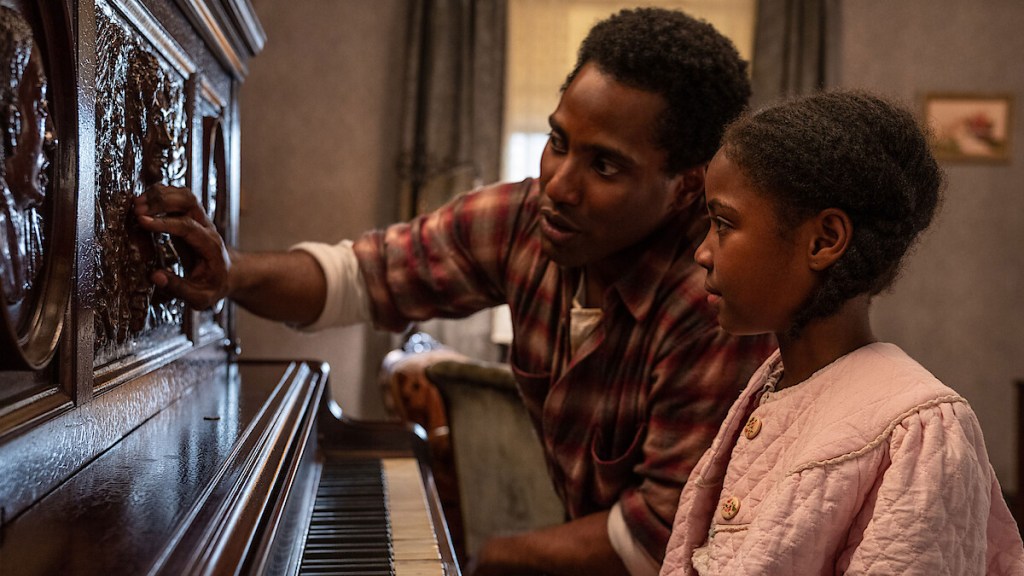
The Piano Lesson (2024) is directed by Malcolm Washington and stars John David Washington, Danielle Deadwyler, Samuel L. Jackson, Ray Fisher, Corey Hawkins, Michael Potts, Skylar Aleece Smith, and Stephan James. The film follows Boy Willie (Washington) and Berniece (Deadwyler), two siblings who gather to debate whether to sell their family’s heirloom: a handmade piano with images of their ancestors carved into its frame. Along with their uncles, Doaker (Jackson) and Whining Bay (Potts); Bow Willie’s simple-minded friend, Lymon (Fisher); and the local preacher, Avery (Hawkins), they discuss themes of legacy as well as moving on vs. living in the past. Berniece wants to keep the piano for its sentimental/historical value, but Boy Willie wants to sell it so he can buy the land where his ancestors once worked as slaves. Which better honors their family’s legacy?
Because the movie is an adaptation of a stage play by August Wilson, It relies heavily on the performances of its central cast. Thankfully, everyone is top-notch. It helps, as well, that Wilson’s strong dialogue is an actor’s dream. John David Washington’s performance as Boy Willie commands the screen, but I was particularly impressed with his expressive physicality. Because the movie is almost entirely dialogue-driven, this sense of physical expression helps keep things energized.
Danielle Deadwyler gives an equally great if not better performance than Washington, but it’s tough to compare. Washington’s character gets to be more traditionally entertaining while Deadwyler carries the majority of the film’s emotional weight. We’ve seen characters like her countless times before, but that’s easy to ignore when the performance is this spirited and emotionally devastating.
Doaker is compelling in the sense that he’s a much more emotionally subdued and mature character than Jackson typically plays. Jackson will always be one of those actors whose natural charisma outshines his characters, but it’s still nice to see him stretch his legs as a performer. As for Fisher, Hawkins, and Potts, they’re serviceable but don’t do much to elevate their respective characters.
Although the film explores a complicated moral quandary that encompasses multiple nuanced themes, it often struggles to overcome the inherent drawbacks of its stage roots. The film medium allows the story to implement story-telling devices such as flashbacks, but that’s about it. It never uses the film medium to its full advantage and makes the viewer wonder how this experience would be much different than seeing the story performed on stage.
There’s also a supernatural element to the story that I was somewhat mixed on. This element feels unique in the context of the story being told, but it only ends up working in a thematic sense. In the context of the surface-level story, it feels somewhat convenient and tonally out of place with the rest of the film.
Overall, this is a somewhat flawed but satisfying adaptation of August Wilson’s play that features fantastic performances and uncommon thematic depth. It explores money: what we have vs. what we think we deserve; The Past: living in it vs moving on from it; and Perspective: how we often dwell in the bad so much that we forget about the good. It’s sure to bore anyone who isn’t compelled by slow dramatic pacing, but everyone else should find it to be a masterful display of acting and dialogue. That being said, the ideas explored relating to race are ones we’ve seen in film countless times before. It feels like an adaptation that was produced a decade or more too late. B

 The Movie Matt