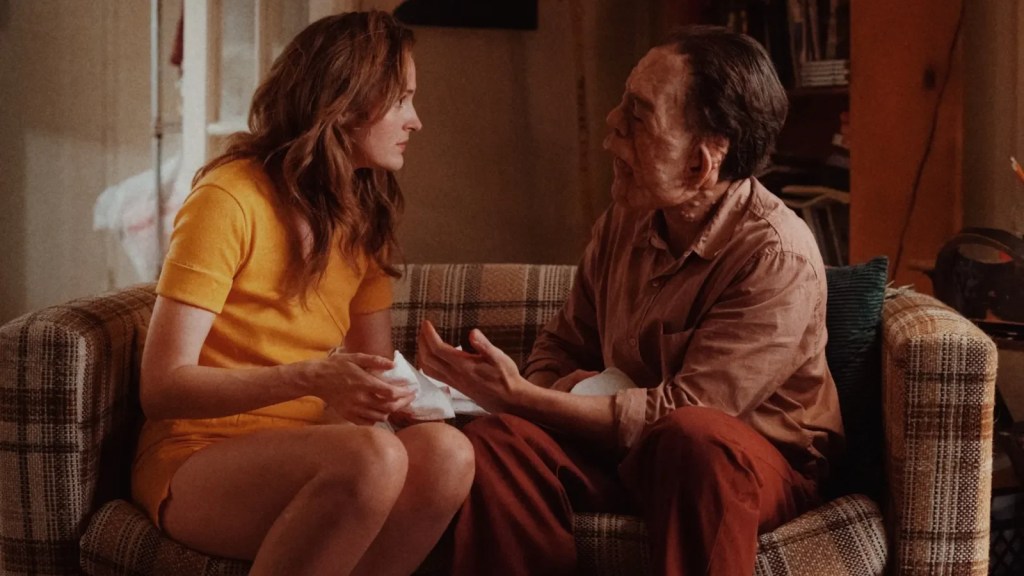
A Different Man (2024) is directed by Aaron Schimberg and stars Sebastian Stan, Renate Reinsve, and Adam Pearson. The film follows Edward (Stan), an aspiring actor living with neurofibromatosis, a condition that causes his face to be severely deformed. Having lived with the day-to-day struggles and public ridicule of his condition, Edward lacks any form of social confidence. One day, Ingrid (Reinsve), an aspiring playwright, moves in next door and quickly befriends Edward. Longing for the possibility of a romantic connection, Edward volunteers for an experimental medical procedure that rapidly begins to change his appearance. Instead of living as Edward, he adopts a completely new identity: Guy. As Guy, he soon develops a romantic relationship with Ingrid who he learns used her experiences with Edward to write a play based on him. Because Guy is Edward, he quickly wins the part. Unfortunately, Oswald (Pearson), a man with the same condition as Edward soon befriends Ingrid and Guy. As Guy slowly reverts to the personality of his old self, Oswald exudes the confidence he always wanted. Edward begins to realize that he may never be able to escape who he truly is.
For my money, Stan gives one of the best lead performances of the year. He archives a good amount of characterization simply through his physicality. We see just by his posture how much the world has hurt him. After going through his procedure, we can even see his body subtly trying to adjust to his newfound anonymity. His uncomfortable vibe is so strong that it makes a majority of the character interactions tough to watch. However, I don’t necessarily see this as a negative. We’re meant to feel what he feels, and although it’s uncomfortable, it’s also necessary for his character.
Reinsve’s character is effective because she’s truly painted as a realistic person in terms of her flaws. Ingrid may come across as toxic and rude, but a lot of that is due to how Guy reacts. He sees her actions as hurtful, but in reality, he’s allowing himself to be hurt. This is an example of one of the film’s most interesting themes: What’s the line between truly being a victim and willfully allowing oneself to be a victim?
Adam Pearson, who in real life suffers from neurofibromatosis, likewise gives a stunning performance as Oswald. His natural energy and charisma despite his condition only hammers home the film’s themes. I have to be careful with saying this, but he also comes off as a bit scary. Not in terms of his looks, of course, but the way the story uses him almost as a psychological horror villain. He never does anything bad, but his presence alone sends our protagonist into a tailspin. We know that whenever Guy interacts with him, no matter how positive, it’s not going to be good for Guy psychologically.
The film features great visual storytelling and the practical effects are minimal, but brutal and effective. However, the dialogue was particularly impressive. Lines often have double meanings – the surface level and the thematic. It’s one of those movies I think will reveal even more meaning on a second watch. Its central theme that a person will always be themselves regardless of what they look like is an admittedly basic one, but it’s analyzed to great thematic depth and isn’t afraid to explore ideas parallel to it as well. The film’s thematic depth and psychological thriller approach emulate the style of a classic Brian De Palma thriller, and all I can say about that is: If you’re going to borrow, you may as well borrow from the best.
Overall, this is a sometimes slow and uncomfortable psychological thriller that’s filled with deep themes and great lead performances. This is a film buff’s kind of film – one that requires close analysis to experience the full effect. Its explorations of victimhood and personal identity are a real punch to the gut, I just wish the film was a tad more entertaining in the traditional sense of the word. Either way, it’s good stuff. B

 The Movie Matt