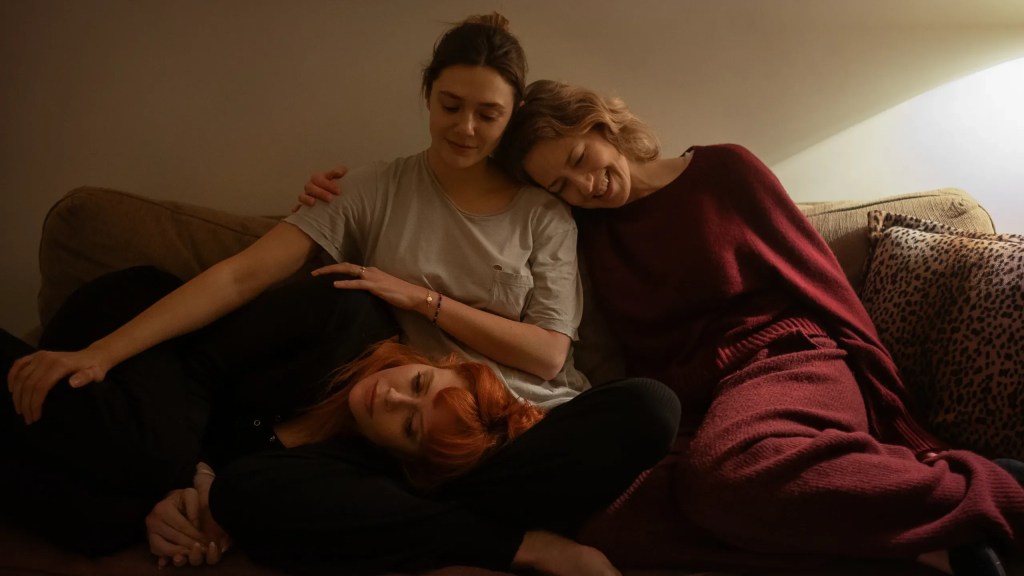
His Three Daughters (2024) is directed by Azazel Jacobs and stars Carrie Coon, Natasha Lyonne, Elizabeth Olsen, Jay O. Sanders, Jovan Adepo, Rudy Galvan, and Jose Febus. The film follows Christina (Olsen), Katie (Coon), and Rachel (Lyonne) – three estranged sisters who meet in their father’s (Sanders) apartment to care for him during his final days. Living together once again, they’re forced to come to terms with one another’s wildly different personalities and make peace with the idea of their father’s eventual absence.
The film is entirely dialogue-driven, so it’s a relief that it’s anchored by three strong lead performances that feel totally distinct from one another. That being said, they have a clear hierarchy in terms of quality. Because her character has the least to do, Elizabeth Olsen ends up being the least compelling of the bunch. That being said, she feels perfectly cast as this kind of soft-spoken, ditzy mom who is said to have in the past done way too many psychedelic drugs. On top of being the most easily likable of the three sisters, her character arc is the most subtle of the film. Thankfully, her few emotional breakthroughs are nuanced and effective.
The second strongest performance is Carrie Coon. She plays what many would refer to as a typical “Karen.” She’s brutally criticizes anything she doesn’t like/agree with, but seems to have zero self-awareness when it comes to her own shortcomings. In order to balance these less-than-desirable traits, the script intelligently explores the source of this behavior: anxiety-fueled love. Most would consider her way of dealing with their father’s impending death to be the most “adult,” but she’s also incapable of accepting the idea that everyone grieves differently. Coon’s performance is so effective that we shift between hating her and empathizing with her depending on the given scene.
The best of the bunch is easily Natasha Lyonne as the black sheep sister who spends her days smoking joints but may also be more responsible than she appears to be. Her spiky yet vulnerable personality feels like a specific kind of person I’ve met in real life. Similar to Coon’s character, Lyonne’s Rachel is often frustrating, but balanced by balancing by having nuanced reasons she is the way she is. Her character also breeds a good amount of conflict that is simultaneously funny and dramatically compelling.
This back-and-forth approach to the dialogue is the film’s lifeblood; and although it can occasionally feel wordy/overwritten, it’s consistently authentic. The only issue with the script is that the “we all go through it” premise often feels too small-scale and familiar. It’s clear what will happen by the end, but it’s short enough to not overstay its welcome and features a third-act dream sequence that feels subversive for the genre.
Overall, this is a small-scale but well-balanced and emotionally effective character study that features fantastic lead performances and sharp dialogue. It’s a win on most technical levels, but I feel as if I’ve seen this kind of tear-jerker countless times before. It won’t appeal much to casual, blockbuster-oriented viewers, but it should be in the conversation during this year’s awards season. B

 The Movie Matt