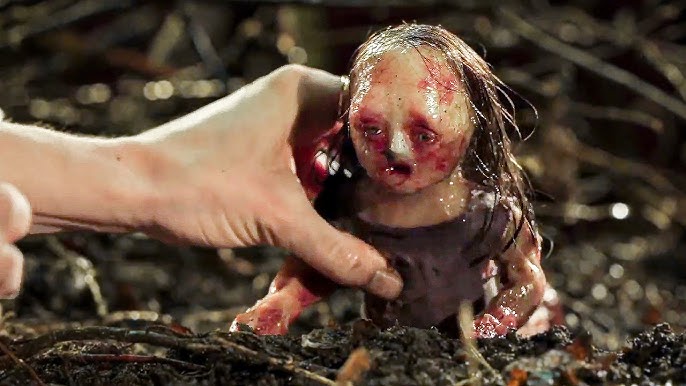
Stopmotion (2024) is directed by Robert Morgan and stars Aisling Franciosi, Stella Gonet, Tom York, Therica Wilson-Read, Caoilinn Springall, Bridgitta Roy, and James Swanton. The film follows Ella Blake (Franciosi), a stop-motion animator who vows to complete her mother’s (Gonet) final work after she passes away. Struggling with the memories of her mom’s strict parenting, Ella soon begins to take the project in her own dark direction at the behest of a mysterious young girl (Springall) who lives nearby. Ella’s boyfriend, Tom (York), sees this unsettling behavior and enlists the help of his sister, Polly (Wilson-Reid), to uncover what’s happening before something unspeakable occurs.
Although Francisoi’s character is put through the usual motions of the horror protagonist who’s having a mental breakdown, stop-motion animation is often used to visualize these moments in unique ways. Her performance itself is serviceable and the same can be said for the supporting cast. These include Stella Gonet as Ella’s overbearing mom and Caoilinn Springall as the mysterious little girl who is clearly not quite right in the head. Gonet’s character is just another version of the “overbearing mother” trope, but her performance is strong enough to make a viewer forget about all of that. The same goes for the creepy kid – unoriginal yet well-executed.
Along with the strong performances, the movie is elevated by its uniquely unsettling stop-motion sequences which also occasionally bleed into the live-action elements. It’s a quite doozy of practical effects to see someone scratch their leg and realize it’s suddenly made out of wax. This harkens back to House of Wax (1953) but never quite feels like a ripoff. The wax/puppet theme has been done before, but I’ve never seen it go in the psychological horror direction.
The film features themes of forging one’s own path and thinking for one’s self as well as the idea of how people often take the ideas of others and then subconsciously reclaim them as their own. There’s also effective foreshadowing that helps to tie the film together nicely during the final act. It’s unfortunate, then, that this final act devolves into a somewhat familiar supernatural slaughter-fest with little explanation for the events at hand. There aren’t enough concrete answers to balance all the intentional subjectivity, resulting the an experience that by the end feels a tad unfulfilling.
Overall, this fits right at home with the rest of Shudder’s horror releases this year. It’s sure to be a fulfilling experience for fans of horror, but easily skippable for anyone else. That being said, I think this is a step above the pack due to the wonderful stop-motion elements and surprisingly capable lead performances. It falls apart a bit in the third act, but there’s enough here to recommend it to anyone who seems interested. B-

 The Movie Matt