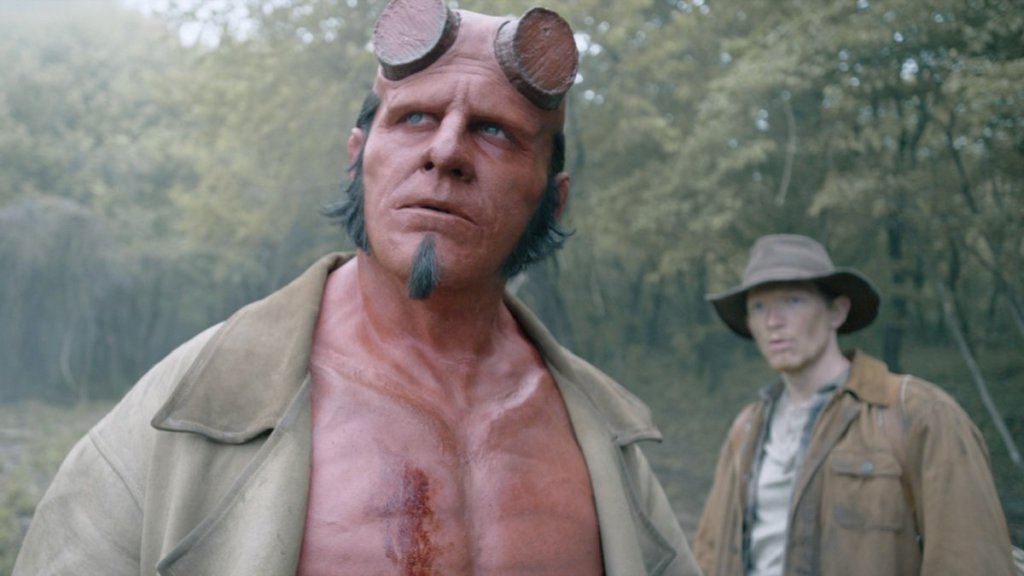
Hellboy: The Crooked Man (2024) is directed by Brian Taylor and stars Jack Kesy, Jefferson White, Adeline Rudolph, Leah McNamara, Joseph Marcell, Martin Bassindale, Suzanne Bertish, and Hannah Margetson. The film is yet another reboot of the franchise and follows the titular Hellboy (Kesy) in 1950s Appalachia as he attempts to uncover the secrets of a local community of witches led by a terrifying demon known as The Crooked Man (Bassindale). With the help of his rookie partner, Cora Fisher (Rudolph), and Tom Ferrell, a local mountain man with a mysterious past, Hellboy sets out to defeat The Crooked Man once and for all.
Although none of the performances here are horrible, they’re not very believable because the setting never feels particularly authentic. Costumes are inconsistent and half of them feel far too modern for the setting. On top of this, dialogue jumps from authentically 1950s to jarringly modern depending on the scene. It’s clear that this lack of time-period authenticity is due to budgetary limitations, but at least the film attempts creative ways to spice up the visuals/action. Although the CGI is poor, there’s a sort of hyperactive visual style that feels unique even if it isn’t particularly easy on the eyes.
Kesy is pretty low-key in comparison to previous portrayals of Hellboy, but there’s something about a less flashy version of the character that feels right at home with the film’s more horror-centric approach. Although we’ve seen the character of Hellboy face down demonic creatures with cool confidence before, the creatures themselves haven’t been particularly scary and/or intimidating. When Hellboy reacts this way to undeniably disturbing creatures, it’s twice as entertaining. Hellboy is cool when he faces down otherworldly creatures, but he’s even cooler when he faces down otherworldly creatures that are scary in the more traditional sense. In other words, he’s a stronger horror protagonist than an action hero. It’s a big shift in approach, but an inspired one that’s more true to the comic-book source material than any previous iteration.
The script is extremely efficient and intelligently doesn’t spend time on Hellboy’s well-known backstory. Any fan of Hellboy would just find another iteration of his origin boring and unnecessary. Instead, the script thrusts the character straight into a situation and allows that situation to play out – similar to Spiderman: Homecoming (2017). In a sense, this feels like the third or fourth adventure in a Hellboy television series, but I’m all for it. This sacrifices a small amount of exposition/characterization, but it’s undeniably refreshing to see a movie that is aware of the fact that its core audience is interested in the action, not necessarily the depth of the characters.
It stinks then that the action itself isn’t particularly unique or exhilarating. It’s all edited in a way that feels choppy and confusing, resulting in multiple sequences that just don’t end up making a lot of sense. This feels almost akin to the typical video game story in terms of its lack of continuity – as if we move from cutscene to cutscene while missing out on everything that occurs in between.
Overall, this is clearly a low-budget effort – as if the studio was forced to quickly make another entry in the franchise to avoid losing the rights. That being said, the film still succeeds in finding creative ways to distract from the tiny budget. The performances aren’t particularly impressive, but I did find myself enjoying Jack Kesy’s subtle portrayal of Hellboy as well as the supporting turns from Adeline Rudolph and Jefferson White. I wouldn’t say this is a better movie than Hellboy (2019), but it is more intelligent and accessible. If you won’t be turned off by some cheap-looking visuals and are of fan of the franchise, it’s an easy way to kill 90 minutes even if it fails to deliver anything new. C

 The Movie Matt