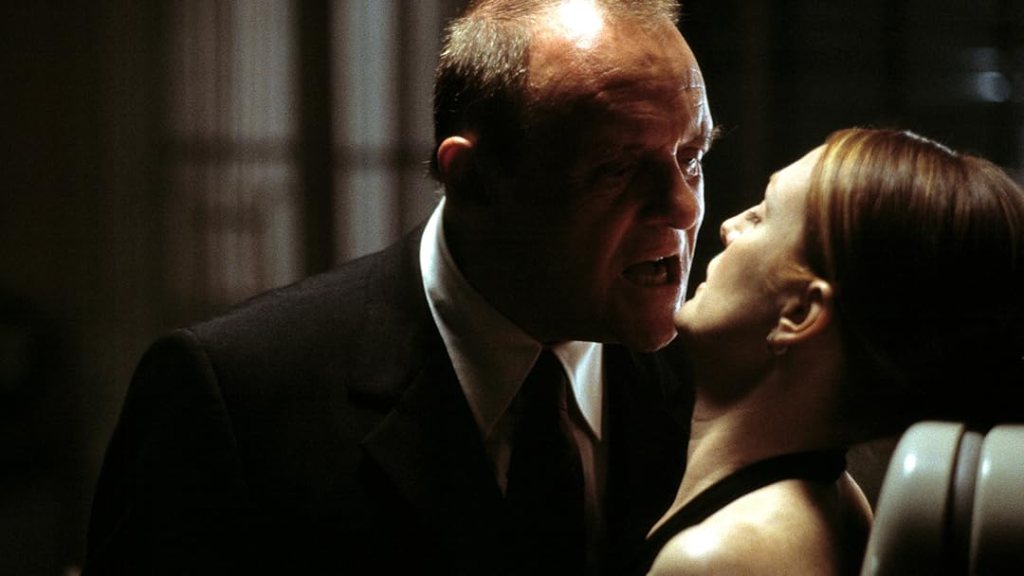
Hannibal (2001), directed by Ridley Scott, stars Anthony Hopkins, Julianne Moore, Gary Oldman, Ray Liotta, Frankie Faison, Giancarlo Giannini, Francesca Neri, Zeljko Ivanek, Hazelle Goodman, and David Andrews. This is the decade-later sequel to The Silence of the Lambs (1991) and follows the titular Hannibal Lecter (Hopkins) as he attempts to avoid capture while hiding out in Florence, Italy. However, it’s not just the police who are looking for him… Meanwhile, FBI Clarice Starling (Moore) is placed on leave after a botched assignment results in the death of one of her men. Soon after, she is approached by Mason Verger (Oldman), a wealthy pig farmer and rare survivor of one of Hannibal’s “meals.” This encounter with Lecter left him deformed and paralyzed, thus fueling his taste for vengeance. He intends to use Clarice as bait to lure Lecter out of hiding and capture him before the police do. On top of this, he also places a $500,000 bounty on Lecter. This leads Clarice, a dirty FBI agent (Liotta), various bounty hunters, and a disgraced Italian police officer (Giannini) to pursue Hannibal simultaneously. The thing is, Hannibal always finds a way to have the upper hand.
Hopkins is once again great, no surprise there. It’s impressive that no matter the material, Hannibal Lecter remains irresistible. The script finds new aspects of the character to explore, achieving what every sequel should: Developing/growing the characters in ways that make them more complex without sacrificing what we liked about them in the first place. Moore is a serviceable replacement for Jodie Foster talent-wise, but I feel as if this role was always a lose-lose situation for her. She either makes the role distinctly her own, sacrificing continuity with the previous film, or she tries to copy Foster’s mannerisms and voice (a kind of acting that often comes off as forced). She chooses the latter, which is the best option for the film as a whole even if it leads to a weaker performance. It’s a real “team player” move from Moore. Between Clarice and Lecter, the film focuses on the strange ways in which a psychopath interprets and/or shows love. It is not explored perfectly and there aren’t a lot of satisfying answers, but it does feel unique. This creates an odd mixture of romantic obsession thriller and serial killer horror that works far more often than it doesn’t. On top of this, Gary Oldman’s portrayal of Mason Verger is one of the most skin-crawling characters in cinema. If you can make a character like this, initially present him as someone who should have our sympathy, and then slowly peel back his layers of evil is chilling to watch. He’s no Hannibal Lecter, but instead, the kind of unforgettable and demented rival Hannibal deserves.
Director Ridley Scott brings a gritty visual style to the series that feels unique compared to the somewhat plain, but realistic style of its predecessor. Although it’s more interesting to look at, it’s one of the many choices/directions that makes the movie feel noticeably more silly and improbable than the first movie. This causes Hannibal, who is maybe at his most brutal and manipulative, to somehow feel much less scary than he did previously. Excluding Clarice, the film is filled with characters who are just as (or at least close to) morally corrupt as Hannibal. Even though Hannibal is clearly the most deranged, he truly only kills people who are “rude.” In Hannibal’s mind, he kills to make the world a better place. Although the rest of the characters don’t eat people, their motivations for acting immorally are completely self-serving. It strangely makes you reconsider who the evil ones truly are (Not really, though. C’mon, the guy eats people). The thing is, as soon as we become too sympathetic to Hannibal, he’s not close to as terrifying as he initially was. Hannibal should be likable and entertaining, but never a hero. It’s not half as scary and that’s a fact. This being said, whatever Hannibal lacks in terms of fear, he makes up for with brutality. There are some truly effective scenes of gross-out gore, but I never felt as if they go too far or become too pervasive.
Overall, this is a unique and creative sequel to The Silence of the Lambs that takes the characters in unpredictable new directions. It makes a few missteps in terms of characterization and realism, but it’s still a tight thriller that’s a head above the pack. It’s not the perfect sequel, but it’s a good one that avoids the all-too-common symptoms of “sequelitis.” It drags slightly in parts and the themes don’t feel as effortlessly prevalent, but it’s always entertaining. It’s definitely not the original, but it delivers the proper ingredients that make these movies so damn entertaining. B

 The Movie Matt