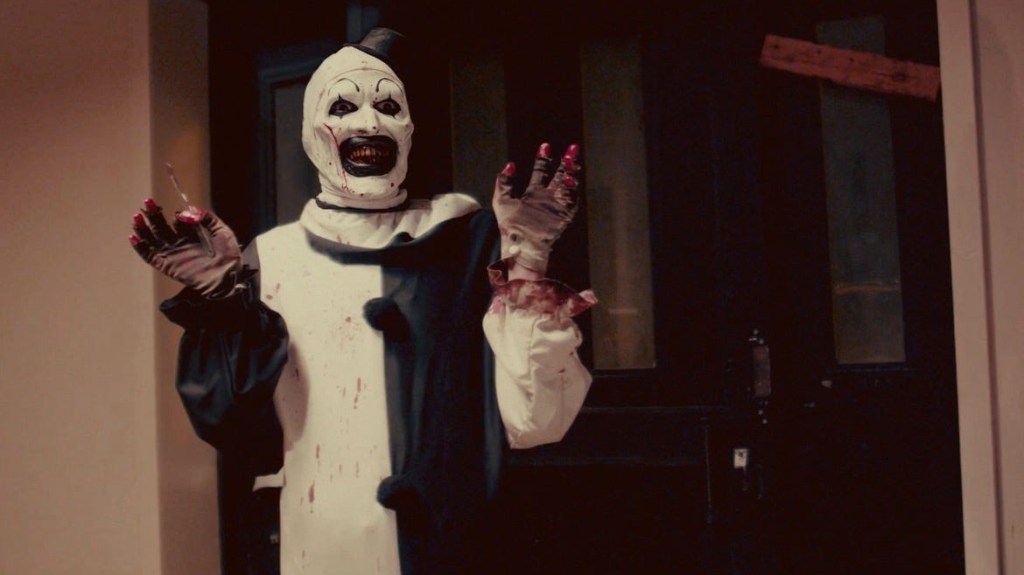
Terrifier, released in 2016, is directed by Damien Leone and stars Jenna Kanell, Samantha Scaffidi, and David Howard Thorton as the infamous Art the Clown. After Leone’s low budget film All Hallows’ Eve (2013), hardcore horror fans were itching to see more of the film’s villain: Art the Clown. So what was it about this demonic killer clown that struck such a cord with fans? This was a year before the It (2016) remake would hit theaters and once again shoot demonic clowns straight into the veins of the horror zeitgeist. This was also almost 30 years after the original It (1990) film adaptation. Does the hoopla about this character have to do with the fact that Art is a creepy clown? Does that simply appeal to horror fans on its most basic level? Were they just hungry for that at this point? Well, I truly believe that the appeal of Art the Clown has less to do with the fact that he is a demonic clown and more to do with the fact that he effectively emulates exactly what audiences have always loved about the best eighties slasher villains. For me, slasher villains from the eighties fall into one of two categories.
The first category are your faceless and emotionless brutes such as Jason Voorhees, Michael Myers, and even Leatherface. These characters almost never speak and on the surface seemingly have no personality. So why would audiences enjoy these characters if they have zero personality? Well, they have personality. A whole hell of a lot of it actually. They just don’t show their personality through dialogue and emotion (excluding Leatherface in some of the sequels that I pretend don’t exist). It’s quite morbid to admit, but these characters are revealed solely through their actions, and considering that these characters are slasher movie villains, most of their actions are killing people. These characters are revealed through the creative, entertaining, and sometimes dare I say “charming” ways in which they stalk and dispatch their victims.
The second category are your jokers. These are the kinds of villains that like to play with their victims. This includes villains such as Freddy Krueger, Chucky, or even Leprechaun. These creeps have significantly more personality in the traditional sense. They make jokes, have feelings (some more than others), and will sometimes have a larger goal beyond just killing victim after victim. These characters often become the stars of the show, being the sole reasons that audiences view their films. Audiences will even go as far as rooting for the killer over the innocent victims. What is common across the board for these villains is that they are undeniably funny. The funny one-liner after a brutal murder is almost synonymous with these characters.
What really struck me about Art the Clown is not the fact that he doesn’t really fit into either of my two categories, it’s that he’s a true hybrid of both categories. Art never speaks. He is even stabbed at one point and mimes a scream instead of actually doing so. That’s commitment. This would seemingly place him in my first category, but even though he never speaks, he’s constantly miming in an extremely communicative way. He archives more personality with his mimes than most do through their words.
Although Art the Clown is one of the most iconic slasher villains in decades, Terrifier is not a perfect film. For the most part, the film does a decent job of disguising its low budget. The kind of gritty visual style hides some of the cheap elements as well as fitting in nicely with the general tone of the film. Aside from David Howard Thorton as Art, Jenna Kanell gives an effective performance as the lead, Tara. The low budget really begins to show in the performances of the supporting cast. The gore is pervasive and effective, but I had the feeling it could have even taken things a step further if everything didn’t look so black and muddled. In a way, the gore is too messy. I didn’t even know what I was looking at most of the time.
SPOILER ALERT!
A little more than halfway through the film, the main character of Tara is killed by Art. In a twist, her sister Victoria, played by Smantha Scaffidi, becomes the main protagonist. Considering that the film is as barebones as it gets in terms of plot and character development, this becomes a huge problem for the viewer in terms of caring about the characters for the remainder of the film. We spend two-thirds of the film getting to know Tara, and as soon as we begin to care about her, she is killed off. This was admittedly a surprising twist, but would have worked much better if we had another character to attach ourselves to afterwards. There is nothing wrong with the character of Victoria, she just feels like a stranger by the time she enters the film in any significant way.
SPOILER ALERT!
Before Terrifier, cinema hadn’t really produced an iconic slasher villain worthy of the greats since maybe Scream (1996), but even that is up for debate depending on what the individual viewer considers the definition of “slasher” to be. And considering that Ghostface is more of a persona than an individual makes the topic even more muddled. Well, there can absolutely be no debate about Art the Clown’s classification as the modern-day slasher king. This is because Art not only emulates what great slasher villains did before him, but brings the slasher genre into a new era. Because it was such a long wait from the last true slasher villain, I feel that Terrifier doesn’t just take one step up in terms of brutality, gore, scares, and just general meanness; it takes it up at least five steps. Terrifier looks back at classic slashers and asks “Is that all you’ve got?”
Overall, Terrifier is an extremely effective slasher with one of the most memorable horror characters in years. Although the film does suffer from a nonexistent plot, weak performances, and weak characters (excluding Art), it should deliver on the important elements that die hard horror fans crave. Whether or not the Terrifier films improve from here, it is certain that David Howard Thorton’s Art the Clown has cemented a place firmly in the horror canon. B-

 The Movie Matt