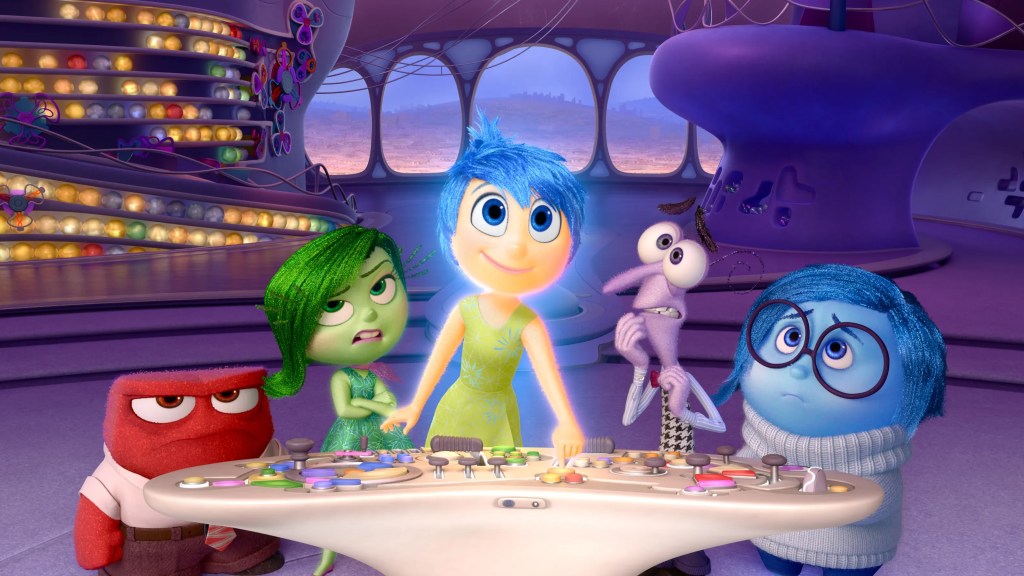
Inside Out (2015), directed by Pete Docter & Ronnie Del Carmen, stars Amy Poehler, Phyllis Smith, Kaitlyn Dias, Richard Kind, Lewis Black, Mindy Kaling, Bill Hader, Diane Lane, and Kyle Maclachlan. When 11-year-old Riley moves with her family from Minnesota to San Francisco, her internal emotions – Joy (Poehler), Sadness (Smith), Fear (Hader), Disgust (Kaling), and Anger (Black) – struggle to make sense of their newfound situation.
Although the film features some big names in its voice cast, it never feels like stunt casting that’s only here to add recognizable names to the posters. Each actor perfectly emulates the emotion they play which includes lesser-known performers such as Phyllis Smith and Richard Kind. My only small issue with the characters relates to Riley. I understand that it’s tough for a child to move in any scenario, but it’s a little eye-rolling when a character is this sad about moving from Minnesota to midtown San Francisco. It’s tough to connect to a person’s woes (even a child’s) when they’re framed to be this privileged financially.
Riley’s story is also as small-scale, personal, and inconsequential as it gets, but it is one that just about anybody can connect to. It also helps that this small-scale story is coupled with the much larger-scale story of her internal emotions. Where Riley’s story provides intimate experiences that allow us to connect on a personal level, the emotions’ story provides large-scale moments that add stakes and excitement. Likewise, whatever the human side of this story lacks, it makes up for in relatability/realism.
The comedy is sometimes purely childish, but more often than not, it works well in appealing to adults as well. This comedic sensibility also has a range because it implements different kinds of jokes. In other words, there are jokes for just about any kind of comedic sensibility.
The film teaches us that all of our emotions are important and require one another for balance. It ends up being profound in the way it points out how even our “negative” emotions such as anger, sadness, fear, and disgust are necessary for our mental health. It also explores how our experiences are continuously reshaping who we are and the idea that this might be scary, but it’s ultimately for the best. Memories/experiences might fade, but all that does is make room for new ones. As it should, this makes the movie emotionally effective in the most universal sense. For my taste, it does end up coming across as over-the-top cheesy, but I suppose it probably plays better for the kids than it does for me and that’s the point.
Overall, this is yet another Pixar classic that seamlessly blends childlike thrills with universal themes of mental health. It never overstays its welcome and remains consistently compelling throughout. My only slight criticism comes from the fact that the themes and messaging are often far too on the nose for adult sensibilities. That being said, this is mostly a movie for kids, so it’s forgivable. It also features one of the most emotionally palpable scores I’ve heard in a while. If you’re under the age of twelve or simply love animated movies, you can’t do much better than Inside Out. B+

 The Movie Matt