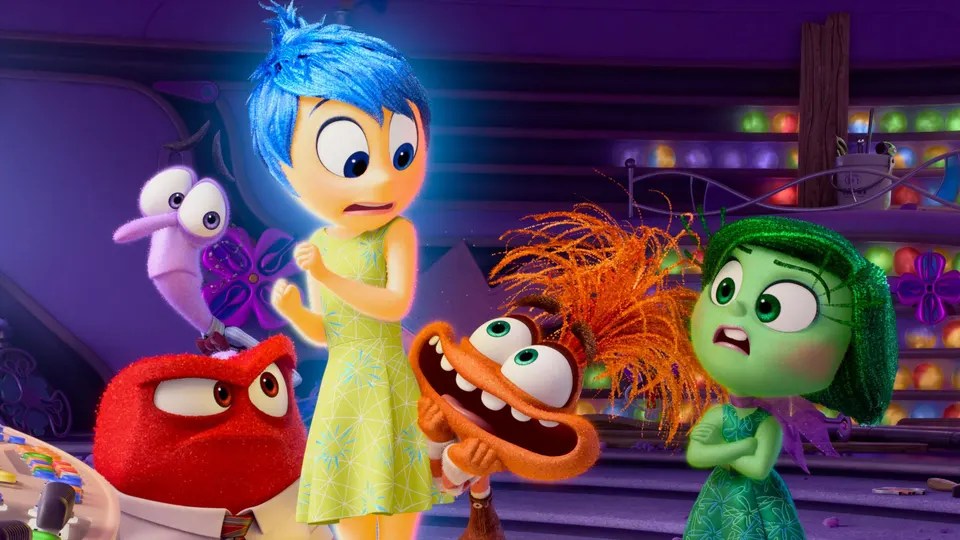
Inside Out 2 (2024), directed by Kelsey Mann, stars Amy Poehler, Maya Hawke, Kensington Tallman, Phyllis Smith, Liza Lapira, Lewis Black, Tony Hale, Ayo Edebiri, Lillimar, Grace Lu, Sumayyah Nuriddin-Green, Adele Exarchopoulos, Diane Lane, and Kyle McLachlan. The film once again follows Riley (Tallman) and her various internal emotions as they go through the ‘dreaded’ process of puberty. This brings the arrival of four new emotions – Anxiety (Hawke), Envy (Edebiri), Ennui (Exarchopoulos), and Embarrassment. These changes only become more archaic when Riley and her friends join a hockey camp filled with popular high school girls whom she wishes to befriend. Because Riley is worried about not making the team, Anxiety begins to take over completely, leading her to disregard her old friends and do anything it takes to impress her coaches/teammates. This leads Joy (Poehler) and the other 4 original emotions to band together in order to restore the old Riley before it’s too late.
The returning voice cast once again gives great performances, and thankfully, the same can be said about the new additions. Maya Hawke is smart casting as Anxiety. She’s shown in her previous work in projects such as Stranger Things (2016-) that she can play this archetype perfectly, and she does so with ease. There’s also something timely about Anxiety being the ultimate antagonist. My problem here compared to the first movie is that the characterizations of the emotions are inconsistent. For example, Anger is rarely angry, sadness is rarely sad, and disgust is rarely disgusted. I understand the desire to make these characters more rounded, but it kind of defeats the purpose of their archetypes. It’s also once again a bit tough to connect to Riley’s personal struggles because, besides her internal (and admittedly normal) pain, she’s framed to be a perfect human being who gets straight A’s, is always nice, and never gets into trouble. Yes, she’s a great role model for the younger audience, but she feels almost AI-produced to anyone who desires a more complex character. This perfect framing also makes the movie’s exploration of what makes someone a good person to be a bit muddled.
Although this takes a noticeable jump in animation quality, it’s essentially just the same story but featuring new emotions to deal with. Yes, the small details are different enough, but the plot structure is the same. A lot of the first film’s enjoyment comes from its originality, but this sequel naturally doesn’t have that. It unfortunately just makes the entire experience feel like a strong example of Disney producing a film that feels creatively neutered. This being said, the banter between characters remains fun and it still retains enough heart to be emotionally effective. It also finds a few new themes to explore such as the idea that people often repress things they love for arbitrary social reasons as well as how young adults often struggle to control their various archaic emotions.
Overall, this is a fun little animated film, but it struggles to hold its own next to its predecessor. Most elements are step down from the first movie, but it still does enough to not be a complete disappointment. An attempt is made this time around to have a distinguishable villain/antagonist and the emotional elements work just enough to make the audience shed a tear or two. That being said, there’s a distinct feeling that this entire script was produced and voted on in a boardroom. The best example of this is the character of Riley. At one point, the script describes her as “she’s bored, but never boring,” which perfectly speaks to how “safe” the movie feels. I always write about “balance” as something I look for in a movie, but this is a case where too much balance stifles any risks and therefore originality. If you love the first movie, it’s a serviceable experience. If you’re looking for an improvement with more thematic depth, you will be sorely disappointed. B-

 The Movie Matt