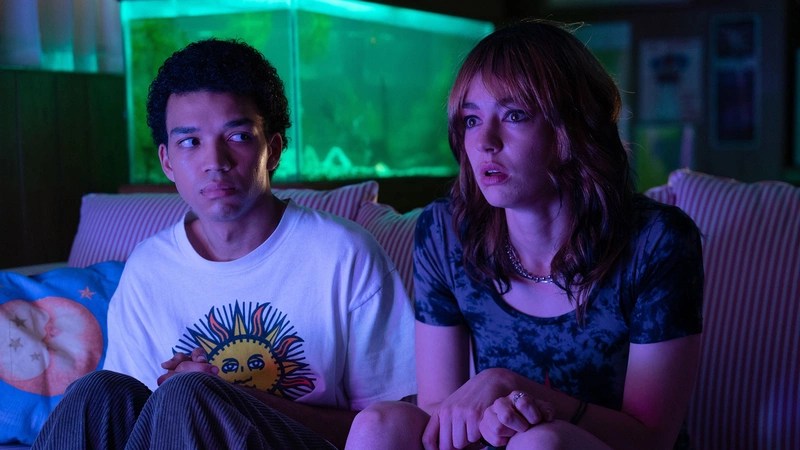
I Saw the TV Glow (2024), directed by Jane Schoenbrun, stars Justice Smith, Brigette Lundy-Payne, Ian Foreman, Fred Durst, Danielle Deadwyler, Helena Howard, Lindsey Jordan, and Conner O’Malley. The film follows Owen (Smith), an awkward teen struggling with a complicated home life and searching for his place in the world. One day he meets Maddy (Lundy-Payne), another kindred spirit who introduces him to a late-night teen horror program called “The Pink Opaque.” Over the next two years, Maddy and Owen bond over their love for “The Pink Opaque,” becoming unlikely friends in the process. That is, until one day, Maddy disappears without a trace. Years later, Maddy reappears and informs Owen that she’s been living in the world of “The Pink Opaque” and wants Owen to join her. Owen must decide if Maddy is simply crazy or if he’s been living a lie his entire life.
Justice Smith and Brigette Lundy-Payne give emotionally resonant performances that effectively convey feelings of individuality, isolation, and general teenage angst. One of the film’s strengths is its ability to stir the audience emotionally, and I think this is simply due to these performances. The characters constantly convey themes of being trapped, but more specifically, they focus on being trapped in the context of gender dysphoria. Because these themes can be read on both a specific as well as a more general level, it succeeds in speaking to people who otherwise wouldn’t connect to gender dysphoria. Loneliness is a universal theme even if gender dysphoria isn’t. It makes an otherwise foreign experience to most viewers feel a lot closer to home when they can connect it to something they have experienced. For those who have experienced gender dysphoria, I imagine the more specific themes will hit home wonderfully, making this film a classic within the transgender community.
Beyond these themes of isolation and gender dysphoria, the film also explores how isolation can make us sink into our favorite art, almost as if it understands the individual better than the people around them do. The film displays “weird” people bonding over “weird” art and how sometimes it can be their only solace from the cruel world around them. This points out the importance of strange, specific pieces of art that feel personal even if they sacrifice widespread appeal. Unfortunately, the film’s seamless blend of surface story and specific themes sort of falls apart in the last 30 minutes. The specificity of the themes becomes far too on-the-nose, leading to a wrap-up that satisfies in terms of hammering home these themes, but not in terms of storytelling. In other words, it becomes clear what the movie is trying to say, but there are far too many loose ends in terms of character and plot.
There’s also the fact that, although emotionally resonant, it’s tough to follow characters who are so consistently depressed and awkward. It’s clear that Owen doesn’t connect to most people, but even when they honestly try to connect with him, he brushes them off and quite frankly acts like a “dick.” The ending reframes this in a way that makes a lot of sense, but it still doesn’t change the fact that it’s frustrating to watch.
As for its visual style, the movie absolutely kills it. The neon blue, almost rave-like color scheme perfectly blends the otherworldly with the somber. Even if the subject matter isn’t a person’s cup of tea, it is undeniably a visual treat. Not to mention, there are also some great teen film sensibilities here. Schoenbrun seems to understand the genre well and avoids most of its typical pitfalls.
Overall, this is an unpredictable and thematically dense film-going experience that is guaranteed to piss off the bigots of the world. That being said, I don’t think those people have a leg to stand on when criticizing this film. It doesn’t shove its message down one’s throat. It instead simply displays what the experience FEELS like. No one wants to be told what to feel or think, they want to feel or think it on their own. I haven’t experienced gender dysphoria, but I have felt lonely, isolated, and trapped. Because of this, I Saw the TV Glow resonated with me. It’s not for everyone and many will describe it as “annoyingly arthouse,” but it is undeniably a movie ripe for heated discussion. Normally this would land in the B- rating category because of the specificity of its subject matter, but I think it is much too layered and unique to not at least earn a B

 The Movie Matt