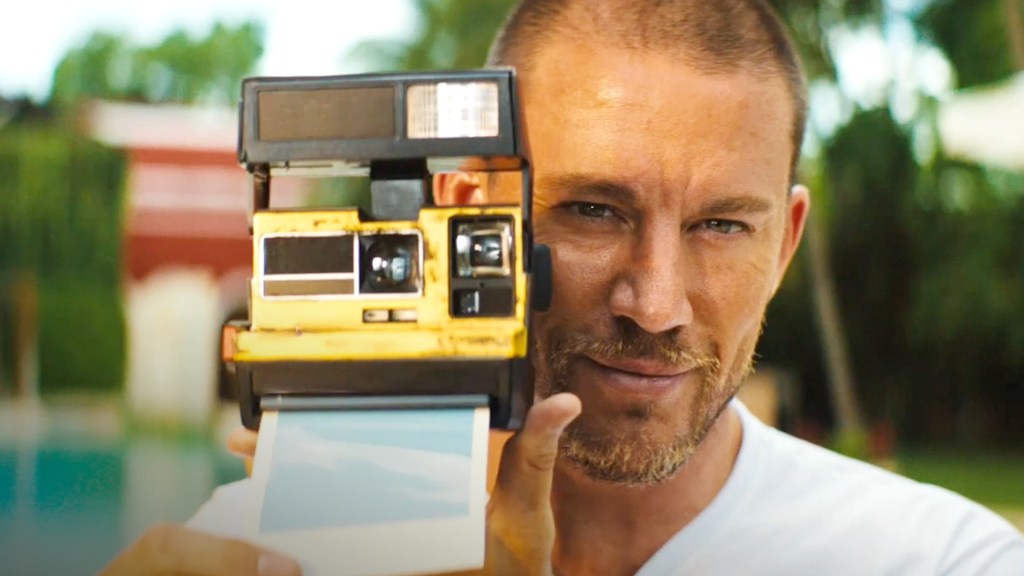
Blink Twice (2024), directed by Zoe Kravitz, stars Naomi Ackie, Channing Tatum, Alia Shawkat, Adria Arjona, Christian Slater, Simon Rex, Haley Joel Osment, Liz Caribel, Levon Hawke, Trew Mullen, Genna Davis, Cris Costa, and Kyle MacLachlan. The film follows Frida (Ackie) and Jess (Shawkat), two down-on-their-luck friends who decide to crash the fundraising gala of tech billionaire Slater King (Tatum). When various events lead Frida to a chance romantic encounter with Slater, he invites her and Jess to vacation at his luxurious private island. Seeing it as an opportunity to improve their lives through a powerful circle of new friends, the two quickly accept his offer. Once there, they are greeted by Slater’s friends who welcome them with open arms. As the days pass by filled with luxurious foods and designer psychedelics, Frida notices that the guests are a little too happy – nothing bothers them and they seem to have no intention of ever leaving the island. Soon after, Frida begins to awake with little memory of the nights before. In her search for answers, Frida begins to suspect that the island’s carefree facade may be hiding a dark secret.
Because this film is such a slow burn, it doesn’t have the opportunity to rely on flashy set pieces or constant surprises. This makes the performances all the more important in the sense that they are what provide a majority of the film’s entertainment and tension during the first two acts. Thankfully, Kravitz has built an ensemble cast that’s up to the task. The film succeeds in providing supporting characters that are fun as well as memorable and I think this is due to two things: casting and performance execution. Zravitz finds a good mix of obvious casting choices as well as some more daring ones, and impressively, both kinds work in the film’s favor. Tatum plays against type as the suave billionaire with a dark secret and succeeds in having us believe both sides of his personality. It’s not a groundbreaking performance, but it proves Tatum has a lot more range than Hollywood often gives him credit for. As an example of perfect type-casting, Christian Slater plays exactly the kind of character we’ve seen him play countless times, but to full effect. His aloof assholishness provides a lot of dark comedy to the film which helps to balance out the specific, darkly-comedic tone that Kravitz intends to achieve.
As for Ackie and Shawkat, the two friends we follow to start the film, I was impressed by the authentic portrayal of not just their friendship, but of their characters individually. There’s a certain shaggy-dog nature to their dialogue that is simultaneously confident, cringe, and just plain real. Whether it’s these characters or the various supporting ones, the script finds subtle ways to distinguish them from one another. For example, one character is the only person on the island who has a lighter, so is constantly having it stolen by other people. Not only is this important story-wise, but it subtly establishes small things about the character in a way that doesn’t add to the runtime. In other words, the script often kills two birds with one stone: character and story are intertwined as they should be.
Even supporting characters played by Adria Arjona, Simon Rex, Liz Caribel, and Haley Joel Osment are memorable. Does the film need them to stand out? Not necessarily; I don’t think it would’ve ruined the film. What this does do, however, is help to up the ante in the film’s third act. Although we may not like a lot of the characters, we’re at least invested in their various outcomes. This causes the third act, although not entirely original, to feel extremely exhilarating.
As for the film’s themes, I can see them being divisive. The underlying focus here mostly has to do with the power dynamics between men and women (or the powerful vs. powerless) as well as the #MeToo movement and even allusions to Jeffery Epstein’s infamous island. These are themes that have been overplayed to death in the last decade and I was a bit hesitant going into it considering that the messages of these films often boil down to “treat women nice and don’t abuse power.” Obviously, I agree with those things, no shit. The thing is, this is just not a complex and new thing for a film to explore, it’s just boring at this point. Thankfully, Blink Twice succeeds in being one of the more thematically intelligent films to explore the subject. It takes the typical messages we expect with this topic and takes them a step further so they can be taken on a more general level. For example, instead of specifically focusing on the power dynamics between men and women, it’s more of an exploration of power dynamics in general. The themes can appeal to someone on a specific level as well as a general level, making the appeal overall a lot stronger. However, where the film really finds its footing thematically is when it explores the idea of forgetting vs. forgiving. In a sense, the film does something unique and makes us think about the aftermath of the abuse of power. What makes sense in these situations and what does moving on truly look like for both sides with no punches pulled?
Overall, this is an impressive directorial debut from Zoe Kravitz, and If she continues, she’s already on pace to be my favorite current female director. It’s one of the better slow burns I’ve seen this year and features a fantastic ensemble cast who succeed at elevating the tension at every turn. That being said, there are still the occasional flashes of a first-time director making a few questionable decisions, but they are few and far between. I can see the themes being a bit too on the nose for certain viewers, but I think that will more likely be because of a general aversion to the subject matter as opposed to its execution. It’s not for everyone, but it’s an undeniably original creative vision. B

 The Movie Matt