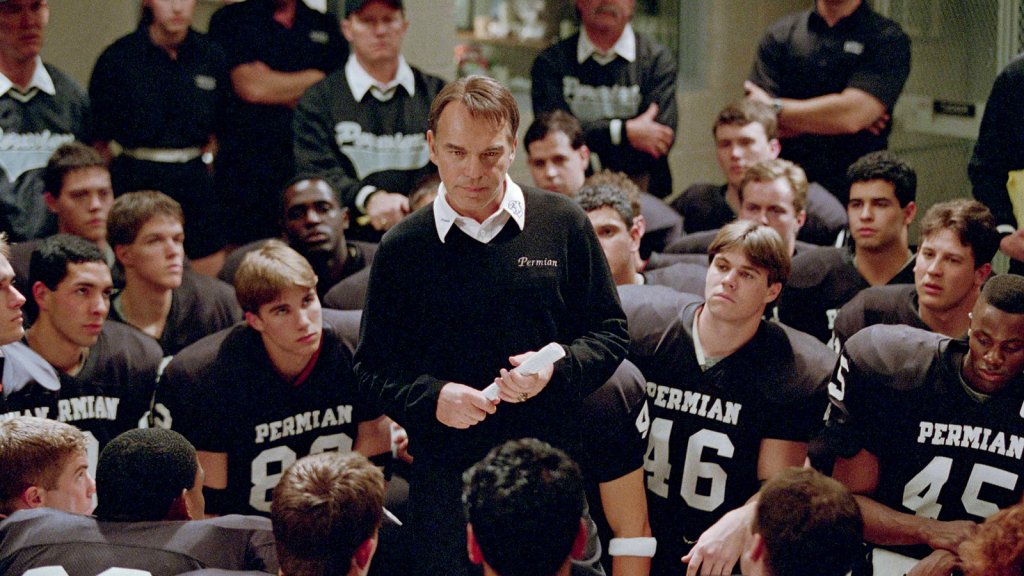
Friday Night Lights (2004), directed by Peter Berg, stars Billy Bob Thorton, Garrett Hedlund, Lucas Black, Derek Luke, Tim McGraw, Jay Hernandez, Lee Jackson, Lee Thompson Young, Grover Coulson, Connie Britton, Connie Cooper, Brad Leland, and Amber Heard. The film is based on the book by H.G. Bissinger and follows the 1988 Permian Panthers high school football team based out of Odessa, Texas. Unlike most US states, Texas treats high school football as a way of life. Since they are the top-ranked team due to their star running back, Boobie Miles (Luke), expectations to win a state title are through the roof. This makes life for head coach Gary Gaines (Thorton) a living hell as he struggles to balance the town’s massive expectations with the various hardships that each of his players face in their personal lives. After Miles suffers a devastating injury, it’s up to coach Gaines and his various players including quiet Quarterback Mike Winchell (Black), fumble-prone fullback, Don Billingsley (Hedlund); and second-string running back, Chris Comer (Young), to pull together and save their season from utter disaster.
Although none of the cast members give particularly memorable performances, they do achieve a certain symbiosis with the film’s very specific tone. Director Peter Berg provides a level of dramatic weight relating to high-school football that’s effective even for those who have little interest in the sport. He archives this through the film’s unique setting and its tendency to prioritize focus on the characters’ personal struggles as opposed to their relationship with football. That being said, there’s still a clear connection with how these struggles affect them on the field. It results in amplifying the film’s football sequences because we care about each character’s success on an individual level. That being said, the film often struggles with focusing on each character equally. For example, Don’s relationship with his dad, Charles (McGraw), takes up far too much screen time. The themes of domestic abuse feel important to explore and it does display how some people can’t move on from early success, but it ultimately feels like an excuse to show off Tim McGraw’s acting chops (which admittedly ARE impressive). No real issues with it besides the fact this aspect overstays its welcome. There are also a few emotional scenes that are either over-acted or aren’t cut away from quickly enough. This results in the viewer sometimes thinking “C’mon, man. Just get over it.”
The cinematography by Tobias A. Schliessler is this film’s golden goose. He achieves everything a great cinematographer should – provide a unique style that supports the film’s overall tone and generally just looks cool. It features dark filters that age the visuals in ways that feel perfect for the 80s setting as well as implements a hybrid documentary approach that helps the feeling of realism. This approach includes quick zooms, the occasional shaky cam, and countless out-of-focus shots of the Texas countryside. It’s no wonder that this spawned a popular television series of the same name that ran for five seasons using the exact same visual approach.
Sports films often become predictable in the sense that there are essentially two outcomes: they win the big game or they lose the big game. Friday Night Lights archives the uncommon by leading to a finale where winning and losing aren’t necessarily the most important things on the line. In other words, our enjoyment of the film’s outcome doesn’t rely on how it’s able to subvert the “winner/loser” trope.
The film’s biggest problem is that it essentially communicates to the audience that most problems in life can be solved by playing football and playing hard. For example, Don and his dad reconnect in the film’s final moments because Charles sees that his son left it all on the field. So what is the film trying to say? If you play football well, your dad won’t have a reason to beat you? Gimme a break. The overall attitude that football is the best and only leads to great things is just a bit too basic of a theme for me to attach myself to.
Overall, this is an extremely well-made football film that against all odds treads new ground in the genre by delivering a snapshot of a football town that almost seems otherworldly. Simply on a technical level, the film is a marvel. That being said, it does suffer from the occasional sports film trope and oftentimes feels over-the-top in terms of individual character stakes. If you dislike sports films, this won’t change anything. If you are a fan of this genre, you’ll find enough here to distinguish it as a memorable addition to the canon. B

 The Movie Matt