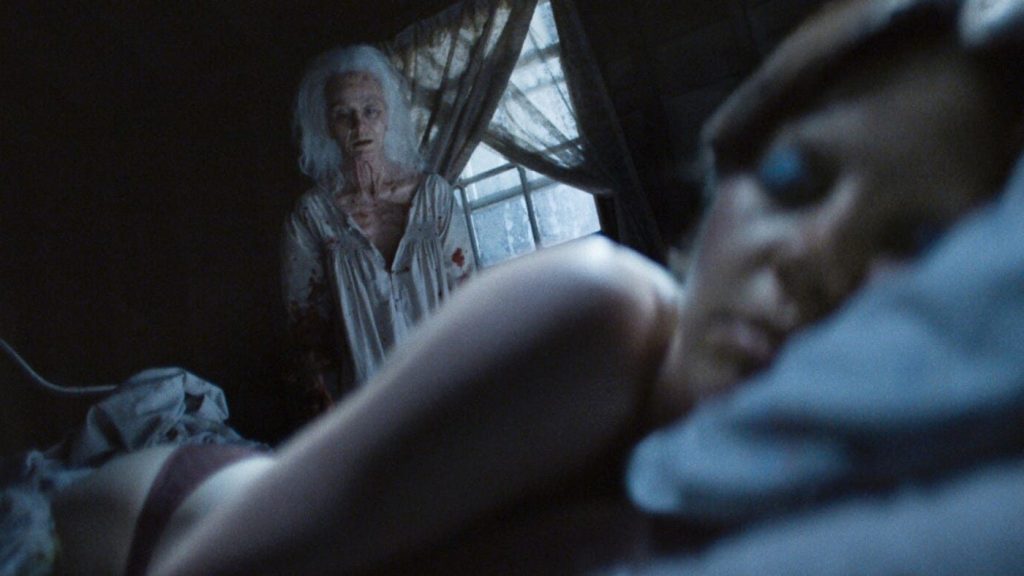
X (2022), directed by Ti West, stars Mia Goth, Stephen Ure, Jenna Ortega, Kid Cudi, Brittany Snow, Martin Henderson, and Owen Campbell. The film takes place in the 1970s and follows a group of pornographic filmmakers traveling through Texas en route to make a dirty movie. So they can have a place to film, the group rents a bunkhouse on a rural farm owned by a distrusting old man and his mysterious wife. As they commence their shoot, it becomes clear that the elderly couple are not all who they seem to be. Seemingly offended by the group’s “European” ideas on sex, the couple proceeds to drive them from their property by any means necessary – even if takes more permanent measures.
The ensemble here is spot-on, with each actor conveying their characters’ archetypes clearly and efficiently. Unlike most genres, slasher films have even less time to flesh out their characters considering that they often begin to die off around the halfway point. This doubles how impressive X is in terms of subtle and efficient character development. The film often doesn’t even waste time fleshing out characters through dialogue. Instead, it often uses editing tricks such as a split frame against the backdrop of a certain song, the meaning of said song being much different depending on which frame/character you’re looking at.
Although I could praise most of the film’s cast, I’ll save my breath for the standout performances which are Mia Goth as Maxxine/Pearl and Stephen Ure as Howard, the elderly owner of the farm. Mia Goth plays the film’s main protagonist along with its main antagonist. As Maxxine, Goth brings a necessary level of alluring sexuality as well as a rough around the edges attitude that blends to create an extremely authentic portrait of a sex star who dreams of bigger and better things (but is still too naive to realize her path probably isn’t the best one). As Pearl, Goth is completely unrecognizable. It took until my third watch a year ago to realize it was her playing the role. She completely disappears into the character. Granted, it’s helped by some fantastic makeup effects, but I think she’d disappear into the role regardless of how the character looks. As for Stephen Ure as Howard, he knocks it out of the park. He presents us with a slasher villain who is old, slow, and weak, yet that’s exactly what seems to be his (and Pearl’s) slasher villain power. They achieve their kills simply by catching their victims off guard. This may seem goofy, but it’s actually extremely effective for putting the main characters in direct danger that they don’t recognize without those same characters then coming across as stupid/oblivious. He’s also given motivations that simultaneously make us understand and just slightly (very slightly) care about the character.
The film takes full advantage of its era/setting in countless ways including a grindhouse visual style and era-appropriate music that is used to elevate certain sequences as opposed to shallowly reminding us of a time gone by. Similarly, the film references many classic slasher films, but not in a way that feels shallow. For example, the film doesn’t steal any sequences or ideas, but subtle visual cues. These include classics such as Psycho (1960), The Texas Chainsaw Massacre (1974), and even Friday the 13th (1980). The dialogue is also consistently great and the pacing is so tight that not a single section of the film feels slower than the others. That being said, my one complaint about the pace is that things begin to lose a tad bit of steam when the film starts to regress into a predictable slasher formula in its final third.
What this film does so well above all else is how it’s able to deconstruct the slasher genre’s ages-old relationship with sexuality. The film’s biggest thematic conflict is the battle between religious oppression and sexual freedom. The viewer is immediately challenged by being asked to follow/connect with characters that would traditionally be considered morally irredeemable. However, even this preconceived opinion is challenged early on when one of the characters is presented as wanting to elevate pornographic filmmaking to fine art. This addition of a somewhat noble intention complicates the idea that these characters are just sex-crazed hooligans looking for an easy way out. That being said, they’re also not presented as heroes of the artistic scene. The film generally just finds a good balance between humanizing these people without idolizing them.
It also highlights the nasty depths that a person can reach due to prolonged sexual repression. The film makes it clear that if sexuality is too heavily repressed, it can turn into something that feels so rare and meaningful to the individual that it may even be worth killing for. On the other hand, the film also explores how too much unfettered sexual activity can lead people to disregard feelings of true connection and/or monogamy. Too much in either direction can hurt human connection/love.
Where the film really begins to subvert slasher movie sexuality is in the order in which victims are eventually killed off. As opposed to the traditional formula where the most promiscuous characters are the first to die, X does the opposite. It’s a simple subversion, but one that somehow has taken until this film to be implemented.
Although the film sometimes focuses a bit too heavily on pornographic sequences, they’re all balanced by a decent sense of humor and subtle thematic cues that only make the film deeper upon a rewatch. What blows my mind is that even if a viewer wants to ignore the genre subversions and complex themes mentioned previously, this film can still be enjoyed on the surface as a typical slasher. The subtleties that make this film so awesome for a slasher fan might go over the head of someone less knowledgeable, but I still think the film will satisfy those people completely. They just may not recognize what makes it so special in a historical sense.
Overall, this is one of the best slasher films to come out in the last decade and succeeds in feeling like a welcome throwback as well as an elevation of its genre roots. The script is sharp, the cinematography is eye-catching, and it’s just generally a whole lot of fun. Is it bad taste? Maybe. But when the film itself questions whether it’s in bad taste, can I knock it even if it is? It won’t be for the faint of heart or anyone with religiously conservative tastes, but for everyone else, it’s a kick in the crotch when it comes to high-energy Grindhouse fun. A-

 The Movie Matt