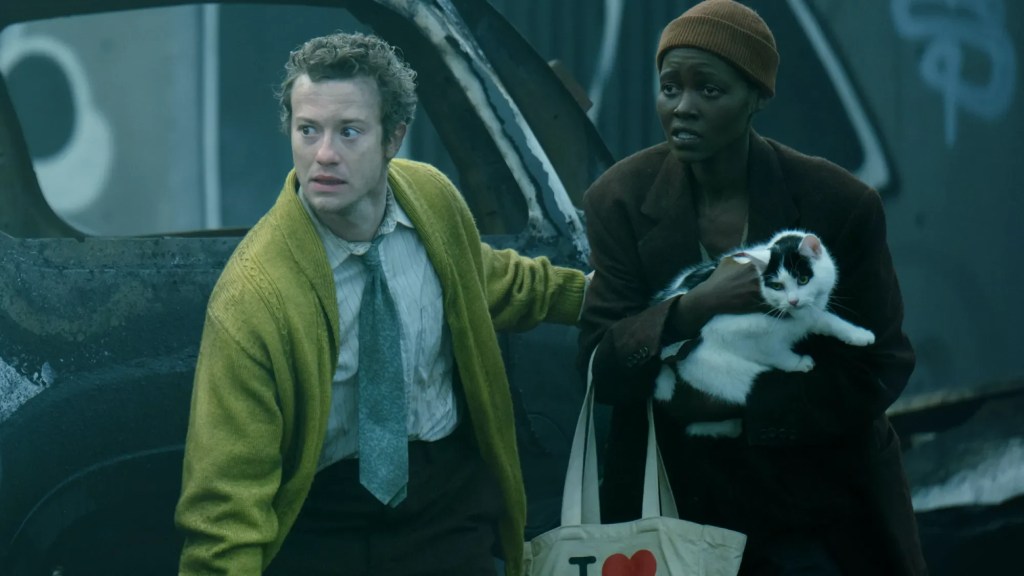
A Quiet Place: Day One (2024), directed by Michael Sarnoski, stars Lupita Nyong’o, Joseph Quinn, Alex Wolff, and Djimon Hounsou. This is the third installment in the A Quiet Place franchise but acts as a prequel to the previous films. As the title suggests, it follows survivors on the fateful day during which aliens invaded Earth. More specifically, the film follows Samira/Sam (Nyong’o), a woman struggling with a terminal illness who joins her hospital’s field trip to see a show in New York City; though, more importantly to Sam, snag some classic NYC pizza along the way. When the monsters arrive and the city goes to hell, Sam teams up with her nurse, Reuben (Wolff), as well as Eric (Quinn), an English law student. Together they try to escape the city (as well as snag some zaa) before it’s too late.
Like the the first two installments, this is a simple film in terms of story/plot, therefore it heavily hinges on the strength of its central performances. Thankfully, this franchise is now 3/3 with delivering strong leads. Nyong’o’s performance is emotionally rich as well as physically authentic when considering her character’s physical ailment. The character also feels authentic in terms of her attitude. She exudes a closed-off nature even in the face of the apocalypse, yet she never feels difficult to connect with. The character taps into the dark but honest feeling of dread that the real world can sometimes provide, suggesting that the ultimate apocalypse may not be as bad of an alternative as some might believe. This is a great example of how director Michael Sarnoski consistently finds ways to find a certain beauty in the end of the world. Another example is how he focuses on the silver lining of an impossibly silent New York City. There’s an inherent calmness in silence, even if it’s accompanied by flesh-eating monsters. I’m glad the film isn’t shy in focusing on these elements, it feels new to the series while still feeling in line with the established tone.
Alex Wolff gives a sensitive turn that allows his character to quickly become one we allow ourselves to care about. Similar to their collaboration in Pig (2021), Sarnoski seems to bring out the best in Wolff no matter how small the role. As for Quinn, he easily establishes himself as being able to command the screen beyond his breakout role in Stranger Things (2016-2025). This is all achieved while having little dialogue which allows his work as a physical performer to shine. A Quiet Place films in general seem to be the perfect big-budget horror film to allow the raw talents of actors/actresses to shine.
Although the film is a prequel, I don’t feel as if it suffers too heavily from “prequelitis” in the sense that we know the ultimate fates of our central characters. That being said, it does still suffer slightly in the sense that we understand certain things about the monsters/world that the characters do not. This takes a bit of steam out of scenes when we ultimately know what certain actions will result in. In other words, we know more than the characters which can sometimes hurt the film’s forward momentum.
I’ll also say that at this point in the franchise, the general style of the tension-fueled sequences is becoming just a tad stale. Everything is well done in a technical sense, it just feels inherently unoriginal at this point. Besides all of that, this continues the series tradition of being a swiftly edited and fast-paced horror-thriller that can appeal to most audiences. It also continues the recent tradition of featuring feline characters in prominent roles. Though, up to this point these cats have been only used for comedic effect or as tools to shamelessly tease the audience with fake-out deaths. Though Sarnoski shamelessly uses Frodo’s (our resident feline) fragility in the face of the apocalypse to increase tension, he also implements him into the film in ways that feel important to both the characters and the plot. Hollywood’s obsession with cats seems like it’s here to stay, and as someone who’s allergic to most animals with fur, I’m totally cool with it if it’s implemented this well.
What takes this movie up a notch for me compared to its predecessor is the unique setting. Sarnoski uses the massive city to its full advantage which leads to memorable sequences not possible within the rural setting of the first two films. Although the story doesn’t feel larger, the setting does. This results in a satisfying balance between the small scale that made the first two films so special and the feeling that the series is expanding in the ways it should by its third installment.
In terms of plot, this actually may be the simplest of the three films (which is saying something considering how simple the first two already are). However, this may be the most complex of the three in terms of emotionally effective character development. That being said, I don’t think any of it ever matches the perfect simplicity of Krasinski’s characterization in the first film. However, I feel as if that was achieved more through a strong script as opposed to tone/direction. I’m a gigantic fan of Sarnoski’s Pig, and what I loved about that film was his unique and emotionally evocative direction. I was afraid that like many indie directors who transition to big-budget films, he would lose a majority of his individuality. Though it is a bit muted compared to Pig, Sarnoski’s style stands out as one of the best aspects of the film.
Overall, this is a worthy installment in the franchise that I enjoy a bit more than its predecessor. It’s stylistically in line with the first two films even after a shift in directors. I actually feel as if the direction takes a step up here even if the general premise is becoming just a tad stale. It doesn’t break any barriers, but it’s a great way to kill 2 hours on a rainy summer afternoon. It’s a tough movie to gripe about. B

 The Movie Matt