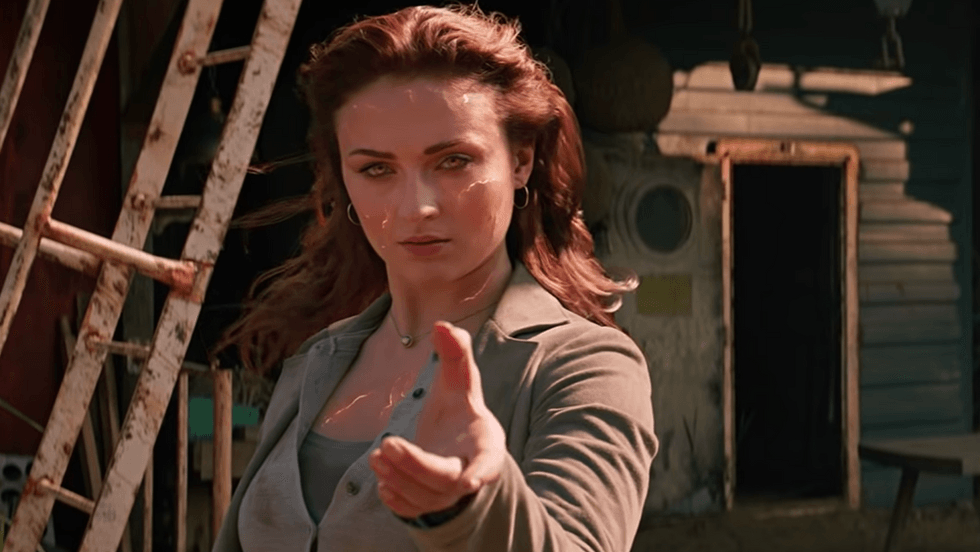
X-Men: Dark Phoenix (2019), directed by Simon Kinberg, stars James McAvoy, Sophie Turner, Michael Fassbender, Jennifer Lawrence, Nicholas Hoult, Tye Sheridan, Jessica Chastain, Kodi Smit-McPhee, Alexandra Shipp, and Evan Peters. This is the tenth film in Fox’s X-Men franchise and follows the titular team as they attempt to stop Jean Grey (Turner) after her abilities grow too powerful to control. Manipulated by Vuk (Chastain), the leader of an alien species intent on harnessing her power, Jean proceeds to forge a path of destruction and death. Reeling from the loss of one of their own, the X-Men are left fractured, blaming one another for what went wrong. It’s up to Professor X to reunite his team and save the day, even if that means coming to terms with the past mistakes that drove Jean away in the first place.
The performances here are extremely forgettable and range from overplayed to plain uninterested. Only McAvoy and Fassbender are worth being described as memorable (if that). Turner, whose character takes on a much larger role in this film, can’t carry the extra weight. She’s not particularly bad, she just isn’t able to elevate any of the material. Beast (Hoult) finally receives a bit of intrigue, but his involvement isn’t developed enough to feel fully satisfying. The cast goes off the rails when it relates to the characters of Quicksilver (Peters) and Mystique (Lawrence). Quicksilver just disappears from the film at one point while Mystique is disposed of early on. It’s clear that Lawrence did not want to be a part of this film. That being said, her death feels appropriate for her arc. It also succeeds in pushing forward some stagnant characters such as the previously mentioned Beast. Similar to X-Men: The Last Stand (2006), I somewhat appreciate that this movie just says “screw it” in terms of its willingness to kill off some central characters.
What’s truly awful are the film’s villains. Not only do they jump the gun in terms of being much too sci-fi adjacent, but they’re also lifeless and are driven by unoriginal motivations. Speaking of jumping the gun, you know a series has done so when they force the characters to take their antics to space (which this film does).
The dialogue is often laughable and the writing is generally so poor that most scenes end up taking little advantage of their initial promise/premise. Explanations of certain characters’ abilities are completely abandoned which just ends up leading to a lot of unnecessary questions that trip up the viewer if they think for more than ten seconds.
On one hand, this is one of the more focused films in the series, but on the other hand, it feels like it focuses on the wrong things. There are once again far too many characters but the film balances them worse than any of its predecessors. Jean gets far too much focus while characters such as Storm and Cyclops, who require more development, are mostly forgotten about outside of action sequences.
Speaking of the action, it’s one of the film’s bigger strengths. It’s mostly an improvement over X-Men: Apocalypse (2016) in terms of special effects and takes advantage of each of the characters’ unique powers. Unfortunately, it’s all hindered by an overuse of slow motion from longtime franchise producer turned-director, Simon Kinberg. It just creates a feeling that the action is a bit juvenile, almost like the director is saying “Look at how cool this looks. Isn’t it cool? It’s cool, right?”
Overall, this is considered one of the worst X-Men films for good reason. It feels even more rushed than the previous installment and has “production troubles” written all over it. The focus is unbalanced and outside of a few long-awaited character moments, nothing here feels like it justifies its existence. There aren’t any new themes or exciting arcs, it just feels forgettable in every sense of the word. Although this is a step down from Apocalypse, it’s not a large one like most fans seem to believe. This just proves the timeline should have ended with X-Men: Days of Future Past (2014). C

 The Movie Matt