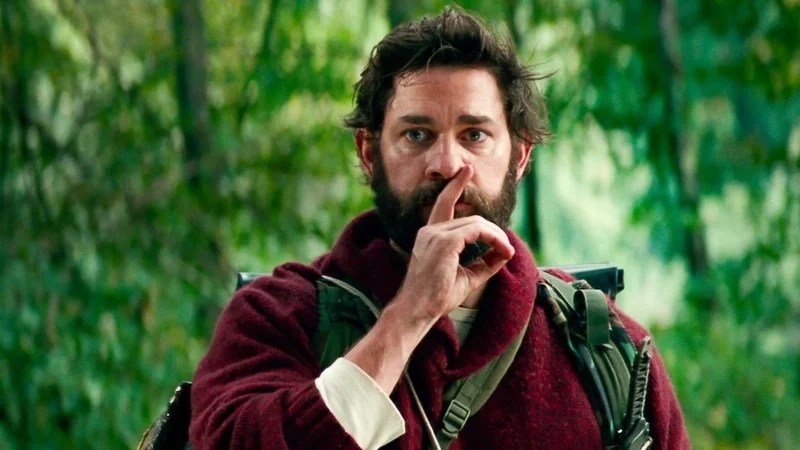
A Quiet Place (2018), directed by John Krasinski, stars John Krasinski, Emily Blunt, Millicent Simmonds, and Noah Jupe. The film follows a family as they struggle to survive in a post-apocalyptic world where they are hunted by blood-thirsty alien creatures that are attracted to even the smallest of sounds. Because of this they a forced to live a life of silence, communicating with sign language and avoiding noisy tools such as plates and even shoes. After a series of unexpected occurrences threaten their sanctuary, the family is forced to band together to save not only their home but each other.
This is an admittedly simple story, but it’s elevated by almost every aspect of the filmmaking process. This includes the fantastic performances from the 4 leads of the film. Krasinski and Blunt convey a variety of heartbreaking emotions all while relying on almost zero dialogue. It’s also easy to buy their connection as husband and wife which is honestly no surprise considering that the two are married in real life.
As for the younger cast members, Jupe and Simmonds, they provide some impressive work considering their age. They are likewise able to convey clear emotions with little dialogue. The script also provides them with the perfect balance of agency and fear for their age. Krasinski seems to have a strong understanding of where films often sell kids short in terms of intelligence (besides the kid in the opening scene who is just unbelievably dumb even for his age). However, he also understands the ways in which kids can be incompetent due to their lack of experience.
With such a short runtime and almost no dialogue, I want to point out once again how amazingly efficient this film is in terms of exposition and character development. It smartly uses the universal themes of family and loving one’s family unconditionally to the fullest extent possible. The film’s themes merge perfectly with its plot and lead to one of the most effective and tension-fueled climaxes I’ve seen. But this climax isn’t just thematically strong, it’s also supported by fantastic acting, editing, and sound design.
The film’s premise of complete silence may seem a bit gimmicky at first glance, but it forces us to experience what the characters are feeling as opposed to discovering it through dialogue. Films are a melting pot of various artistic mediums, but above all else, they should tell a majority of their story visually. If not, why wouldn’t a person just read a book? It’s one of the number one storytelling rules in film: show instead of tell. The silence also forces the audience to fall into a kind of hypnotic captivation. Every sound means something, so when there’s a string of silence it keeps the viewer on the edge of their seat even if there isn’t any immediate danger to the characters.
Overall, this a horror film that is simple and swift but as well-made as they come. Although previously mentioned as simple, it’s a film that’s elevated by almost every element of the filmmaking process. There isn’t a single piece that carries the quality more than another, resulting in a film that stands out fully even though it’s tough to describe why beyond the unique premise. This is also a rare horror film that feels as if it could be enjoyed by a majority of audiences, even those who traditionally don’t love the genre. Its scares are created because of tension, not gore or freaky visuals. It’s almost a perfect PG-13 horror film, but it could’ve used a touch more complexity. A-

 The Movie Matt