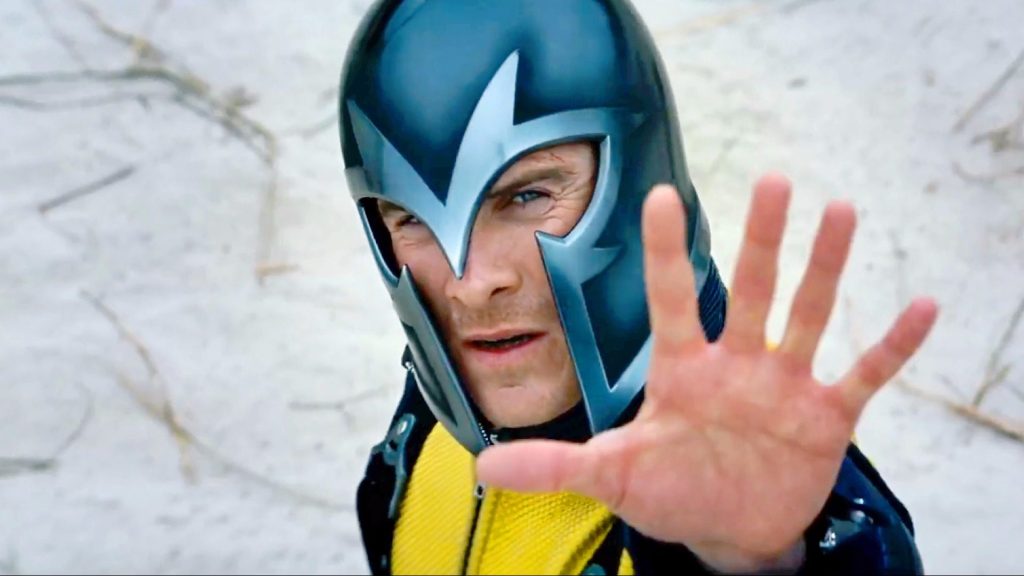
X-Men: First Class (2011), directed by Matthew Vaughn, stars James McAvoy, Michael Fassbender, Jennifer Lawrence, Kevin Bacon, Nicholas Hoult, January Jones, Rose Byrne, Lucas Till, Caleb Landry Jones, Zoe Kravitz, Edi Gathegi, Oliver Platt, and Jason Flemyng. The film takes place in the 1960s and follows the formation of the X-Men as well as the complex relationship between Charles Xavier/Professor X (McAvoy) and Erik Lensherr/Magneto (Fassbender). When a powerful mutant named Sebastian Shaw (Bacon) gets his hands on a stockpile of nuclear weapons, it’s up to the X-Men to save the day. The thing is, Magneto has a history with Shaw and this thirst for vengeance begins to lead him down a dark path. This eventually leads to a confrontation between Magneto and Xavier that will ultimately seal their fates.
Against all odds, Fassbender and McAvoy are able to match and sometimes even exceed the performances of their predecessors: Ian McKellan and Patrick Stewart. It’s just fantastic casting that immediately shows the audience that the studio didn’t cut any corners in terms of intended quality. It’s a lot of fun to see a much younger and immature Professor X experiencing things such as romance. It humanizes the character in ways that feel new but avoids betraying who fans have always known the character to be. Likewise, Magneto’s history involving the Holocaust is expanded upon in ways that are both dark and satisfying. Following Magneto as he kills those more evil than himself succeeds in endearing us to a character that might otherwise be beyond redemption in the minds of some.
Jennifer Lawrence as Mystique likewise gives a strong performance but, from a fan perspective, it feels strange that a character like this gets so much focus. I have a sneaking suspicion that this is because of Lawrence’s popularity at the time of production, but either way, this doesn’t necessarily help or hurt the film. As for Nicholas Hoult’s Beast, I have mixed feelings as well. It’s not a bad performance in any particular way, but I can’t help but notice how much of a step down it is from Kelsey Grammer’s portrayal in X-Men: The Last Stand (2006), makeup included.
As for the villains, I think Kevin Bacon’s Sebastian Shaw is the best this series has had to offer up to this point. I’ve rarely seen him as a villain, but he truly shines in the archetype. This makes it extra disappointing that he’s paired with January Jones’ emotionless performance as Emma Frost. She’s just so cold and there’s almost no characterization to be found. I struggle to understand anyone who thinks this is even a remotely acceptable performance.
On top of all of these performances lies a fantastic cameo that should be to guideline on how to do them right. Wolverine features for about 20 seconds in an appearance that is both fun but meaningful in the sense that it hints at his whereabouts during this time period (something that fans would have otherwise inevitably asked about).
This is easily a much more satisfying and necessary-feeling prequel than X-Men Origins: Wolverine (2009) and answers questions we were actually asking. It’s the longest film in the franchise up to this point but it amazingly feels like it’s the shortest. I think this is due to the film’s constant innovation in the way in which it tells an X-Men story. Director Matthew Vaughn feels consistently intent on providing the audience with ideas and action that we haven’t seen before in the X-Men films. For example, action sequences take full advantage of the mutants’ powers in ways that constantly keep our attention, especially in a third act that truly rises above its peers.
Unfortunately, the film struggles with some cheesy dialogue as well as some frustratingly convoluted lore. There’s also an occasionally immature mindset to the comedy similar to The Last Stand as well as most of Matthew Vaughn’s previous films. This only makes me take the film a bit less seriously, which I doubt is what they were going for. To round things off, the film also implements a handful of new mutants that have oddly similar powers to mutants we’ve seen before. It feels a bit creatively bankrupt to not be able to come up with new powers to show off. It just adds a small feeling of redundancy.
Overall, this is tied with X2 (2003) as the best film in the franchise up to this point. Although it’s a bit unbalanced and often ignores its cool 1960s setting, there’s enough effective setup and payoff to make this feel like a more fully formed experience. At the end of the day, what carries the film above all else are the two performances at its center. Whether you’re a diehard fan of the X-Men or if this is your entry point to the series, you could do a lot worse than X-Men: First Class. B

 The Movie Matt