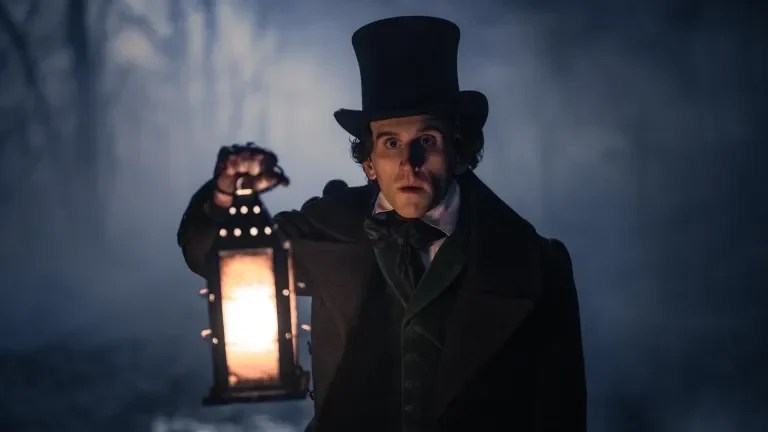
The Pale Blue Eye (2020), directed by Scott Cooper, stars Christian Bale, Harry Melling, Toby Jones, Lucy Boynton, Timothy Spall, Simon McBurney, Harry Lawtey, Gillian Anderson, Robert Duvall, Fred Hechinger, Joey Brooks, Charlotte Gainsbourg, and Steven Maier. The film takes place in 1830 and follows Augustus Landor (Bale), a skilled but aging detective who is brought out of retirement to investigate the gruesome murder of a West Point cadet. Through his investigation of various cadets, Landor meets a young Edgar Allan Poe (Melling) who quickly becomes one of his closest allies (and prime suspects). When it is made clear that the killer intends to strike again, it is up to Landor and Poe to uncover the mystery before it becomes more personal than either of them could have possibly imagined.
The duo of performances at the film’s core are truly something to behold, Melling proving capable of matching Bale at any given moment. Bale doesn’t provide anything particularly new with his performance, but he’s still able to provide a certain amount of broken gravitas to the role. Even at his best, I often find that Bale comes across as cold in his performances. Thankfully, the character’s emotional beats work better than I was initially expecting. On top of that, Melling provides a lot of unexpected heart as Edgar Allan Poe. I was expecting this character to come across as cold and depressed, but I was delighted to find that he’s actually a bit more complex. Instead of simply reveling in the macabre, Poe yearns to explore the beauty/inevitability of death. He’s portrayed as a much more uplifting character than his eventual published works might hint at. After discovering that the film is inspired by one of Poe’s less macabre works, “Landor’s Cottage,” this portrayal makes a lot of sense. I also think it makes the character much more likable without completely sacrificing his gothic personality. As for everyone else, they are well cast, but few of them truly stand out besides Gillian Anderson in a small role that really allows the actress to chew the scenery. They all feel authentic to this era and I feel as if that’s the most important thing in this kind of historical fiction.
Although the film features heaps of strong gothic atmosphere and some truly compelling dialogue, the first two-thirds of the film are painfully slow. Everything feels right in terms of character and storytelling, it just takes far too long to gain any momentum. The film saves most of its’ intrigue for the third act which results in a strong ending, but it unfortunately isn’t strong enough to make up for everything that comes prior.
This is another slightly frustrating work from director Scott Cooper. He’s one of those directors who shows a ton of promise but can’t quite cross the threshold of making a truly great film. He has never made less than a B- film, but he has also never made more than a B film. Maybe his films appeal to a certain taste that I just don’t have, but I’m still waiting for his magnum opus.
Overall, this is a worthwhile piece of gothic fiction that will leave the viewer satisfied if they can get past the plodding pacing of its first two acts. Bale provides some strong emotional depth while Melling gives a standout performance that is truly memorable. The unfortunate part is, I can’t see anyone revisiting this film unless they’re a diehard fan of gothic material. B-

 The Movie Matt