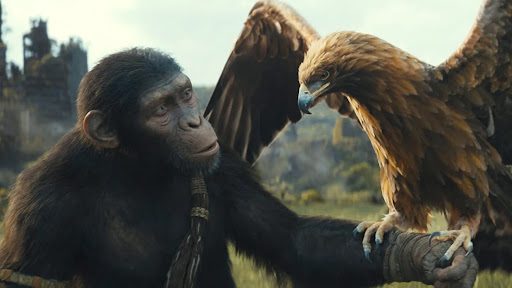
Kingdom of the Planet of the Apes (2024), directed by Wes Ball, stars Owen Teague, Freya Allen, Kevin Durand, Peter Macon, Eka Darville, and William H. Macy. This is the fourth installment in the modern Planet of the Apes franchise and takes place almost 300 years after the events of War for the Planet of the Apes (2017). The story follows Noa (Teague), a young ape on the verge of adulthood who is thrust into an epic journey to save his people after his home is raided by a vicious band of warrior apes led by the brutal Proximus Caesar (Durand). Proximus warps Caesar’s (the protagonist of the first three films) legacy to support his fascist ideals, leading to immense bloodshed as well as the slavery of apes and humans alike. On the run from Proximus’ brutal underlings, Noa eventually crosses paths with Raka (Macon), an orangutan who teaches Noa about Caesar’s true legacy including the idea that apes and humans are stronger if they are willing to work together. These teachings culminate in Noa and Raka teaming up to escort an atypically intelligent human named Nova (Allen) across a dangerous jungle landscape. As events become more desperate, Noa realizes it’s up to him and him alone to lead his people toward a better future.
Once again, this series displays cutting-edge motion capture technology that continues to take a step up with each installment. It’s tough to decide whether the strength of the facial expressions are due to the performances or the simple fact that the effects can display them in the first place. Either way, the film allows us to deeply feel the emotions of these characters even though they’re all a bunch of CGI monkeys. That being said, the new cast of characters is a clear step down from the previous three films. Noa is a likable enough lead character, but he feels too familiar and therefore a bit boring. There really aren’t any interesting or entertaining aspects to the character. He’s just the typical quiet but admirable hero.
Raka is presented as the most well-spoken ape of any in the franchise and therefore acts as the film’s Obi-Wan Kenobi figure. The thing is, he’s much too similar to the character of Maurice from the previous films in terms of both attitude and visuals. There are a lot of different types of primates in the world, so why introduce a character that is bound to be confused with another character of the same species?
Durand chews the scenery as the film’s villain, but the character once again feels all too familiar. His motivations give off the typical “I want to control everyone and everything” vibe. This is a pretty standard villain motivation but the film doesn’t even show us the genesis of this already boring motivation. Not even showing us why he’s this way only makes the character all the more disinteresting.
As far as the two human characters go, it’s a mixed bag. Freya Allen does all she can to elevate her character but the script makes the baffling choice of presenting the character as a mute for half of the film. This wouldn’t be an issue, but when the script does allow the character to talk, she comes across as cold and mysterious. This is necessary in the plot sense, but unfortunately doesn’t leave much room for the audience to attach themselves to the character in any meaningful way. As for the other human character played by William H. Macy, I felt that he was perfectly cast. Similar to his character in Shameless, he provides this character with a sense of deep-seated insecurity and fear. This provides an interesting glimpse into what it looks like when a slaver becomes a slave.
Although this is similar in length to the previous installment, this is the first film in the franchise that I feel dragged a bit. I think this is partly due to the film’s previously mentioned weak characters. The first half of the film is dedicated to introducing us to these new characters and therefore feels slow considering that the characters aren’t very compelling in any sense of the word.
Even with its character missteps, the film is surprisingly able to spawn some truly exciting setpieces that provide some strong pathos. If nothing else, director Wes Ball proves he understands how to choreograph an edge-of-your-seat action sequence. Unfortunately, the film’s most important action sequence is also its weakest. The climax devolves into a typical Lion King-esque King vs. Hero sequence that we’ve seen recently in films such as Black Panther (2018) and Aquaman (2018).
What really works about this film overall is its commitment to the future/future installments. The film subtly hints at plans to eventually lead into the plot of the original Planet of the Apes (1968) film. The creators of this series continue to display a deep love for the material and it feels good to know the intellectual property is still in good hands even after it was bought by Disney.
Overall, if you enjoyed the previous three Planet of the Apes films, it’s a safe bet that you’ll enjoy this one as well. That being said, it’s clearly the weakest of the modern Planet of the Apes franchise up to this point. Most of the film’s problems start with the characters. They are even the source of seemingly unrelated issues. When it comes to storytelling, characters we care about are usually the reason why we care about everything else. With weak characters such as these, I can only recommend this film to established fans of the franchise. B-

 The Movie Matt