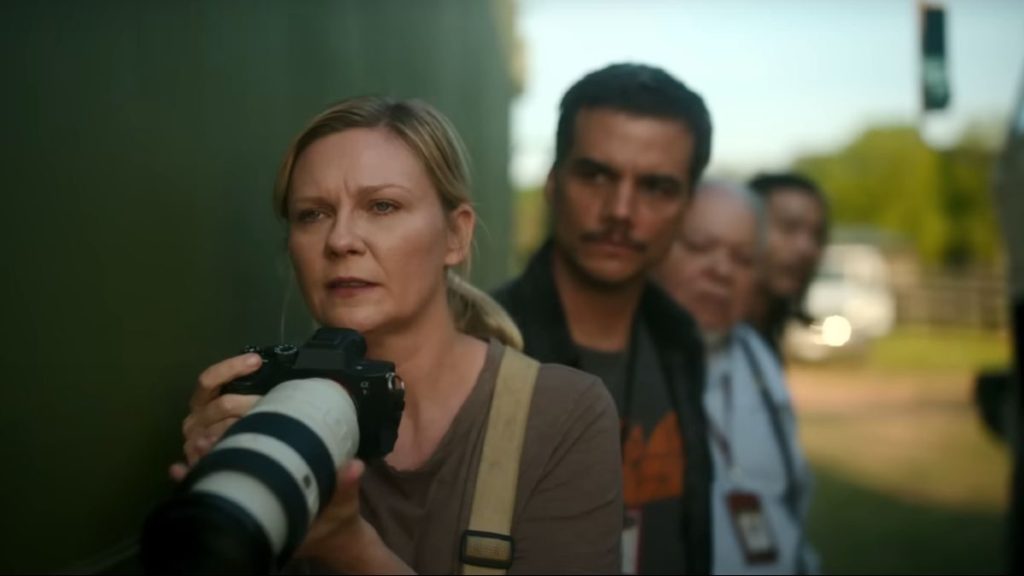
Civil War (2024), directed by Alex Garland, stars Kirsten Dunst, Wagner Moura, Cailee Spaeny, Stephen McKinley Henderson, Nick Offerman, Nelson Li, and Jesse Plemons. The film follows a group of journalists during a Second US Civil War as they travel to Washington DC in order to interview the president before he is killed by opposing forces. Along the way, the group encounters a divided America that hides danger beyond every turn. As a neural entity, they still find themselves subject to the violent injustices of both sides. Fighting for their lives, the group questions their roles as journalists and whether their photos are important warnings or gasoline for a violent fire.
Although the main cast provides quality performances, their characters seem slightly underwritten. One of the film’s central themes relates to the idea that journalists should set themselves at arm’s length from the subject they are documenting. However, I don’t feel that the characters being distant supports that point. This immediately presents the characters as true professionals but focuses more on the characters trying to remain human amid their work. I feel it would have been more interesting if this struggle was flipped, focusing on these characters trying to remain objective in the face of their inherent emotions/desires. We would then receive the same struggles without sacrificing human connection. All this being said, this may have been Garland’s intention, forcing us to consider the human price of unbiased journalism. It lands on the theme that unbiased journalism may not be pretty, but it remains necessary.
The film constantly reinforces the importance of unbiased journalism by having characters die precisely when they involve themselves in the events they are documenting. Quite clearly, Garland presents involved journalism as the death of objective journalism. This shakes our morals in truly challenging ways. It’s tough to see these characters simply watch as people are killed directly in front of them. We beg for them to do something or help, but they never do. However, this would undermine Garland’s theme of presenting objective journalism in the most authentic way possible. As soon as journalists start involving their own stories or political biases, objective facts are often the first thing on the cutting room floor. Before a person can form a truly educated opinion, they need an untainted and unbiased story, something that is often lacking in today’s culture. Garland also isn’t afraid to complicate this theme by implying that sometimes journalists have no choice but to involve themselves. To do their jobs right, they are forced to quell their emotions, but at the end of the day, they’re still human. It’s not a perfect system.
Kirsten Dunst embodies these themes perfectly and easily gives the best performance the film has to offer. There’s a hardened nature to her character that is initially grating but evolves into something much more complicated. Her character speaks to the idea that even the most hardened journalist will eventually succumb to their basic human emotions. It’s impossible not to in the face of such human tragedy. There’s a real push and pull between human morals and objective reporting. It’s irresistible to think about. Similar to how great reporting should work, the film allows us to come to our own determinations.
The film closely follows the typical Heart of Darkness structure but elevates it through the atypical characters and setting. The setting/premise is easily the film’s selling point. In such politically divisive times, it feels quite daring to set the film during a civil war. That being said, the film makes the smart choice of never attaching either of the film’s opposing factions to a certain political leaning. There is only good and bad as opposed to conservative or liberal. People will undoubtedly make real-world connections, but if they do, they’re clearly missing the point.
The film unfortunately left me with the feeling of wanting more. The story and characters don’t always feel like they have room to breathe. I just needed time to feel the group’s journey more fully. This leads to an ending that isn’t particularly disappointing but feels anti-climactic in a character sense. Yes, it hammers home the idea that images are far more powerful than empty words, but I wanted more character resolution.
Once again Alex Garland has created a film that can be endlessly discussed and analyzed. It’s a pleasure to see him tackle subject matter that’s a bit more realistic. Unfortunately, he lets the characters down (a problem in his previous films). The film tackles a timely subject without feeling political or preachy. For our nation’s news to thrive, we need honest and objective journalism, not constant opinion pieces that wave a finger in our faces like self-appointed moral police. The job is tough, dangerous, and underappreciated. Not to mention, the world’s best journalists are often murdered in cold blood for simply doing their jobs. This movie makes me want to practice journalism not because it looks fun, but because it feels like a necessary practice that is slowly going extinct. B+

 The Movie Matt