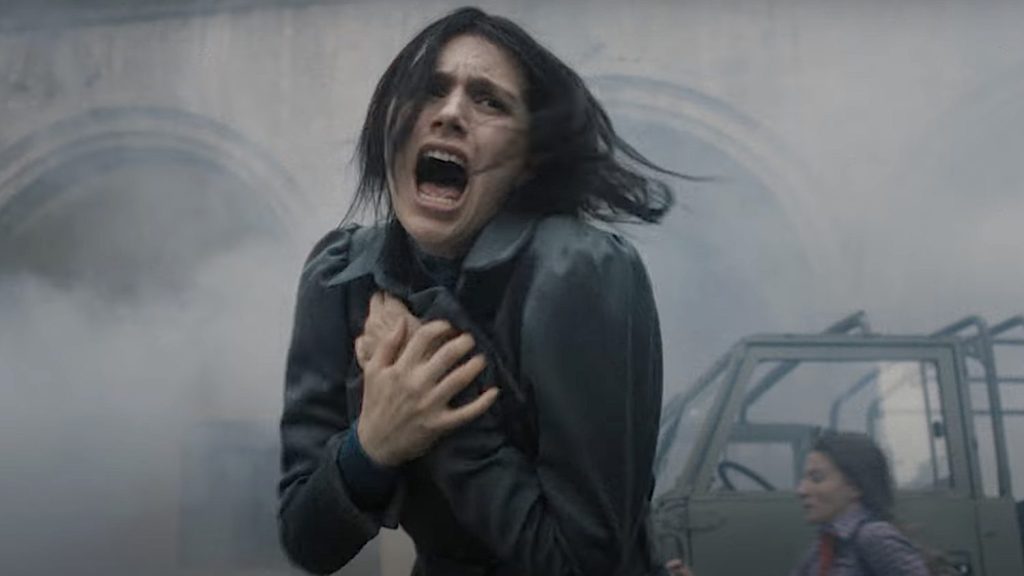
The First Omen (2024), directed by Arkasha Stevenson, stars Nell Tiger Free, Ralph Ineson, Sonia Braga, Nicole Sorace, Tawfeek Barhom, Bill Nighy, Maria Caballero, Ishtar Currie-Wilson, Andrea Arcangeli, and Charles Dance. The film is a prequel to The Omen (1976) and follows Margaret (Free), a young American woman who travels to a convent in Rome in order to become a nun. Soon after arriving, she meets a troubled child named Carlita (Sorace) and the two begin to connect over their shared traumas. As mysterious and disturbing deaths begin to occur, Margaret is approached by Father Brennan, an excommunicated priest who believes certain members of the church are hatching a plot to bring forth the antichrist. Skeptical of this theory, Margaret begins to slowly realize that the intentions of the congregation may be a bit more sinister than they originally appeared.
One of this film’s strengths is the main cast. Nell Tiger Free gives the exact performance I wanted out of Sydney Sweeney in Immaculate (2024) and perfectly blends innocence with intelligence. I simultaneously believe this character would want to take the veil but not be so much of a religious zealot that she can’t see the obvious evil occurring around her. This film also takes a good amount of time to flesh out the character in ways that make her feel truly real. We see her struggle with taking the veil without undermining her ultimate desire to do so. The decision isn’t presented as a light one, so it immediately puts this character in a position where she comes off as selfless and determined. It’s subtle, but it archives the same character work in a way where other films come across as a bit too on-the-nose.
Raph Inseson perfectly revives the character of Father Brennan (played by Patrick Troughton in the original film). He adds layers that support the character instead of changing him in a way that dishonors the original portrayal. The character originally seemed like nothing more than a religious kook, but The First Omen adds a lot of necessary emotional layers that make the character a lot more interesting across the board.
Sonia Braga is also great as Sister Silvia. Her character harkens back to Mrs. Baylock in the original film and provides a good amount of sinister subtly. I enjoyed the fact that none of the eventual villains are portrayed in a way that is cartoonish or over-the-top. Worshippers of the devil are often portrayed as zany and ridiculously evil to the point of laughter, but The Last Omen avoids that trope. Similar to Hereditary (2018), the film seems to know that it’s a lot scarier if it feels like these people could be our next-door neighbors.
The film does a mostly good job of blending callbacks to the original film while still treading some new ground. That being said, a few of these callbacks were a bit too on the nose for my liking. It often presents similar kills with one small twist. The thing is, these small twists seem like an afterthought and don’t change the overall effect. I wish they would have found entirely new kills that were as creative and chilling as the original, but I realize that’s easier said than done.
The cinematography is a real treat. It opens with a sequence similar to the beginning of Halloween Kills (2021) that takes us back to the 1970’s, film grain and all. Likewise, it uses some classic horror camera tricks that are rarely seen today. Even when the film abandons this visual style, there’s a real sense of symmetry in shots throughout the film. This oddly creates a sense of unease through this symmetry. It’s almost like things are too perfect. You know something is off because it’s just so unnatural.
Where the film unfortunately goes off the rails is in its climax. It has a somewhat happy ending that I felt betrays the overall tone of what The Omen franchise should be. It might satisfy casual audiences, but it stands out after the majority of the film feeling so in touch with its roots. It goes for your typical prequel ending that leads directly into the events of the original film. It works, but I can’t shake the feeling that it came across as a bit safe and/or lazy. The film reeks of a director who was given creative freedom, but the studio couldn’t help but get their paws on it at the last minute.
Overall, this is a worthy prequel to The Omen (1976) that still has its fair share of flaws. I can’t see many audiences disliking this film, but I feel that they’ll miss out on a lot of its pleasures without a decent knowledge of the original. Although this is well-made on most technical levels, I couldn’t help but feel a bit empty when it was all said and done. Maybe it has to do with seeing the lesser, but very similar Immaculate (2024) about a week prior. Or maybe it was the ending. I’m not particularly sure. B-

 The Movie Matt