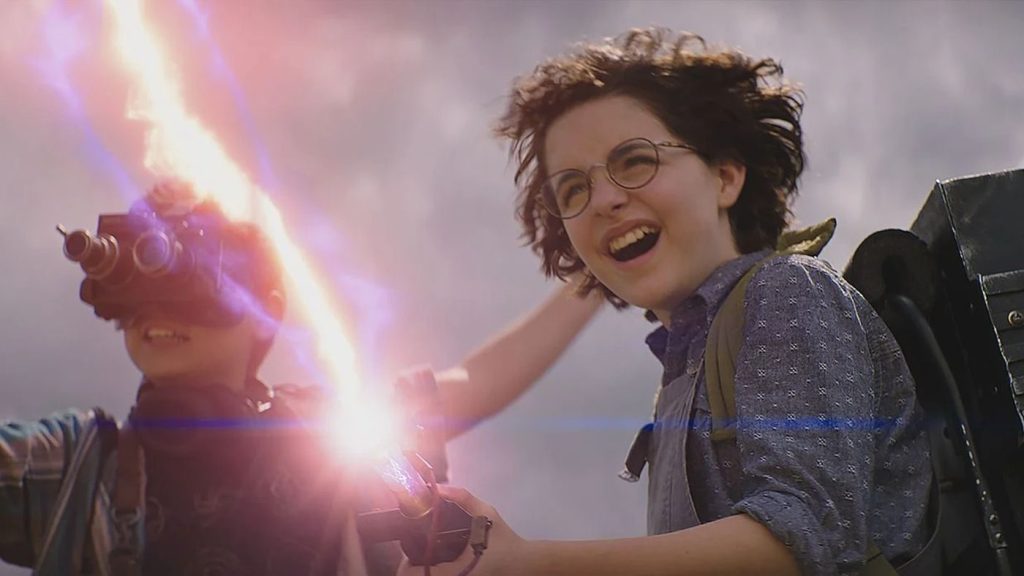
Ghostbusters: Afterlife (2021), directed by Jason Reitman, stars McKenna Grace, Carrie Coon, Paul Rudd, Finn Wolfhard, Logan Kim, Celeste O’Connor, Bill Murray, Dan Aykroyd, Ernie Hudson, and Annie Potts. The film is the fourth film in the Ghostbusters franchise. Still, it essentially acts as Ghostbusters 3 after the failure of the 2016 remaining/remake which seems to take place in a separate reality from the original two films. Afterlife follows the descendants of Egon Spengler (portrayed by Harold Ramis in the first two films but passed away in 2014) who inherit his secluded farmhouse after he passes away of seemingly natural causes. The family consists of Egon’s daughter Callie (Coon), her son Trevor (Wolfhard), and her Egon-like daughter, Phoebe (Grace). Callie is puzzled by her father’s mysterious past and still detests his memory as a result of him abandoning their family. His motivations for doing so remain unclear and she hopes to find closure. Meanwhile, Phoebe is quickly enrolled in summer school and meets her quirky teacher Mr. Grooberson (Rudd) as well as a podcast-obsessed boy who appropriately calls himself Podcast. Together, the group begins to investigate the strange contraptions Egon left behind as well as a supernatural entity that is bubbling below the surface of their sleepy little desert town. When they soon realize they’re in over their heads, it’s up to Pheobe to enlist the help of her family as well as a few unexpected allies to save the world.
The cast here is immediately an improvement over the cast of Ghostbusters (2016). They’re finally able to recapture the magic of what made the original two films work so well: Comedy sourced from the interactions between likable and nuanced characters. Although the characters may be written in a way that’s a step down comedically from the original cast, they are also the most emotionally nuanced characters in the series. However, some of them are noticeably better written than others. The original cast doesn’t appear for much of the film, but it works unexpectedly well due to the strength of the new cast.
McKenna Grace is a lot of fun as the film’s young protagonist. There’s a good balance of using this character as a stand-in for Egon while still succeeding in presenting a fresh, more emotionally rounded character. We believe that she could be Egon’s granddaughter without her feeling like a clone.
Trevor is easily the most underwritten character but the performance by Wolfhard is genuine enough to not feel like a total drag. His teenage angst is a bit annoying, but again feels genuine. The character’s biggest issue is that he doesn’t feel important to the plot in any significant way. He’s mostly just relegated to a subplot involving a teenage romance that we’ve all seen a trillion times.
One of the stronger elements of the main cast is the budding romance between Callie and Mr. Grooberson. Carrie Coon as Callie gives a performance that feels genuine and it helps that the character is given some very understandable turmoil. It eventually leads to some pretty effective emotional resolution in the film’s back half. On the other hand, Paul Rudd as Mr. Grooberson is just perfect casting. He’s believable as a scientist, father figure, and love interest as well as a potential new member of the Ghostbusters team. The romance between the two works for a few different reasons. First, the actors just have an undeniable chemistry that is both quirky and cute. Second, the relationship doesn’t feel unrealistically perfect. The two have differences and disagreements, but this just results in a romance that feels wholly earned. Finally, Mr. Grooberson also builds strong relationships with the kids, resulting in us not just wanting to see the relationship succeed, but also the possibility of a loving family dynamic.
One of the elements that makes the film work is the palpable feeling that this was made by a cast and crew that have a deep admiration for the franchise. The film is directed by Jason Reitman, son of Ivan Reitman, the director of the first two Ghostbusters films. You can tell that Jason understands exactly what makes a Ghostbusters film work on a core level. That being said, he also injects his own creative flair in a way that feels like it improves the film instead of drastically changing the tone. You can tell from the film’s first scene that Jason understands how to balance horror and comedy in a way that feels appropriate for the series. The characters are the most emotionally nuanced we’ve seen and the handling of callbacks/nostalgia feels naturally implemented. The callbacks actually mean something in terms of the plot. It feels more like a rediscovery of what made the series great as opposed to lazy rehashes of a much better film.
The film also does a tear-jerking good job of honoring the late Harold Ramis. Not only was he a dynamite comedic actor but he was also one of the best comedic directors of his generation. He directed classic films such as Caddyshack (1980), Vacation (1983), Groundhog Day (1993), and Analyze This (1999). His legacy is much bigger than just Ghostbusters. He was a comedy legend and this level of recognition feels earned. It’s the film’s beating heart and rightfully so. However, I do have a small issue with the use of his CGI likeness in the form of a ghost. The character is shown too often to the point where the fact that he doesn’t talk only reminds us of his untimely passing in real life. It just didn’t always feel right in a way that I can’t quite pinpoint.
Unfortunately, the film’s many callbacks and attempts at emotional manipulation occasionally give the viewer the feeling that the filmmakers are pandering a bit too heavily to Ghostbusters fans. Luckily, I’m a huge Ghostbusters fan so it works better for me than I think it will for most casual fans. It also lazily rehashes the villain of the original film in a way that’s fun but ultimately makes you wonder why they couldn’t have come up with something new. My last issue has to do with the fact that although this film is funny, it’s not particularly goofy in the way that even the 2016 reimagining was able to achieve. Therefore it causes the more cartoonish-looking ghost to feel a bit out of place.
The film easily has the best CGI in the franchise and the action scenes are fun, well-shot, and injected with just the right amount of manic humor. The climax is the best in the series and reaches emotional highs that trump any that came before. It made me tear up multiple times as a huge fan of the franchise. But what I really appreciated was the film’s revival of 80’s comedy-horror tropes. There’s the trope of a single mom moving her family to a new town as well as a group of kids attempting to solve a mystery that’s larger than they can realistically handle. It feels like a hybrid of The Lost Boys (1987), The Goonies (1985), and of course, Ghostbusters (1984). It honors not just Ghostbusters but the entire era in which that film came out.
Overall, this is a worthy continuation of the first two films and succeeds at delivering some of the best emotional beats the franchise has to offer. It takes the series in a new direction while also providing enough of what we’ve always loved about this franchise in the first place. I imagine this won’t be nearly as effective for general audiences as it will be for fans of the franchise. Some may not like the shift from more adult comedy to more family-friendly fare, but that has always seemed like the series’ natural direction in my mind. It has its flaws, but it’s also a truly fun Ghostbusters film that gets me excited for its newly released sequel. B

 The Movie Matt