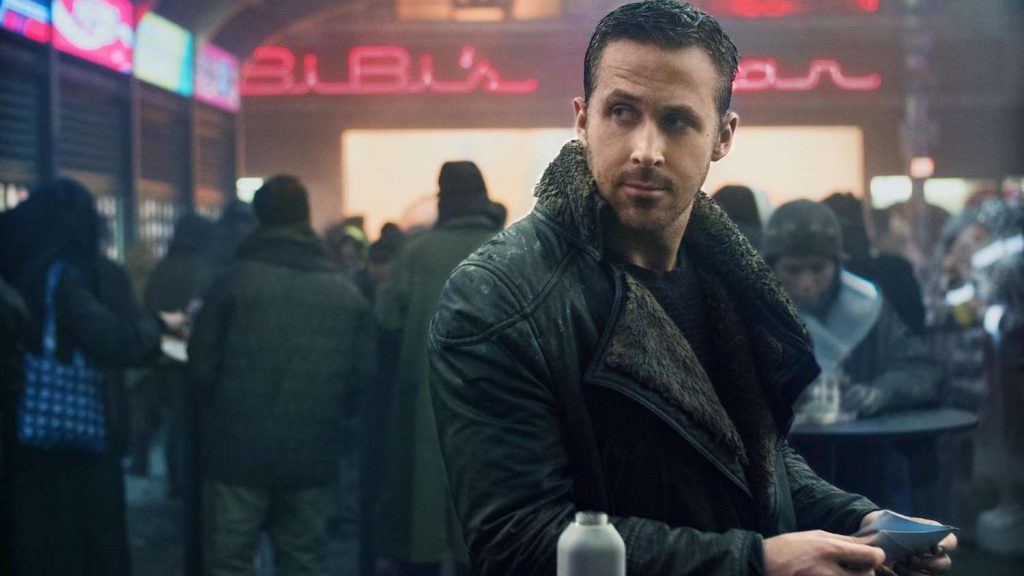
Blade Runner 2049 (2017), directed by Denis Villeneuve, stars Ryan Gosling, Harrison Ford, Ana De Armas, Sylvia Hoeks, Robin Wright, Jared Leto, Mackenzie Davis, Hiam Abbass, and Dave Bautista. This is the 35-year later sequel to Ridley Scott’s Sci-Fi classic Blade Runner (1982). The film follows a “Blade Runner” android named “K” (Gosling) who is tasked with tracking down and “retiring” older android models. After the discovery of a long-buried secret that threatens to aggravate tensions between androids and humans, K sets out to find Rick Deckard (Ford), the blade-runner protagonist of the original film. Along the way, K begins to question his existence and what it means to be human.
Although some might see the performances as “cold” when considering that at least half of the cast plays androids, I found that they toed the line perfectly. Yes, they often come across as cold and calculated, but when certain characters begin questioning their existence, we feel their strife wholeheartedly. With Gosling, for example, his face often remains emotionless. However, through performative choices such as intense contemplations, side looks, and just generally how the character is written, we slowly see this facade unwind. It takes its time and feels earned. He doesn’t just become more human at the snap of one’s fingers, it’s a slow process with all kinds of setbacks. We see the emotions of the androids through their actions, not necessarily their face. It’s one of the many details the film uses to blur our ideas of what does and doesn’t make someone “human.”
Robin Wright gives one of the film’s better performances as K’s handler, Lieutenant Joshi. As one of the film’s few human characters, she is often used to show how even humans who are sympathetic to androids often struggle to avoid seeing them as simply tools for their comfort and pleasure. She is fantastic here and it makes me wonder why she hasn’t received any leading roles since.
The clear standout of the film is Harrison Ford who reprises his role as Rick Deckard. The character is unfortunately sidelined until the film’s third act, but it feels appropriate to the story being told. The few scenes that do revolve around Deckard are some of the most wholly satisfying parts of the film, but not just in a fan-service sense. Villeneuve is too skilled of a director for those kinds of simple pleasures. Deckard is the beating heart of the film. When the android characters as well as the villains struggle to sort out their emotions/humanity, Deckard makes the film’s morals crystal clear. He makes it clear that humanity is something born from within. It is not just physical features that make an individual human. Humanity is shown through action, it’s not simply inherited through how one was born. In a scene between Deckard and the villainous Wallace (Leto), both human characters, this juxtaposition is clearly shown.
What works so well about Blade Runner 2049 is its willingness to expand on a revered sci-fi classic without hurting that film’s legacy. One of my more spicy hot takes is that this film blows the original out of the water. It does what a great sequel should do and improves on the original in just about every way. The amount of interesting sci-fi concepts that the movie tackles is almost overwhelming. Also, the world is so honestly formed that a person can watch a 2-hour video explaining the subtle visuals that imply its skewed history. But the important part is that all that extra research isn’t necessary to enjoy the film.
Another aspect that impressed me was the film’s epic nature as opposed to the original’s more contained nature. The film is a bit too long, but it does hammer home the feeling of going on a kind of odyssey. The world is so visually spectacular that the length is easy to ignore. We’re happy to be there even if things are moving slowly. I’m torn on the length, honestly. It’s another one of those aspects that both hurts and helps the film.
At the end of the day, this film is so well-made that I feel as if it would have succeeded even if it wasn’t connected to Blade Runner. The sci-fi ideas are so strong that they would be impressive when applied to any film in the genre.
My only issue with the film is that it occasionally feels too slow in the sense that it will constantly dwell on moments of silence. Sometimes it works well and increases the film’s quiet intensity. Other times, it feels absurdly over-dramatic. The film is also 20 minutes too long and the plot can sometimes cause a bit of confusion. This shouldn’t matter if you’re willing to rewatch the film or discuss it with friends, but if you expect to get the full effect after one viewing and no explanations, you might feel that it’s a bit convoluted.
Overall, this is another dynamite sci-fi film in Denis Villeneuve’s filmography. At this point, I may even consider him over Christopher Nolan as the modern king of sci-fi. Although it’s not my favorite film in his filmography, it may just be his biggest success when considering how tough it is to live up to a film like Blade Runner. Roger Deakins’ cinematography is once again as good as it gets and the film features a director and cast at the top of their respective games. If you don’t like heady sci-fi, I don’t think I can recommend it. It is much too slow and contemplative for those audiences. If you enjoy sci-fi and just beautiful filmmaking in general, this is a must-watch. That being said, there are still some aspects that hold it back from being a personal “all-timer.” B+

 The Movie Matt