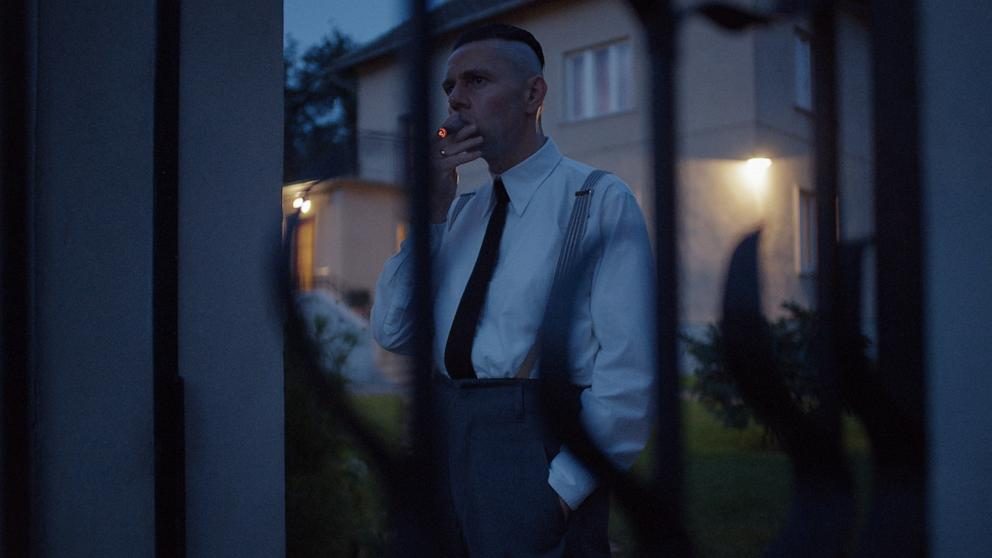
The Zone of Interest (2023), directed by Jonathan Glazer, stars Christian Friedel and Sandra Huller. The film follows the day-to-day life of the Auschwitz commandant Rudolf Hoss and his family. They live in a home directly outside the camp walls and the film always keeps this point of view. As the definition of pure evil surrounds them, they inexplicably carry on as if nothing is wrong. As time progresses and their sanctity is slowly broken, they are forced to come to terms with their place in the eyes of history.
The performances here are quite subtle but effective. Friedel and Huller as the two leads find a nice balance between abstract and naturalistic performance. Christian Friedal does strong work in the sense that, in the early portions of the film, we’re able to somewhat attach ourselves to such a horrendous man. This is through the film’s dedication to only presenting him while he is in his “safe zone.” He’s by all accounts a loving father and husband and this almost makes us occasionally forget what the man does for work. That being said, the film isn’t scared to challenge this veil of normalcy. When the characters are occasionally confronted by what they’ve done, they actively try to make it go away. It makes them even more deplorable. It makes it clear that they know exactly what is going on. They can’t claim ignorance here. It results in a display of Nazi evil that is strikingly original and thankfully doesn’t sacrifice the impact of The Holocaust.
The film juxtaposes all of its stunningly beautiful images with the unseen horrors taking place in the camp next door. It achieves this through its tremendous use of sound. Throughout the film, we are only aware of the camp through the horrible sounds we hear in the background. Some of the more common auditory motifs are babies crying, pained screams, and a litany of gunshots. This is again juxtaposed with beautiful sounds of nature when the family ventures further away from the camp. No matter how much the family ignores the camp throughout the film, they are surrounded by death. The smoke from the burn chambers covers the sky, always slightly cloudy (but seemingly not due to clouds). In one particular scene, a Jewish prisoner spreads ashes around the house, unknown to the family. They are literally surrounded by the ashes of their victims.
The film has this ability to bring the dialogue down to earth in ways that feel authentic. For example, there’s a scene in which Rudolf is discussing gas chambers with his superiors. They speak in a calm and calculated manner, seeming mature, like something you’d see in a modern-day business meeting. Against all odds, it makes these scenes infinitely more terrifying than they otherwise would have been if the conversations featured heightened emotions. The calm and calculated nature of the extermination of human beings kept me up at night. This feeling of coldness and dehumanization permeates throughout the film. In one scene, the oldest Hoss boy stays up late at night examining a box full of gold teeth that were taken from the bodies of Jewish victims. We see that the dehumanization of Nazi teachings is already beginning to take effect at a young age.
It is interesting though that the film displays the rise of Nazi Germany as being more generational than anything. Born from the economic hardships of World War 1, there’s a feeling from these characters that they are finally receiving the life they’d always dreamed of. In a sense, they see their family’s duties as a necessary evil as opposed to a blind hate for the Jewish community. Granted, of course they still hold a disdain for the Jewish people, but that’s displayed more as a piece of the puzzle as opposed to the sole driving force. It doesn’t get close to feeling apologetic, but it does provide a good bit of honest nuance, once again hammering home the film’s feeling of authenticity.
Overall, this film’s effect is astounding. I was hesitant going into the film, wondering how another Holocaust film could possibly feel original. I was worried I would walk out with my 500th lesson on how horrible the Holocaust was. That lesson is undoubtedly true, but not particularly new. I couldn’t have been more wrong. Where the film stands out is its authentic and nuanced display of Nazi evil. It’s not about showing us how evil they are, It’s about showing us their complacency with the evil that surrounds them. This claims that the blind acceptance of evil is as morally bankrupt as the evildoers themselves. The only small issue I ran into was the question of whether the mundane nature of the film is worth the ideas it raises? I think for the most part, yes. It’s just a question of whether you as a viewer can handle this more plodding material. It wasn’t the most viscerally entertaining film of the year, but maybe one of the most original in its approach. If you’re a WWII/Holocaust history nut, this is a must-see. A-

 The Movie Matt