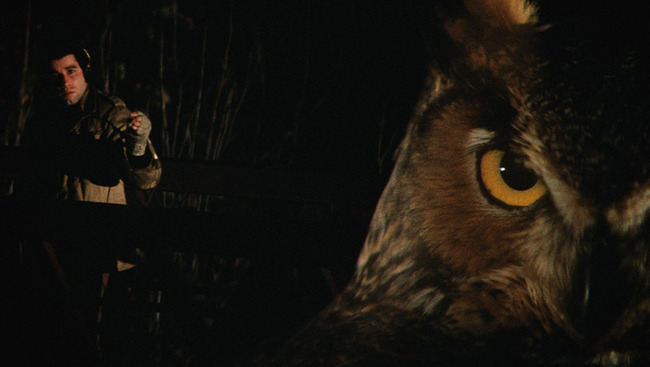
Blow Out (1981) is directed by Brian De Palma and stars John Travolta, Nancy Allen, John Lithgow, and Dennis Franz. The film follows Jack (Travolta), a movie sound recordist who accidentally records proof that a car accident was indeed murder, becoming entangled in a political conspiracy that threatens his life at every turn. Teaming up with a call girl (Allen) whom he saves from the wreckage, Jack sets out to prove his theory through small details in the recordings he took. What he doesn’t know is that a rouge hitman (Lithgow) is hot on their trail, intent on tying up loose ends by any means necessary.
Travolta is easily the star of the show here. He conveys a level of charisma that is rare in cinema. He has a level of angsty complexity that makes the character easy to connect with. He has principles but is imperfect. Yet this is all balanced in a way that allows the character to be likable no matter his various flaws. Blow Out is notable for Travolta in the sense that this was the last great film he starred in before Quentin Tarantino would help to revive his career 13 years later by casting him as Vincent Vega in Pulp Fiction (1994). Tarantino has long stated that his favorite director is Brian De Palma and one of his favorite films is Blow Out. It’s no wonder he held a desire to revive Travolta’s career because he kills it in this film. The role also allows him to show off a good bit of range in ways that feel natural to the character.
Nancy Allen unfortunately gives a lesser performance than her counterpart. Some may argue that Allen only received the role because, at the time, she was married to director Brian De Palma. Although I don’t particularly like this performance, it’s a bit dishonest to claim that, on paper, she wasn’t a capable enough actress for the role. What’s strange about the performance is the choice to have the character talk in a squeaky, almost ditzy tone of voice. This fits the character, but it’s coupled with the fact that she constantly doesn’t seem to take her life-and-death situation very seriously. She puts herself in harm’s way, doesn’t believe clear proof, and is so oblivious that she could have a gun held to her forehead and still not realize she’s in any danger. The fact that we can’t connect with this character makes it hard to connect with the romance between her and Travolta. This is a shame considering that the film’s climax relies on us buying into the authenticity of their feelings for one another.
John Lithgow is fun as the film’s sinister antagonist but unfortunately isn’t given enough nuance to stand out as an all-timer bad guy. That being said, he’s truly horrifying and is presented as more of a slasher villain as opposed to the typical political thriller assassin character. There are little details that make the character fun such as his choice of murder weapon and his intense drive to tie up loose ends at any cost, but it’s all surface-level stuff. A fun villain, but not necessarily a deep one.
In a story that focuses heavily on sound and sound effects, it is only appropriate that the film tells its story heavily through those same technical elements. The film will often present us with seemingly unrelated sounds and images, but these moments are subtly foreshadowing or tipping us off to the film’s thematic intention. De Palma occasionally doubles down on this, giving us a split-screen image with two unrelated happenings and a likewise unrelated sound effect that plays over both. The combination of that sound with two different images is simultaneously telling the audience two things at once, but also a third message when you reconcile it all. It’s a rich, thought-provoking, and energetic type of editing that shows a true master at work. I also appreciate the use of sound in the sense that it never tips us off that something surprising is about to happen. In modern films, I often find myself having surprises spoiled because I’m easily able to recognize what a certain type of music or pace of music is leading to. Here, music kicks in after the shock of surprise. This makes those moments surprising in a way that feels more akin to real life. It sacrifices a more visceral type of surprise for surprises that are a bit more intellectual and authentic.
Besides the cinematography being absolutely iconic, the script stands out to me. Intrigue is added to the story at a perfect pace, starting with a simple scenario and then slowly but consistently adding details that make the situation much more complex and therefore more original and entertaining. It also respects the audience’s intelligence, letting us solve the mystery in tandem with the characters. We’re not just simply told things, we are forced to observe and decipher at our own pace, making the film a much more engaging experience than so many other mystery-thrillers that choose to tell instead of show. My one small issue is that the timeline of events in the film’s climax is a bit messy. There are some inexplicable time jumps that are confusing. For example, for one character, it seems as if hours have passed, but for another character, it appears as if only about 15 minutes have passed. It’s just a strange oversight from a mostly careful director.
The last aspect of the film that I appreciate is its fantastic bookends. The film opens with a scene that makes it feel like a low-budget horror film. Right when the audience is about to judge the film’s quality, it is revealed that it is actually a horror film that Travolta’s character is creating sound effects for. This was a fun misdirection opening that many films have copied since. It also mirrors the film’s ending which circles back to a similar scenario, providing one of those special endings that reframes the beginning. It’s unclear what it means precisely, but it means just enough to provide that kind of thought-provoking discussion that makes a film so deeply interesting.
Overall, this is a masterfully directed thriller with a few crucial missteps that hold it back from being one of the best of the best. The lead performances are all over the place, one being amazing, one being flawed, and one being serviceable. The technical elements are impressive and De Palma fills the film with so many various shots and editing tricks that it almost becomes overwhelming (in a good, thematically rich sort of way). The script also feels well-formed and tells its story in a surprisingly clear way considering all of the mystery and intrigue that is involved. The film unfortunately feels a bit basic by today’s standards in terms of story, but this is balanced by the fact that De Palma’s directorial prowess is extremely rare. This level of direction would be impressive in the modern-day let alone the early 80’s. Besides a few stumbles in logic during the film’s climax, this is a deadly thriller that satisfies on a visceral level as well as a cerebral one. B+

 The Movie Matt