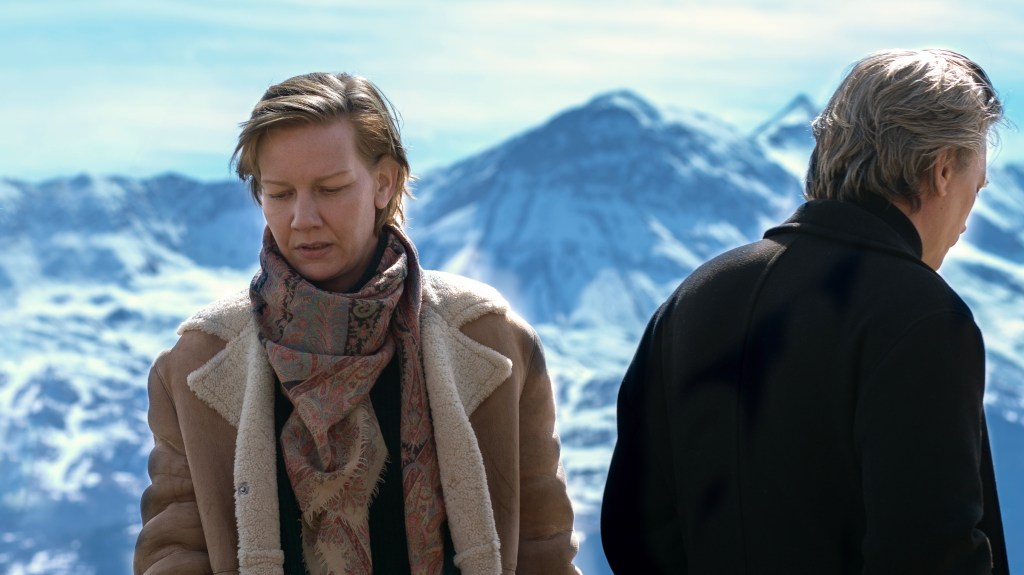
Anatomy of a Fall (2023) is directed by Justine Triet and stars Sandra Huller, Milo Machado Graner, Swann Arlaud, Antoine Reinartz, Jehnny Beth, and Samuel Theis. The film follows writer Sandra Voyter (Huller) and her blind son, Daniel (Graner) after their husband/father, Samuel (Theis) dies after falling from the top floor of their secluded family home. What ensues is an investigation into the details surrounding Samuel’s death and whether or not foul play was involved. When Sandra becomes the prime suspect in the case of Samuel’s murder, Daniel is forced to come to terms with contradicting evidence and hurtful courtroom speculation in order to discover what truly happened to his father.
Huller gives one of the best performances of the year as Sandra. The character carries a majority of the film and allows Huller to show off a good bit of range. The character is written so well in part due to the film’s choice to present her as seemingly innocent of any crimes. Our only doubts about her moral standing are birthed through outside speculation of what could have occurred. If we were judging her guilt solely based on feeling, she would undoubtedly be innocent. It speaks to the idea that speculation can the true hide reality as effectively as not investigating whatsoever. In other words, it speaks to the idea that when we can’t find solid answers, we create our own.
Milo Machado Graner gives a powerful child performance as Daniel. The character is initially presented as someone whose testimony won’t have much bearing on the case, but that quickly changes once more details are revealed. He’s one of those characters that unexpectedly becomes the center of the story. However, it’s not such a random focus shift that things feel jarring. My only problem with the character on paper is that his blindness doesn’t seem to play much of a role in the overall plot. It’s such a specific and overall rare condition that I felt it was leading to something that never came. The story presents a blind kid as the only witness to a murder but never really takes advantage of that original irresistible premise.
The rest of the cast is strong as well, but don’t receive too much of a spotlight. One notable performance is Antoine Reinartz as the prosecution’s lawyer. Throughout the trial, he does his job and does it well, but because of our attachment to the idea of Sandra’s innocence, we end up hating him with a burning passion. It’s only upon reflection that we realize that the character is less of a villain and more of just a human being who truly wants honest answers.
The film makes the intelligent choice to avoid showing the actual act of Samuel’s death. Revealing to the audience what happened would completely crumble anything that’s great about it. All of the film’s thrills hinge on its mystery. This is true even after the film cuts to black, creating a very pure topic of discussion relating to each character’s culpability. No details are revealed before the trial, making each small revelation during the trial a point of interest. It keeps the viewer’s attention because of this, using the small revelations to propel our focus just above boredom. I’ve recently criticized fellow Oscar contenders Oppenheimer (2023) and Killers of the Flower Moon (2023) for both featuring courtroom sequences that were, in my opinion, insufferably boring. Against all odds, Anatomy of a Fall is almost entirely placed in a courtroom and somehow doesn’t feel even ⅓ as boring as the sequences in those two films (and that’s even when considering that those courtroom sequences took up at most ¼ of those films). Courtroom sequences rarely work if the audience already knows who’s guilty and who’s innocent. Because Anatomy of a Fall focuses solely on finding answers, it remains compelling throughout.
The film continuously asks us to trust Sandra, but then details about her life cast our feelings in a shroud of doubt. We flip back and forth similar to how the jury must be feeling. The trial is never one-sided and therefore adds to the realism. Even though we believe Sandra’s innocence in our hearts, we never trust that this is the type of movie where the innocent character will be let off the hook. Its realism is so apparent that we distrust the implication of any kind of happy/Hollywoodized outcome. Speaking of distrust, the film also explores how outside speculation of “what happened” can lead to distrust between the people involved even though there wouldn’t have been to begin with. This can either lead people to finally see what they’ve been ignoring or on the flip side believe something is nothing but speculation. The film questions the source of this intense speculation and lands on the idea that speculators subconsciously want to believe the more glamorized version of events (murder vs. accident or suicide). They may subconsciously push the narrative in the more glamorized direction simply because it’s more compelling.
This film has a sizeable runtime but it feels justified when considering the film’s deliberate pace. The dialogue is standard but somehow feels relentless. The back-and-forths aren’t larger than life but are somehow still intense. There’s just a pace and intelligence to the film that holds the audience firmly in the palm of its hand. There’s never a moment where you say “Oh, you shouldn’t have said/did that!” In a sense, the characters feel more capable than the audience. That’s the telltale sign of an intelligent script. The only small aspect I was mixed on was the film’s tendency to underplay certain twists/reveals. Everything is presented in such a realistic/documentary style that it sacrifices almost all cinematic flair/excitement. However, this doesn’t make the film any less compelling as a whole.
On the technical side of things, I was impressed by the film’s hybrid use of both documentary and more standard film cinematography. It finds a nice balance of reinforcing realism while also including a satisfying amount of artistic flair. The film appropriately features almost no musical score of any kind and I admittedly didn’t miss it. Once again, this choice fits perfectly with what the film is going for. It creates a distant, haunting, and mysterious atmosphere that elevates the tone. Also, the film features the consistent use of 50 Cent’s “P.I.M.P.” in the history of cinema.
Overall, this is one of the better courtroom dramas I’ve seen in quite a while. It features some of the year’s best performances and succeeds in being consistently compelling in unconventional ways. I wouldn’t recommend this to audiences who are bored easily, but would recommend this to anyone who wants a film that breeds a good amount of discussion. It might not be the most exciting experience of the year, but it sure might be one of the most thought-provoking. B

 The Movie Matt