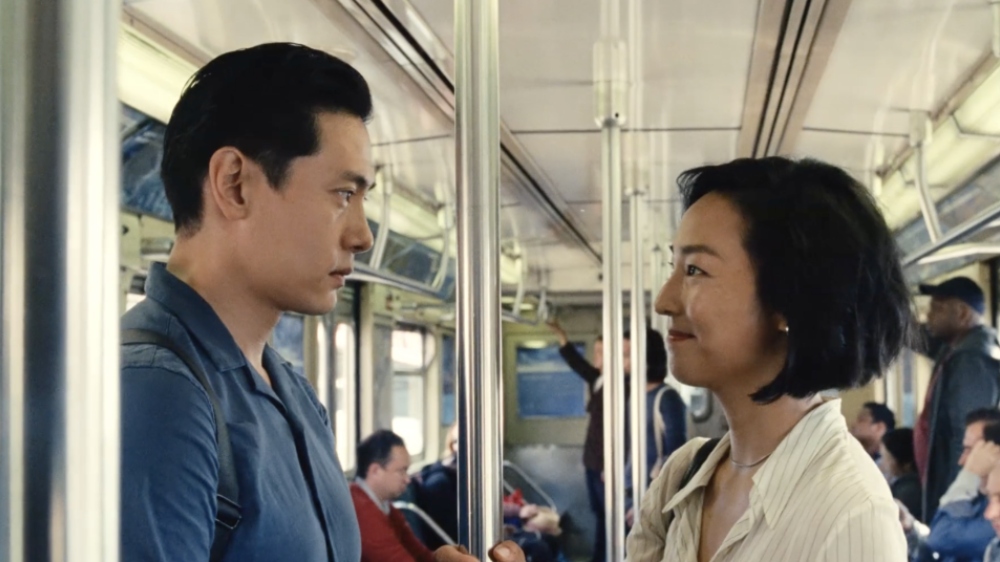
Past Lives (2023) is directed by Celine Song and stars Greta Lee, Teo Yoo, and Joe Magaro. The film follows Nora (Lee), whose South Korean family immigrates to the United States when she is just a pre-teen. 12 years later, Nora’s childhood love interest, Hae (Yoo) reconnects with her through social media. The two become regular video chat pals and eventually develop romantic feelings for one another. When it becomes clear that personal endeavors will keep the two from meeting in person for years, Greta ends the friendship to save herself from the fruitless romantic longing. The two continue their lives and Greta eventually marries an American named Arthur (Magaro). Years pass and Hae decides to visit Greta in New York. What ensues is an examination of Greta having to come to terms with a previous life that passed her by and her current life that she worked so hard to obtain.
This is a small ensemble that gives each of its three leads their time in the sun. They all take advantage of the opportunity and display a lot of complex, mature, and realistic emotions. However, the focus on realistic and somewhat ordinary characters causes the performances to feel a bit safe. Effective, but safe. Greta Lee gives a performance that’s muted, but extremely enticing. She just has this sort of inviting and loving nature that makes you buy into the idea that she’s worth being the center of a love triangle. If the audience is falling in love with the belle of the ball, then you can safely bet that the performer is doing something right. Teo Yoo as Hae is likewise extremely muted, but this feels natural to his character. His strict Korean upbringing shows, creating a good juxtaposition between himself and the other two characters. He’s also able to nicely differentiate Hae’s younger self from his slightly older self. The character ages, but I felt the aging through his actions as opposed to his appearance. The real unexpected character was Arthur (Magaro). The film subverts your expectations by initially presenting him as your typical distant and underwhelming husband character and then flipping that impression on its head by revealing more about who he truly is as a person. For example, the film uses typical visual cues of a lazy husband such as him playing video games whenever she’s not home. The thing is, it’s just a red herring. He’s not lazy or distant, he’s just normal. When he shows depth, it’s completely unexpected yet believable. Also, why does Hollywood have such a vendetta against video games? Calm down, your audiences cross over more than you think.
What’s impressive about Past Lives is its ability to tell two equally strong love stories that fold into each other in ways that rarely conflict but constantly intersect. I’ve had so many problems lately with films that present adult characters who immediately act in immature ways. Past Lives completely avoids this modern trope and presents characters who act like adults whenever possible. Granted, this does eliminate an element of explosive drama, but it feels like a fair trade. There’s a real lack of conflict, but the film seems more intent on realism than spectacle. This is undoubtedly a “show as opposed to tell” kind of movie. We know exactly how the characters are feeling without them having to expressly tell us through dialogue. This is likewise done through its cinematography which consistently hammers home its themes through well-planned images. Because of this, it tends to move at a snail’s pace. However, I was less annoyed than I would have been seeing as the film still feels well-edited when considering the massive period of time that the story covers.
The film comments on the idea that true and lasting love is more about being where you fit as opposed to having exactly what you’ve dreamed about. Love may not always look perfect, but who said it should? This is supported by Greta’s conversations with Hae (whom she seems to be longing for) and Arthur (Who she seems to love, but not as passionately). Her conversations with Hae are awkward but interesting while her conversations with Arthur are more combative but comfortable and nuanced. It makes clear the difference between infatuation and true love. If all love looked the same, how could we ever tell the difference? This is also a film about getting closure and how important that can be in any context. It’s unfair to not let someone know where they stand in your heart. Especially in a romantic context.
The film has a very strong beginning and end. The movie opens with a scene that is contextually reframed by the end of the film. It works so well because it hammers down the theme of the complexity of love. The film also doesn’t present this as the big twist of the film. It’s just a little cherry on top that added to a great ending. Among others, It lands on the idea that people truly become different over time, but that doesn’t mean those earlier versions of ourselves never existed. A memory should be cherished as it is, not what it could’ve been or led to.
Overall, this is a strong love story that plays into realism more than most films would dare. It tells an honest tale of modern immigrants while also exploring complex ideas of cosmic fate. It takes full advantage of the New York City setting and feels akin to something like Richard Linklater’s Before Sunset (2004). My big problem here is that there is a real lack of drama. No one even gets flustered. This is necessary to the film’s DNA, but I couldn’t help that feeling a little bit of explosiveness/drama would’ve helped the film’s impact. This is a pure romance through and through, so stay away if you’re not into softer, more contemplative films. For any kind of cinephile, this is an easy B

 The Movie Matt