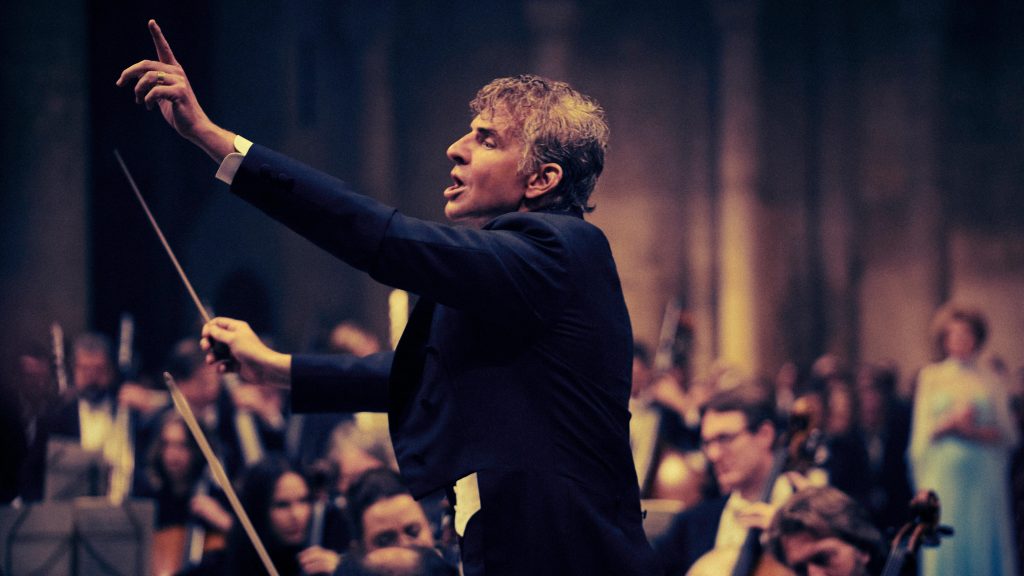
Maestro (2023) is directed by Bradley Cooper and stars Bradley Cooper, Carey Mulligan, Sarah Silverman, Maya Hawke, and Matt Bomer. The film follows the life and times of legendary musician/composer, Leonard Bernstein. We follow him in his early days as he falls in love with actress, Felicia Montealegre. Bernstein’s eccentric way of life leads to struggles with family, identity, fame, and sexuality. In his later life, Bernstein has to come to terms with the revelations of long-kept secrets as well as how his eccentric personality/life has suffocated those closest to him. This is all wrapped around the idea of how Bernstein’s life directly inspired his art.
Bradley Cooper gives one of the best performances of the year, completely transforming into Bernstein. And it doesn’t just feel this way because of heavy prosthetics or a changed voice. He embodies the role in a way that feels genuine. I sometimes found myself forgetting that Bradley Cooper was even performing. I felt as if the character was so well-formed that I often believed it was the real Leonard Bernstein. Cooper apparently spent six years preparing for this role, and I feel as if that work paid off.
Carey Mulligan is likewise fantastic as Felicia and holds her own against Cooper’s larger-than-life performance. A few of her monologues, especially ones that occur in the second half, are some of the most effective moments the film has to offer. I also found the complicated chemistry between Cooper and Mulligan to be extremely effective. There’s not a single moment where I didn’t buy that the two are deeply in love. Granted, this love is complicated and unique. Besides the wonderful acting, I feel that this complex portrayal of love made it feel all the more authentic. The rest of the cast is serviceable but doesn’t receive much focus. This is strictly a film focused on Leonard and Felicia.
The movie truly is a film historian’s treat. There are endless subtle references to classic films or filmmakers, but none of them feel forced. They feel natural to the era and setting. Likewise, a good amount of the score is Leonard Bernstein’s music. I felt that this was a smart choice. When a film focuses on a legendary musician, why wouldn’t their music be used? I’ve seen a couple of musical biopics that refuse to use the subject’s music and I’m still scratching my head about it. The haunting piano of Berstein’s music elevates a good chunk of the emotional sequences.
The early portion of the story is shot in the style of classic B&W films. But it goes beyond just being B&W. It also uses the styles, techniques, and tones of that era. It was a novelty that I felt was likewise effective and naturally irresistible. It also has a nice thematic meaning in the sense that Bernstein’s sexuality was never black and white. When the film switches to color halfway through, Bernstein is meant to come to terms with this aspect of his life. It also signals a tone change where Bernstein’s life begins to fall apart. We have a filtered version of his life (B&W) and an honest version of his life (color). How the public saw Bernstein vs. how he was. However, the film is smart enough to show us that even the filtered version of his life still has a lot of truth to it.
The film opens with the idea that art is not about answering questions, it’s about provoking them. I agree 100% percent with this sentiment, but it almost felt like a message to the audience, telling them exactly what to take away from the film. It’s almost like Cooper wrote the script, didn’t feel like it made many clear conclusions, and put that message in as damage control. I felt like the film is more suited for the message that love, in any form, can inspire great art. We can’t explain why, but it does.
Although the film is subtle in most of its theming/messaging, I felt that certain moments were patronizingly on the nose. For example, there’s a dance sequence in the early portion of the film that features Bernstein watching male dancers practice for his latest production. The film cuts back to him in awe as he watches them dance. I just felt as if I’d seen that moment countless times. It was attempting to be subtle but was anything but that. Likewise, a few scenes of dialogue choose to tell something that would’ve been much more effective if shown. Also, it dives occasionally into pretentious territory. Characters will ramble on aimlessly about how they feel but can’t quite articulate it. They end up sounding like your local stoner who swears they have figured out the universe. All that being said, there are moments of dialogue that are extremely effective. It’s just that the quality/execution feels inconsistent. When events begin to turn sour in the film’s second half, it unfortunately falls into cliche biopic territory. Because of this, everything feels like it slows to an absolute halt. The acting remains top-notch, but it felt boring especially when considering how strong the film begins.
Overall, this feels like a worthy biopic that focuses on someone who feels truly unique and interesting. He was a man who embraced everything, even when the rest of the world wouldn’t, even if it came at the expense of those closest to him. The film has some all-timer scenes but there are not enough of them and even fewer of them that feel impactful on the larger story being told. That being said, it features one of the best performances and directorial efforts of the year by Bradley Cooper. I just wish he could’ve brought things home a bit better in the film’s back half. B

 The Movie Matt