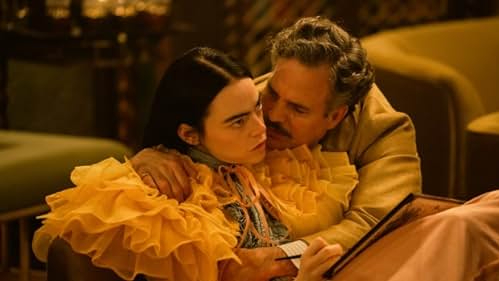
Poor Things (2023) is directed by Yorgos Lathimos and stars Emma Stone, Mark Ruffalo, Willem Dafoe, Ramy Youssef, Kathryn Hunter, Jerrod Carmichael, and Christopher Abbott. The film follows the story of Bella Baxter (Stone) who is one day created in the lab of Dr. Godwin Baxter (Dafoe). Godwin is a Frankenstein-esque surgeon who finds the dead body of a pregnant woman who committed suicide. Godwin proceeds to remove the brain from the dying baby and place it inside the head of the dead mother. Alas, Bella is born. As Bella’s intelligence increases, so does her autonomy. When suave aristocrat Duncan Wedderburn arrives and sweeps Bella off her feet, the two begin a journey to see the world. As Bella learns more about herself and the world, she realizes that her entire life has been guided by others. Bella sets out to follow her own dreams and desires, much to the chagrin of the men in her life. What results is an intense journey of self-discovery. Unfortunately, the social misunderstandings that Bella creates may bring her more trouble than she was expecting.
Emma Stone’s performance is really impressive here. Physically, both sexual and otherwise, I haven’t seen a performer go to the lengths that Stone reaches. This is a character that is meant to develop throughout the film. Not just emotionally, but physically as well. We see intelligently paced changes in both aspects. Her movements slowly become less wooden. Her voice slowly becomes more clear. Her thoughts slowly become more complex. Keyword here is “slowly.” There isn’t some montage scene halfway through that shows her learning. We get a natural progression. This is important because this progression is one of the driving forces of the plot.
Willem Dafoe as Dr. Godwin Baxter is a particularly wacky character. Almost as if Dr. Frankenstein began experimenting on himself. He wears heavy prosthetics and provides the film with a healthy portion of its fantastical tone. The thing is, I don’t think Dafoe does much that’s interesting in an acting sense. Most of the flair here is provided by the costumes and script.
Mark Ruffalo is the real standout and is the source of some of the biggest laughs the film has to offer. The character is mostly a dick, but we forgive him because he’s so simple and innocent. He’s a slave to his emotions in the way 13 year old’s are, but it matches perfectly with Bella. We believe this character and his relationship with Bella because only a person who doesn’t know any better would run away with a guy like this. His aristocratic voice almost seems faked, but adds to this idea that his character is kind of a fraud. It’s also quite naturally funny.
Other performers such as Ramy Youseff and Christopher Abott are impressive, but don’t get too much to do. Youseff is heavily present, but plays one of the only “normal” characters. The performance gets buried under the flamboyant leads. Abbott is fun, his eyes giving the necessary darkness his character requires.
What initially struck me about the film is its use of almost storybook-like cinematography. A fish eyes lens is consistently used to create this feeling of watching the story from another world. There are shockingly violent images that are mixed with bright and whimsical ones. It creates this tone of dark fantasy that I felt was entirely unique and strange. This balance of tone is exhilarating, but doesn’t always work. The characters are meant to be taken seriously but also laughed at. It doesn’t always mesh for me. I sometimes had a hard time taking anyone’s concerns seriously simply because our protagonist doesn’t take many things seriously. The movie is a lot of fun, but this hurts the emotionally effective side of things.
A main theme here is autonomy. More specifically, women’s autonomy. Even more specifically, women’s sexual autonomy. There’s a real exploration here of Bella’s sexual awakening. Bella never seems to understand romantic/sexual exclusivity and therefore tests the sexual waters in any way she desires, regardless of societal response. This romantic cluelessness drives a lot of the conflict. Bella just “does”. She hasn’t lived long enough to know what consequences are. In that way, this makes Bella very relatable. Humans usually don’t learn their lesson until after they’ve already messed up. The fun part is, very few of these themes slap you across the face in a pandering way. They’re just naturally baked into the story being told. Once again, I don’t want to be told what the lesson is, I want to find it myself.
I always talk about balance being important in films, and this film displays that. One of Bella’s arcs is realizing that life is about the good and the bad. You can’t have one without the other. When Bella first finds freedom, she does only the things that make her happy. When something is unpleasant, she doesn’t know how to handle it. She thinks the world is out to get her. When we finally get to a point where she begins to understand, her character is fulfilled. There’s also a balance here in execution, not just theme. For example, Bella begins working at a brothel at one point in the film. This is typically known as an immoral and dark establishment, but this is precisely the place where Bella finds solace. Dark elements are balanced by unexpected positive ones. The last example of balance has to do with the theme of changing the world vs accepting things for the way they are. The movie argues that we need a balance of both.
Overall, this is a strange film that is hard to recommend. That being said, if you are up for its eccentricities, I think you will find this a deliciously original experience. The performances are daring, the visuals are stunning, and the direction is one of a kind. If you’ve seen any of Yorgos Lathimos’ other films, those would be a good gauge of whether or not you’ll enjoy Poor Things. If anything, see the film for the irresistible world it’s able to create. It’s just often a little too strange for my personal tastes. B

 The Movie Matt