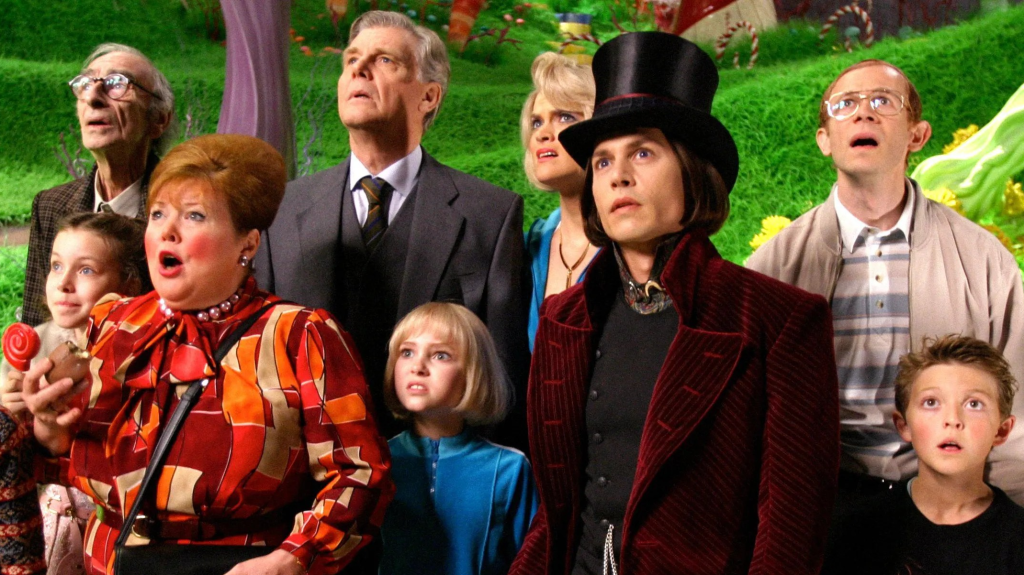
Charlie & the Chocolate Factory (2005) is directed by Tim Burton and stars Johnny Depp, Freddie Highmore, David Kelly, and Christopher Lee. The film follows the impoverished Charlie Bucket as he searches for one of Willy Wonka’s five golden tickets. A golden ticket awards the finder a once and a lifetime opportunity to tour Willy Wonka’s mysterious chocolate. Wonka closed the factory some years prior in order to stop competitors from stealing his secrets. When Charlie finds the final golden ticket, he feels as if all his dreams have come true. Though, when Charlie arrives at the factory, he realizes the other children will stop at nothing in order to win Wonka’s grand prize. What ensues is a journey through Wonka’s otherworldly factory where the naughty children are exposed one at a time. The question is: What are Wonka’s intentions?
What I really appreciated about Depp’s performance here is how distinctly different it is from Gene Wilder in the original. When remaking a bonafide classic like Willy Wonka & the Chocolate Factory (1971), it’s important to avoid sticking too closely to the original. It would be impossible to outdo, so why even try? Instead, a filmmaker must use it as an opportunity to update or reinterpret the source material. Burton and Depp take this approach, and it results in the film being able to avoid the shot-for-shot remake syndrome of films such as Gus Van Sant’s Psycho (1998). This is partly helped by the fact that this film sticks a lot closer in certain ways to Roald Dahl’s source material. Simultaneously, the film is less accurate to the source material in certain ways. Whatever the original portrayed accurately, this movie changed. Whatever the original changed, this movie portrayed accurately. It really is a good compare and contrast case study. Depp’s portrayal of Wonka here leans far more heavily into the character’s socially awkward traits. Whereas Wilder in the original seemed annoyed because he was distrustful, Deep seems annoyed simply because he’s scared of social interaction in general. For example, the character has these goofy notecards every time he doesn’t know what to say. Wilder’s Wonka seemed like the opposite, completely off the cuff and unafraid to fire back. None of this particularly hurts the character, I just noticed that some of the witty comebacks weren’t as funny simply because they were just so awkward and strange. I almost had the feeling Deep was trying to channel Michael Jackson (which is pretty strange). That all being said, I do think the portrayal is still flamboyantly funny enough to do justice to the original.
Freddie Highmore as Charlie does the job nicely. I don’t think this is a particularly complicated character to portray, but Highmore is well-cast and gives off that skinny, nice kid look that the role requires. The rest of the cast is serviceable and update their characters nicely for the modern day. Though, I did feel as if there could have been a few more creative updates for some of them. It really stands out when half of the characters are changed dramatically while the other half don’t seem to have been given any changes whatsoever.
One small role that really stands out here is Christopher Lee as Willy Wonka’s estranged father. When Willy was a child, his dad refused to allow him to eat candy. Lee is perfect casting for this cartoonishly evil role. Though, the character allows the film to have a surprising amount of heart in its climactic moments. It was an element I didn’t know I needed.
One of the biggest successes here is the perfect marriage of Tim Burton’s distinct visual style and Roald Dahl’s whimsical source material. To me, this is kind of a match made in heaven. The production design is carnival-like but balanced by Burton’s trademark dull tones. But unlike this year’s Wonka, the elements of fantasy are relegated exclusively to Wonka and his factory. I criticized Wonka recently for having the entire outside world steeped in fantasy. What’s special about Wonka’s factory/chocolate if the entire world outside is equally as magical? I feel that the dichotomy between our world and Wonka’s world is an important element in making things feel truly magical. Speaking of magic, I think the film suffers slightly in this department due to its heavier (comparatively) use of CGI. That being said, I think the CGI here is really controlled compared to most modern blockbusters. There are still an impressive amount of practical sets which helps to balance the visuals.
In the 1971 version, we didn’t really receive much backstory for Willy Wonka. It provided the character with a good amount of mystery. In a way, this mystery is one of the reasons the character is so compelling. Here, we get much more backstory that includes Wonka’s childhood as well as some of his previous chocolate-related escapades. Although it does take away a small amount of mystery, I never felt like it was overkill. Likewise, we get a bit more characterization of Charlie’s family. Each family member feels unique in ways that the original was unable to achieve. Unfortunately, this is seemingly at a cost. The film spends significantly less time leading up to the moment where the guests enter the factory. What this results in is us not getting to spend a lot of time getting to know Charlie or Grandpa Joe. Likewise, they take a large backseat while on the tour. Until they are the last ones left, the audience sort of forgets they’re even there.
One element that was also distinctly different from the original was that the misfortunes of the child characters are much more dark. You truly feel that each character is going to die. Granted, that doesn’t happen, but everything feels a little more dire in general. It also seems implied in this version that Wonka has carefully planned the demise of each child. Or, at the very least, is testing them each in some way. This adds yet another small element of darkness that the original lacked.
The film’s weakest element has got to be its music. The Oompa Loompa songs take center stage here, but they all feel modernized in a way that feels cheap. Almost as if there was a template for “modern” that each song had to follow. They feel restrained and this results in them feeling truly forgettable. Actually, I found myself being quite annoyed by the music. Likewise, the updated technological score is a complete deterioration.
Overall, this is a worthy remake that has the bravery to try some new things. Likewise, it’s smart enough to provide us with elements of the beloved source material that the original film lacked. Johnny Depp’s performance doesn’t always succeed, but it’s forgivable in the sense that he tries something completely out of the box. Burton is the perfect visual choice for directing duties and he finds a way to recapture the whimsical, child-like magic that makes this story so unique. The film also takes a different direction in its climax that was both completely unexpected as well as emotionally effective. Where the film fails is its weak use of music and tendency to be zany simply for the sake of zaniness. The situation is already inherently zany. Wonka adding more zane on top of that just feels like overkill. If you’re a fan of this story in any way, I can’t imagine you wouldn’t find something to like here. I think most people who knock this movie just have such a blind attachment to the original. Is it a lesser film? Yes. Is it bad because of that? Absolutely not. B

 The Movie Matt