SPOILER FILLED
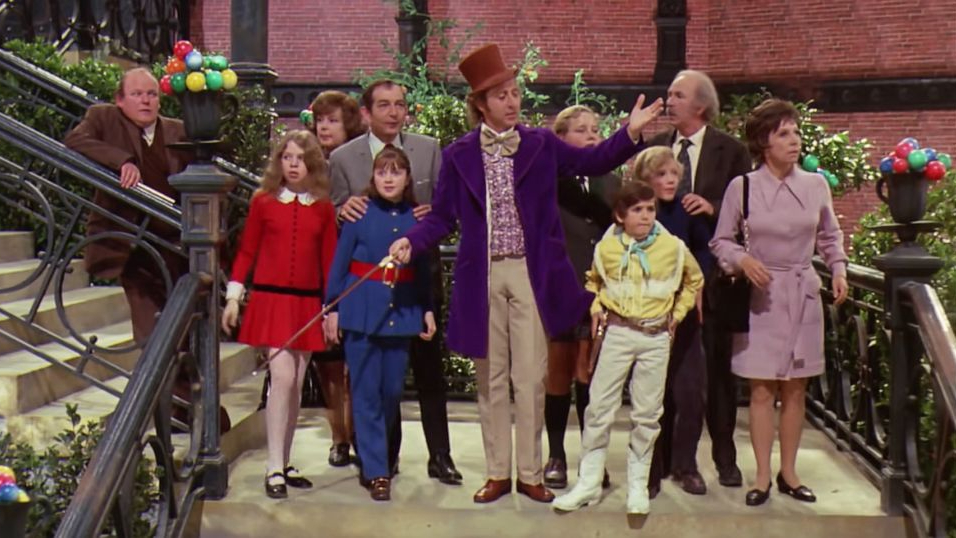
Willy Wonka & the Chocolate Factory (1971) is directed by Mel Stuart and stars Gene Wilder, Peter Ostrum, and Jack Albertson. The film follows the young Charlie Bucket (Ostrum) as he lives his life in 1970’s England. He stays in a small shack with his mother and four grandparents. They are on the verge of starvation, but still seem to maintain a positive attitude. When a legendary but reclusive chocolatier named Willy Wonka (Wilder) announces that he will open his factory to 5 lucky guests, Charlie is immediately filled with hope that he could be one of them. In order to win the contest, he must find 1 of 5 golden tickets hidden inside various Wonka chocolate bars. The thing is, Charlie doesn’t have any extra money to buy chocolate with. In a stroke of magical luck, Charlie finds a coin lying near a sewer. He decides to buy himself a Wonka bar and against all odds finds the final golden ticket inside. On his way home, he is approached by the spine-tingling Mr. Slugworth who offers Charlie a significant amount of money to steal Wonka’s recipe for the “Everlasting Gobstopper.” Charlie is allowed to bring along one guest and decides to bring along his grandpa, Joe (Albertson). When Charlie and Grandpa Joe arrive at the factory, they quickly learn that the other guests are all other children whose personalities range from clueless to downright maniacal (it is shown that they were likewise approached by Slugworth). We quickly learn that Willy Wonka is even more eccentric than people already thought. His factory is wacky and seemingly defies all laws of reality. One by one, the children begin to endanger themselves due to their own shortcomings/dishonesty. Charlie must navigate Wonka’s otherworldly tour in order to make it out unscathed. The question is: What are Wonka’s intentions?
Gene Wilder is absolutely iconic as Willy Wonka. He brings this perfect mix of childlike whimsy, lunatic genius, and tired annoyance. The aspect that really interested me was this sort of tired annoyance. It really helps the character to feel more nuanced. He’s not just some crazy kid who is in the body of an adult. He actually has some subtly dark traits that are exclusive to adults. Almost as if he wanted to be a child his entire life, but couldn’t fight some of the inevitable ways humans grow up. It really supports the ending where Wonka bequeaths his factory to Charlie. It is revealed that his entire intention with the tour was to find an heir. Wonka’s tired annoyance throughout the film is caused by the fact that he believes there is no one in the world he can trust. When Charlie returns the Everlasting Gobstopper, Wonka realizes he can trust him. This feeling of isolation and distrust is something adults are more likely to develop over time. Wonka realizes this and sees it as a detriment to his candy-making. He believes it requires a certain level of childlike wonder, and he’s losing that. He really is a tragic character beneath the surface. The character succeeds at being both fun on the surface and darkly complex underneath. The performance is made all the more strong by the quality of the script. I watched this movie countless times as a child, but only now was able to pick up on more of Wonka’s subtly funny quips. He has a quick-witted response to just about everything. If you’re paying close attention, you’re sure to laugh consistently.
Peter Ostrum actually gives a really strong performance as Charlie. Like many, I’m hesitant with child actors, but Ostrum is different. He doesn’t overplay the role and really succeeds in painting a portrait of a down-on-his-luck kid.
Albertson as grandpa Joe is fun, but sometimes feels out of place in terms of his dialogue. Though, his performance is effective in terms of physicality. His facial expressions are intensely exaggerated and is constantly dancing around with nimble glee. He really is kind of the grandpa we all have or wish we had.
The various children all give fun performances as well. None of it is particularly perfect, but the characters are all unique enough to make things interesting. They’re meant to be unlikable children, and in that aspect, they succeed.
The film is very impressive in the sense that the tone is able to blend our love of sweets with our love of film. Even more so, the film almost equates the feeling you get when eating a sweet to any kind of happiness we experience. Everything from the whimsical dialogue to the musical numbers helps to support this tone of intense deliciousness. This is all balanced by a few darker moments that actually fit much better than I remembered. Granted, not everything has aged well. The idea of what was terrifying in 1971 could sometimes come off as a bit goofy to modern audiences.
Once we reach the factory portion of the film, reality consistently begins to be broken. It’s slightly out of whack with the first act, but it’s easily forgiven because it all fits the character of Wonka so well. I wouldn’t be surprised if some adult viewers believe Wonka had drugged them all before entering.
The special effects haven’t all aged particularly well. For example, when Violet turns into a blueberry, it’s clear that a bright blue light is just being shined on her face. Likewise, some of the sets are a bit less magical than I remembered. In the candy room scene, I was able to tell exactly which items were made from non-edible materials. It kind of loses a portion of its magic if you don’t believe everything is edible.
As for the musical numbers, I was torn. About half of the songs here are all-timers while I could easily take or leave the other half. That being said, none of the numbers overstay their welcome. There also aren’t very many of them. It really finds a good balance that I think keeps the movie appealing even for people who claim that they hate musicals. And it’s also tough to forget the classic “Pure Imagination” score. It’s one of the best of all time.
Overall, this is an undeniable classic with an unforgettable performance at its core. It’s a great underdog story filled with sharp, witty dialogue. When I was a kid, I was just attracted to all the candy. As an adult, the movie holds up in ways that prove this is something more than just wish fulfillment. It’s surprisingly well-paced and is only hindered by a few elements that haven’t aged well in the over 50 years since the film’s release. This is really what I would consider one of the quintessential heart-warming films of all time. A-

 The Movie Matt