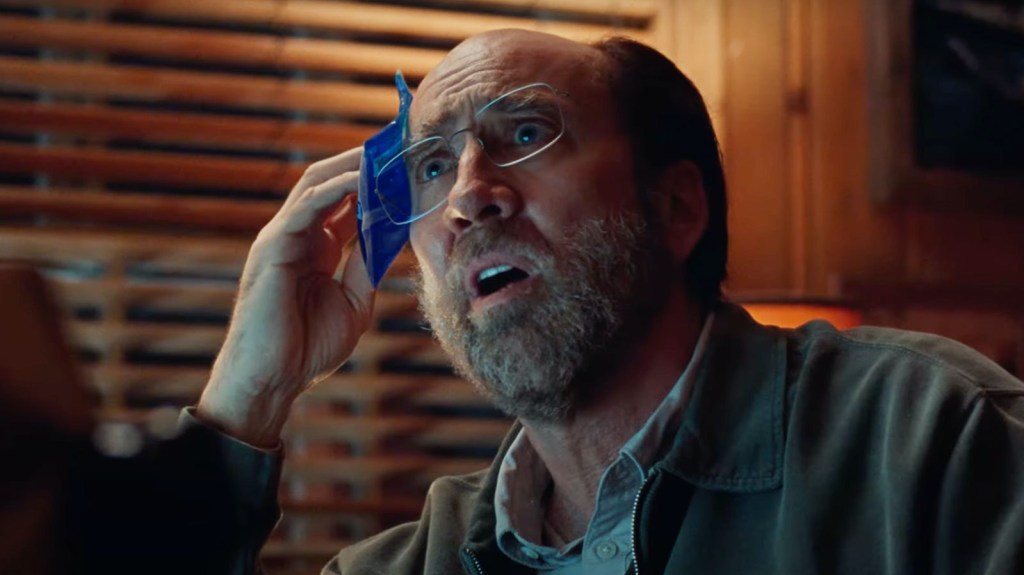
Dream Scenario (2023) is directed by Kristoffer Borgli and stars Nicolas Cage, Julianne Nicholson, Tim Meadows, Dylan Gelula, Michael Cera, and Dylan Baker. The film follows Paul, a middle-aged somewhat unimpressive college professor who finds himself at the center of a strange phenomenon that turns his ordinary life upside down. Paul one day discovers that strangers throughout the world are all having dreams where he appears, but doesn’t interact with anyone or anything in the dream. He’s just there. Paul is forced into a world of fame that he is admittedly not built for. It begins to not only strain his own psyche, but his domestic life as well. When his appearances within dreams begin to turn horrific and violent, the world begins to turn on Paul, treating him as if he is an unredeemable delinquent. The thing is, nobody seems to realize that Paul has no control over any of it. He’s as much or even more so a victim as the people his likeness is terrorizing. Paul must come to terms with his newfound situation and attempt to pick up the pieces of his shattered personal life. The film feels heavily inspired by previous post-modern Cage films such as Adaptation (2002) or The Unbearable Weight of Massive Talent (2022). The structure of Dream Scenario almost mirrors the trajectory of Cage’s real-life film career. In Dream Scenario, Paul is loved, hated, and then loved once again through cult fandom. Audiences loved Cage, hated him, and once again fell in love with him through a strong cult fandom (that eventually evolved into mainstream fandom). Just like The Unbearable Weight of Massive Talent, Dream Scenario uses our understanding of Nicholas Cage in the real world to create a story that comments on fandom, celebrity status, cancel culture, etc.
Cage is really great here, the script allowing him to display his sometimes over-the-top flamboyance while likewise allowing for a more subdued and grounded protagonist. This is achieved through the fact that Cage can appear as any version of himself while in someone’s dream. It’s all about how their subconscious wants to portray him. In the real world, Paul is dorky, awkward, and generally soft. In people’s dreams, he can go as far as becoming a maniacal serial killer. Julianne Nicholson as Paul’s wife Janet gives another nuanced lead performance. She’s able to perfectly portray the role of the wife who is somewhat bored with the marriage. Though, it doesn’t feel one-note. She seems bored but likewise still deeply in love with Paul. Reasons that she falls out of love and back in love with Paul throughout the film always seem complex and believable. Her performance really helps to support the moment that the film chooses to end on.
The film really is an exploration of being a celebrity and the horrors that can sometimes come with it. It focuses so heavily on these themes that it sometimes forgets about the inherent fun of its concept. The film presents itself as a comedy, but never seems to take advantage of a premise that could be the source of a lot of gut-busting jokes. And that’s a big problem with the film as a whole, it doesn’t seem to balance its meta-thematic messages with the comedic tone it promises. There really are very few laugh out loud moments. This wouldn’t be a problem inherently, but there seem to be multiple scenes here that are leading up to a punchline. The thing is, when we spend five minutes in a scene where the main intention is to make us laugh, we should laugh. The punchlines delivered in Dream Scenario were often disappointing or non committal to the joke. The film is also much more uncomfortable than I was expecting. With Paul being such an awkward guy and finally receiving a mass amount of attention, romantic and otherwise, it leads to some effective cringe moments. These aren’t exactly pleasant, but that seems to be the intention. The biggest flaw the film presents is the fact that it attempts to have its foot equally in three different genres. The thing is, these genres aren’t mixed together seamlessly throughout the film. Instead, there are three specific portions of the film that have different tones/genres. The film is able to transition well between these genres, but it makes everything feel less holistic. Almost like I’m watching 3 different films or 3 acts of a play. This ends up making each one of these “3 films” seem undercooked. We don’t really get enough time with any single genre for one of them to feel satisfying. Not to mention, when we reach the ending, it feels rushed in a sense because its message is out of line with the rest of the film. In simple terms, there isn’t a lot of true thematic cohesion here. The film has a lot to say, but by the end of it, there wasn’t a clear overarching lesson, message, or theme.
Overall, Dream Scenario is a film with a devilishly irresistible concept. It portrays this concept in an interesting but very grounded way. This grounded nature helps with realism, but works against the film in terms of pure cinematic entertainment value. The performances are great, but the script eventually works against them in terms of establishing their motivations and character arcs. The film isn’t always as funny as I felt it should be, but the dialogue was never wooden either. This is a really cool movie, but suffers by missing some obvious marks. The structure is frustrating and leads to a lot of loose ends. At the very least, the film is a well-made, generally intelligent satire of what fame sometimes entails. It’s just that the film needs a bit of sanding for its rough edges. B-

 The Movie Matt