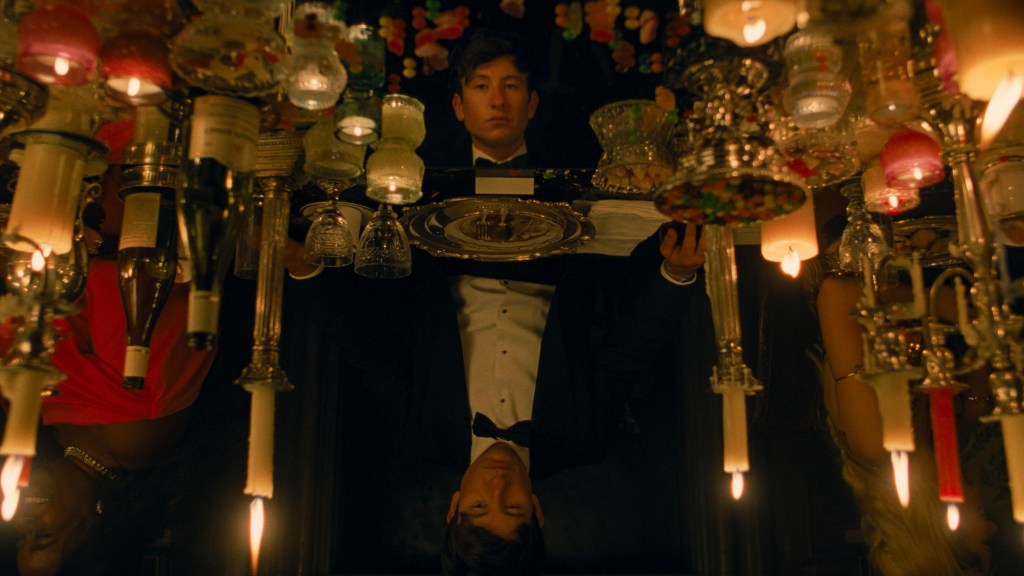
Saltburn (2023) is director Emerald Fennell’s sophomore effort after her much talked about Promising Young Woman (2020) and stars Barry Keoghan, Jacob Elordi, Archie Madekwe, Alison Oliver, Rosamund Pike, and Richard E. Grant. The film follows the brilliant but unpopular Oliver Quick (Keoghan) who quickly finds that being a successful student at Oxford University seemingly has more to do with who you know as opposed to hard work and scholastic achievement. After he by happenstance is given the opportunity to help out the intensely popular Felix (Elordi), a strong friendship is quickly formed. As the school year comes to a close, Feliz invites Oliver to spend the summer with him and his family at their beautiful castle estate: Saltburn. Throughout the summer, Oliver discovers the intense dysfunction between the family. As their privileged attitudes begin to emerge, so does Oliver’s romantic obsession with Felix. Although, this romance isn’t exclusively directed toward Felix. Oliver seems intent on seducing just about every member of the family. The question is: Why?
Barry Keoghan is really great here as Oliver, giving us one of the more complex, disturbing, and mysterious characters that I’ve seen in awhile. The character is really interesting, but revealing too much would lead to major spoilers. The film initially presents Oliver as your sort of typical awkward but extremely intelligent bookworm. Although this is true, the film does the uncommon thing of also quickly presenting him as a formidable presence. He’s smart, but he also isn’t weak. He doesn’t take anyone’s crap and is surprisingly quite smooth with the opposite sex. This character is really authentic quite simply because he’s not a cliche. Elordi is also quite good here, giving us a portrait of someone who has an extremely kind heart but is often influenced by extreme privilege. The rest of the cast is quite strong as well, but they never quite get the chance to reach the heights of the two leads.
This is quite an uncomfortable film at points. It deals with things such as romantic/sexual manipulation and I can see that making certain audiences cringe. As well, the film displays absurd or graphic actions by characters with little to no explanation as to why they are doing so. It often gives the audience the reaction of “What the f**k?” Though, the moments are almost all given an explanation by the end of the film. In hindsight, these moments work well. The movie also does the smart thing of tricking the audience into what kind of film they’ve been watching. We think we’re watching one genre of film, but with events and reveals in the third act, it turns out we were watching something much different than we initially thought. The thing is, it works. Most films that attempt something like this feel like a cheap “gotcha”-type situation. Here, it doesn’t feel like a 180 into a completely different film, it’s more like a reframing. The film actually works better once everything is revealed. Unlike so many arthouse films lately, the ending here is actually the strongest part. It pulls the pieces together instead of ripping them further apart into annoyingly subjective territory.
The film is also quite nicely paced with a real sense of romantic tension and/or romantic doom being implied through the general tone. This all supported through the dark gothic look of Saltburn itself. The money and privilege the family has is nicely juxtaposed with the lingering fact that Oliver is just a visitor in their world and will never have anything close to what they have. This alone delivers a sense of dread to the film that is subtle but necessary for the tone throughout to parallel the dark events of the third act. The film is presented in the tight 1.33:1 aspect ratio and this really helps to have this intimate sort of romantic connection with the characters.
Overall, this is definitely not a film for the faint of heart, but a treat for film lovers who are not afraid to follow odd and challenging characters. Not everything works perfectly in terms of tone, and although the ending works as well as it could have, I don’t think it’s an ending that could ever be pulled off perfectly. If you’re a fan of thrillers, romantic thrillers, or explorations of class, Saltburn should be a treat. That being said, if the word “arthouse” sends up red flags for you, I can’t safely recommend it. B+

 The Movie Matt