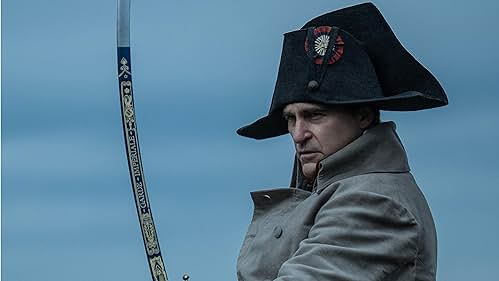
Napoleon (2023) is directed by Ridley Scott and stars Joaquin Phoenix as the titular Napoleon Boneparte. He’s joined by Vanessa Kirby as Napoleon’s muse, Josephine. The film follows Napoleon’s rise to power in the aftermath of the French Revolution. We are presented with Napoleon’s militaristic prowess as well as his somewhat complicated personal life. Achieved is the portrait of a man who is powerful, but seemingly compensating for something. The idea of “Napoleon complex” is perfectly displayed within the character. Napoleon is a somewhat standard historical character study, but thankfully never dull. The film is a mixed bag of imbalance that sometimes supports the themes but oftentimes just causes the film to feel as if it lacks cohesiveness.
Phoenix’s performance is the first example of this imbalance. The personal half of Napoleon is quirky and quite awkward. Phoenix nails this part of the character. When Phoenix attempts to portray the more capable side of the character, things feel undercooked. He mumbles often and comes off as quite wooden. This isn’t a bad thing on paper, but the two sides of the character never quite blended in any significant way. It almost felt as if it was two different characters entirely. Vanessa Kirby has great screen presence as Josephine and I really think that she is becoming one of those actresses that has the ability to elevate most of her roles. Where the film lets the character down is the script. We never get much true insight into what motivates her or what she truly desires. By the end of the film, it’s clear how much Napoleon loves Josephine, but we never really receive any insight into whether Josephine truly loves Napoleon. This may be an attempt to place the narrative firmly from Napoleon’s point of view, but it breaks this viewpoint countless other times. This made me wonder why we didn’t break his perspective more often in order to flesh out Josephine. This would in turn make the romance as a whole more effective. And because the romance is such an integral element to both Napoleon and the film as a whole, it would’ve improved the entire film significantly. The focus here should’ve been much more balanced.
The battle scenes you can tell are created by a true master of the genre. Ridley Scott’s experience with these big sort of period-piece epics he has become accustomed to throughout his career really shows. The thing is, the imbalance shows once again. There aren’t exactly an excess of battle scenes, but we spend sometimes up to thirty minutes with each one. These scenes are then followed by thirty minute sections that cover years or sometimes even decades of Napoleon’s life. The moments that should be fast are dwelled on while the moments that need to breathe are completely rushed. The pacing is completely out of whack.
The film is also oddly comedic throughout. This helps to make the film feel more entertaining moment to moment, but once again sacrifices balance. The amount of comedy is fun but completely sacrifices a majority of the dramatic tension that would otherwise be there. Napoleon by result feels less formidable in action than I felt he should.
Strangely enough, I’m mixed (or “imbalanced”) about the imbalance of the film. This imbalance is the film’s biggest flaw but likewise lends itself to some of the film’s biggest strengths. The comedic tone sacrifices drama but likewise causes the film to seem more instinctually entertaining than most historical 3-hour epics that present their story with a completely straight face. The battles are strangely focused on, but this also helps in breaking up the monotony of the more dialogue driven scenes.
Overall this is a flawed film that mostly follows the genre template but breaks the mold just enough to give us the pure entertainment that similar films have seemed to lack lately. I think this is one of those films that you know if you’re going to like or not by the subject matter alone. If you’re interested in Napoleon, the film mostly delivers. If you’re on the fence or not a huge fan of the genre, skip it. It’s kind of one of those films that you should just take at face value. B-

 The Movie Matt