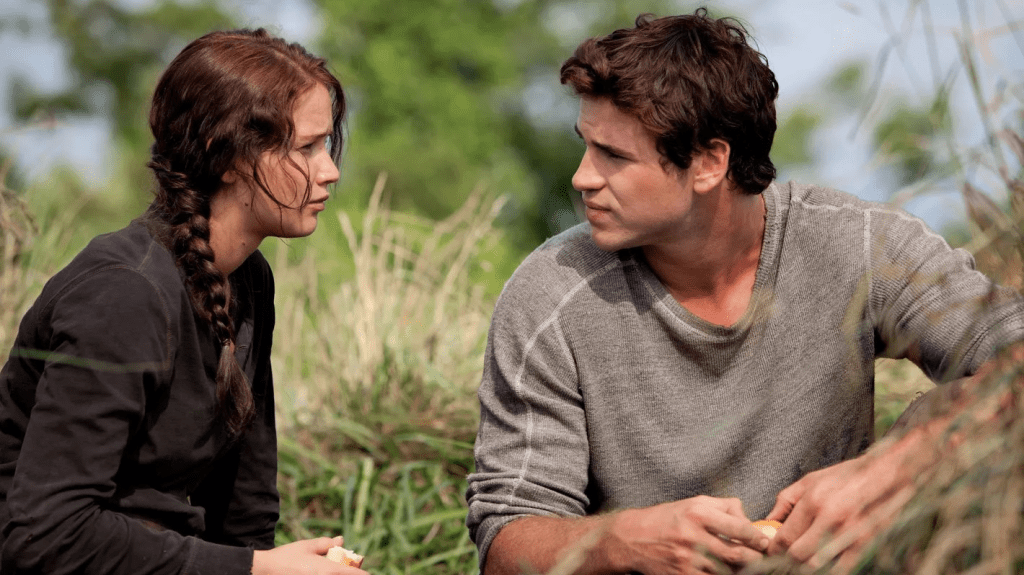
The Hunger Games (2012) is directed by Gary Ross and stars Jennifer Lawrence as Katniss, Josh Hutcherson as Peeta, and Woody Harelson as Haymitch. Rounding out the cast are actors such as Donald Sutherland, Liam Hemsworth, Stanley Tucci, Elizabeth Banks, Amandla Stenberg, Alexander Lugwig, Isabelle Fuhrman, and Jack Quaid. The story follows Katniss Everdeen who lives with her sister in the impoverished District 12. Each year, an event known as “The Hunger Games” takes place. Two “tributes,” one male and one female, are selected from each of the twelve districts to take part in a televised fight to the death with only one survivor. When her younger sister is selected as tribute, Katniss voluntarily takes her place. Katniss must use her few applicable skills and newfound friendships to hopefully make it out of The Hunger Games alive. The film is based on the popular series of YA novels under the same name. The books were written by Suzanne Collins and exist as a trilogy of books next to the 4-film series. I was born at the perfect age to experience the fandom of The Hunger Games books. I was a little too young to experience the craze of Harry Potter when that was at its peak, so The Hunger Games was really the first time I experienced that level of fandom in terms of a book series. That being said, I was never really interested in The Hunger Games as much as my peers. I only read the first book and this first film is the only one that I remember. In hindsight, that seems really odd considering the fact that this is exactly the type of entertainment I craved at 14 years old. Before viewing The Hunger Games: The Ballad of Songbirds & Snakes after its release this Friday, I wanted to go back and revisit the original run of films. The Hunger Games succeeds at being a faithful adaptation of Suzanne Collins’ book while also delivering on the story’s inherently cinematic concept.
The movie begins against a blank screen with a cliche written exposition dump. Admittedly there is a lot of exposition that the film needs to cover, but this should have been done through things such as visuals or at the very least dialogue. The title card exposition approach just feels simultaneously hurried and lazy. The film then picks up with an extremely effective inciting incident that quickly attaches the viewer to the story. When Katniss volunteers as tribute, we immediately understand the hopelessness of her situation, her love for her sister, and her general bravery. And this bravery isn’t presented in a cheap, gimmicky way ala The Marvels. She doesn’t have to signal to the audience “Look at me! Wasn’t that brave? I did a brave thing because women do brave things too!” I agree! Why don’t you tell me again, Disney? Katniss just does brave things because she’s brave. It’s as simple as that, no winks and nods to the audience, no feminist, meta in-jokes. Just a strong female character being who they are. That, in my opinion, is far more feminist than any pandering, message-based movie that has recently claimed to be “feminist” (Excluding Barbie for the simple fact that feminism seems to be the clear and main message of that film. In other words: “It fits”). I don’t understand why blockbusters haven’t been able to get this right for nearly the last decade.
The film quickly establishes the palpable feeling of a dark, grimy dystopia where even the most wealthy exude a shadow of grime. It really feels akin to the visual style in John Hillcoat’s adaptation of Cormac McCarthy’s The Road (2009). The subtle score that is a mix of whistles, dooooos, and dummms also supports the eerie tone.
The leadup to the actual Hunger Games portion of the film is extended but necessary. It takes about an hour, but I never found it boring in any way. The film really needs this portion, because once the games begin, there really isn’t much down time for building/establishing characters. Also, this establishes stakes which in turn give the game its’ necessary level of edge-of-your-seat excitement. The film also features a YA love triangle subplot that I felt was forced. It really stood out as a clear YA element when nothing else did. That being said, the romance isn’t so bad that it’s cringe-worthy. It also brings stakes to the plot in more ways than just its effect on an individual character’s heart.
The cast here is for the most part really effective, only being hindered by sporadically awkward dialogue. This is most apparent in the early conversations between Katniss and Liam Hemsworth’s Gale. I think this comes partly from the script but also the fact that we don’t fully understand Katniss and Gale’s relationship (and I don’t think the writers did either). We are thrust immediately into their seemingly long relationship, and it’s not even clear until later in the film whether it’s romantic or not. Then, we don’t follow up or get any kind of closure for the remainder of the film. I expect all of this to be expanded upon in the sequels, but it makes this specific film feel less whole. The best entries in a continuing story are the ones that work equally as a serialized part of the franchise but also as a great standalone film. The Hunger Games comes close to achieving this, but it didn’t provide at least enough temporary closure on certain elements. Besides those rough early scenes, Jennifer Lawrence gives a very human performance that is subtle at times, but always feels authentic and charismatic. It gets consistently better as the film moves along. Josh Hutcherson is loveable as Peeta, giving off the proper teddy bear energy. As the flamboyant Effie Trinket, Elizabeth Banks does her best impersonation of Dolores Umbridge from the Harry Potter series. Woody Harelson has fun as former winner of The Hunger Games turned broken-down alcoholic, Haymitch. Donald Sutherland is effectively sinister in his small role as President Snow, making me hungry to see more of him. Most impressively though, Alexander Ludwig stands out in his role as Cato. He gives off the perfect “captain of the football team” energy. Except instead of tossing touchdown passes, he’s manically killing teenagers. He is the reason we get one of the most significant thematic monologues throughout the film, helping to hammer home the themes of oppression and control.
The film has an undeniably irresistible concept with its “battle royale” formula. Although Kinji Fukasaku’s Battle Royale (2000) was the first and still one of the best in the genre, I credit The Hunger Games with popularizing the concept on a large scale in the USA. This can be seen in the recent mass popularity of battle royale style video games such as Player Unknown’s Battlegrounds, Fortnite, and Call of Duty: Warzone.
The violence of the film is shot in a shaky-cam style that aids in intensity and speed, but is impossible to follow. This may be a choice to hide some of the more R-rated violence, but I feel they could have done so without giving the viewer a headache. Another element that didn’t particularly work for me was the sort of inconsistently fantastical ways in which the technology is used. The tech is futuristic, but sometimes begins to feel magical, which betrays consistency. Also, a pack of crappy-looking CGI dogs in the climax reminded me of the awful-looking demon dogs from Ghostbusters (1984). Peeta’s use of camouflage throughout the film is patently absurd. I can’t be the first person to point that out, can I? I know this takes place in a fictional dystopia, but the film establishes nothing to get me to believe that Peeta can create perfect camo out of random outdoor items because he “used to decorate cakes”. I know people can make some pretty real looking cakes, but they need some frosting at least! My last fault has to be the fact that the film ends on a pretty predictable note. From the moment they introduce the fact that there can only be one winner, it seemed obvious that they would subvert that claim in some way. Especially after they present Peeta as such a loving and likable character. If this was Game of Thrones, I would’ve felt that he was truly still in some danger, but this is a PG-13 movie based off of a YA novel. Surprising deaths of main characters don’t seem to happen too often in the genre. The movie constantly plays with you in terms of whether they can both make it out alive. The thing is, the more they played with me, the more I knew they weren’t going to kill either of them. This would’ve been a real gut-punch of a way to end the first chapter, hammering home some of the dark themes and setting up strong stakes for the next installment. Instead they use what I call “predictable subversion.” In a sense, they subvert the expectations they THINK the viewers have as opposed to the expectations they actually have.
Overall The Hunger Games is an effective thriller for all ages that avoids most of the pitfalls of weaker young adult material. It does suffer from a few weak technical and writing elements, but manages to succeed much more often than it fails. The film is paced well and the characters are strong, but it slightly struggles as a stand-alone story. Too many thematic elements are left hanging while the film’s main focus seems to be showing off the compelling Hunger Games concept. This is a very well-made film that is both exciting and original. I enjoyed this film much more than I remember, leading me to believe this is one of the better young adult dramas in circulation. B

 The Movie Matt