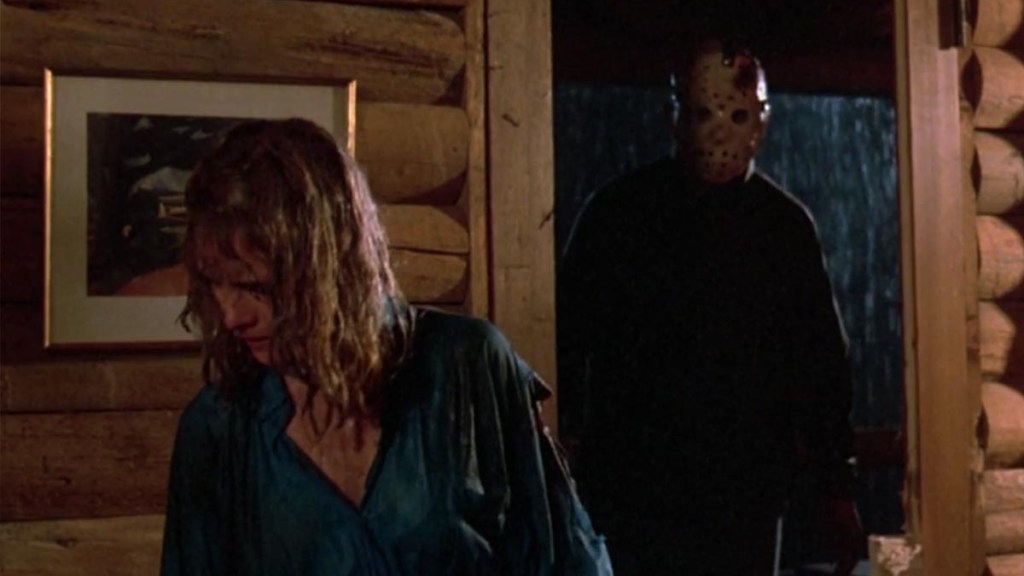
Friday the 13th: The Final Chapter (1984) was directed by Joseph Zito and stars Kimberly Beck as final girl, Trish Jarvis; Ted White as the titular Jason Voorhees, and Corey Feldman as Jason’s arch nemesis, the adolescent Tommy Jarvis. This is the fourth Friday the 13th film and is considered by many to be one of the strongest if not the strongest film in the franchise. This October, I decided to revisit the franchise after considering that along with bits and pieces of various sequels, I had only seen the original film one time. It seemed like the best time to view the films in the chronological order in which they were intended to be seen. The first three films in the franchise deliver on exactly what the audiences wanted out of a Friday the 13th film, but not much else. The franchise often is criticized for being about two things: sex and kills. Although that’s not fully true for this fourth film, it is undeniably true for the first three films in the series. Friday the 13th: The Final Chapter is able to take the simple formula that audiences loved so much about the first three films and elevate it in simple and effective ways.
One of the first things I appreciated about this as a student of the slasher genre was the film’s pacing. It’s morbid to admit, but I would put money on the idea that most fans of the Friday the 13th franchise come to these films in large part to see the various creative kills. The Friday the 13th movies provide this in spades. There doesn’t seem to be a single fifteen minute stretch in any of these films where someone isn’t getting axed off. Friday the 13th: The Final Chapter perfects this pacing partly because of the varying and creative ways in which the characters are killed or set up to be killed. Also, I think the kills are just generally more effective overall when compared to the previous films in the franchise. This is because the characters are more fleshed out than they’ve ever been. That being said, the Friday the 13th franchise has never really set a high bar in terms of the complexity of its characters.
For example, The Final Chapter is not above reusing the standard franchise formula of sex-hungry teens on a cabin getaway who are eventually stocked and slaughtered by Jason. What the film does do is characterize the teens in a way where they each feel unique. Each character has some type of conflict or character trait that defines them in a clear way. The film is also efficient at doing so. The runtime isn’t longer than the previous films, but it still feels like more character development is achieved. This is all without sacrificing the kills the audience came for. It really feels like the entire streamlined package in terms of the franchise.
Partly why the film succeeds so much in the character department is the fact that the protagonists of the film aren’t the standard final girl and boyfriend combo we receive in the previous three films. Instead, we follow a single mother, her teenage daughter, and her adolescent son. This dynamic is not new in terms of cinematic tradition, but it was new up to this point in terms of the Friday the 13th franchise. This adds a layer that these films never previously had, shying away from the sometimes raunchy-feeling protagonists. It’s much easier to attach oneself to a clever and innocent child as opposed to an oblivious teen who can only focus on getting laid up until the moment the severed heads of all their friends start falling from the rafters.
There is also a noticeable step up in The Final Chapter in terms of how creative the kills are. This film boasts some of the most iconic and brutal kills of the franchise, and they are all the more effective because of the previously mentioned pacing. There are a lot of kills, but they always seem to have time to breathe from one to the next. This is also the film in the franchise where the kills begin to more often hold a darkly comedic or ironic edge. The ways in which the victims are dispatched all seem to thematically relate to that character’s conflicts or character quirks. For example, the hunter character who has been searching for Jason so he can get revenge for the death of his sister sacrifices himself to save Trish. His death is caused directly by who he is as a character. His clear character trait of caring for others is cemented in his death. In Friday the 13th films, we often learn more about a character through their death as opposed to who they were when they were alive. In a more comedic example, a character named Paul is caught in a love triangle between his girlfriend and the new flirty girl who has shown up to the party. He chooses the new girl, so his girlfriend storms out. Paul then changes his mind, goes after his girlfriend, and is then killed because he leaves the group. Paul’s infidelity and wishy-washy personality lead directly to his death. Like many kills in the franchise, this is teaching the audience a direct lesson about real-world morals. It’s just that, unlike in the real world, you get brutally murdered for being immoral. Speaking of which, the sex-crazed teenagers are another element of the film that is much improved from the previous installments. Like mentioned earlier, there are actual dynamics and conflicts between the group. There is infidelity, a guy who thinks he’s awful in bed but might not be, and a budding romance that is actually somewhat effective. This isn’t much but it’s undeniably more complex than the previous three films.
I also really liked the very controlled use of Jason here. We don’t see him much until the final act, but it doesn’t ever feel like we’re missing out on something. When Jason does eventually appear, this succeeds at making the moment a true thrill, like a messed-up version of Gandalf’s return in Lord of the Rings: The Two Towers (2002).
Although this is one of the better examples of eighties slasher fare, it’s not without its glaring flaws. Remember, this is still a Friday the 13th film and that comes with a whole lot of cinematic crap. There’s an odd off-screen kill of an important character which isn’t all that bad in itself, but it’s combined with the fact that we never get to see any kind of aftermath/confirmation. This just seemed like they forgot to shoot the scene or something. It raises too many questions to be an intentional choice. Another element that didn’t work so well was the fact that the teenager and family subplot never really seem to cross paths in any significant way. I hate to say it, but it feels like two Friday the 13th films in one. This works in terms of delivering a little bit of new and a little bit of old for fans of the franchise, but it does leave you with a feeling of disconnection between the subplots of the film.
Corey Feldman’s Tommy Jarvis is a fun character that really succeeds mostly because he’s not the type of protagonist we are used to in this franchise or even slasher movies in general. Although we don’t dive too deep into the character’s actual psyche, he is goofy and endearing enough to allow the audience to attach themselves pretty quickly. I do find it a bit distracting that the character is obsessed with making his own movie-quality horror masks. This does tie into how Jason is defeated at the end of the film, but I couldn’t help but feel like the character is partly a stand-in for the legendary practical effects artist of the film, Tom Savini. It felt a bit self-indulgent in a way that was distracting as opposed to a subtle nod to the man.
Friday the 13th: The Final Chapter contains all of the cliche elements of eighties slashers while also presenting them in the best light possible. This is the quintessential camp horror movie, but is often overshadowed by its predecessors (though they are not superior films). It’s bad taste in the best way. It delivers exactly what you want out of the genre while also breaking new ground in subtle ways that don’t distract the audience from what they came to the movie for. These elements instead elevate the film and turn it into something that is the perfect example of “good bad taste.” B

 The Movie Matt