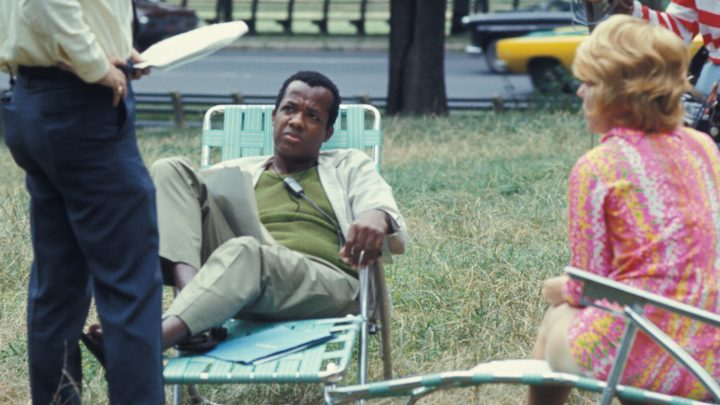
When many audiences think about the power of film, they often think about it in terms of how viscerally entertaining or visually exciting the movie is. In other words, they just want to escape from reality and not be forced to think about anything that challenges their current sensibilities in any way. However, there are other kinds of films that take a specific niche topic and dive deep into the bones of that subject even though it wouldn’t normally appeal to mass audiences. Filmed in 1968, William Greaves’ Symbiopsychotaxiplasm: Take One is an experimental documentary that focuses on the efforts of filmmaker and civil rights activist William Greaves as he masterminds a layered film experiment that begins with the filming of a movie scene in Central Park. Simultaneously, another crew films the crew filming the movie scene. Meanwhile, a third crew films the crew that is filming the crew filming the movie. Confused? Take a second… Greaves remains oblivious as his crews and conditions decay — effectively fogging the line between fiction and reality. This is the kind of film that challenges you, confuses you, informs you, humors you, and quite frankly annoys you. If you love movies and know me in any way, you know I write that as an endorsement.
Born in Harlem on October 8th, 1926; Greaves grew up with 6 siblings and 2 parents who were natives of Jamaica and Barbados. After graduating high school, Greaves studied science and engineering at The City College of New York before dropping out to pursue a career in acting/theater. Knowing the United States wouldn’t afford him many opportunities as an actor, he relocated to Canada and began studying at the National Film Board of Canada. After years of working jobs in various stages of film production, Greaves returned to the US because of an intensifying dialogue focused on the rights of African-Americans during the 1960’s. After seeing Greaves’ writing and directing work on a documentary short titled Emergency Ward (1959), he was noticed by the United States Information Agency (USIA). Along with the United Nations, the USIA hired Greaves to produce multiple documentaries focused on various subjects. (William Greaves’ Biography) Some focused on economic or political issues, while others focused on issues of race. Not long after the assassination of Martin Luther King Jr. in 1968, public broadcasting began to air a news television program titled Black Journal. This program had the goal of being produced, distributed, and consumed by the black community. When the first few episodes of the program didn’t unfold according to plan, Greaves’ duties were expanded to include executive producer alongside his role as co-host. Greaves continued working on the show until 1970. By this time he had even earned the show an Emmy. After leaving Black Journal, William decided to pursue full-time feature film-making. (Hubert, Black Journal)
From about 1972-2001, Greaves released a lineup of films that included titles such as: Ali, the Fighter; From These Roots, Nationtime, Where Dreams Come True, Booker T.Washington: Life and Legacy, Frederick Douglass: An American Life, Black Power in America: Myth or Reality?, The Deep North, and Ida B. Wells: A Passion for Justice. The latter of which was narrated by Pultizer prize-winning novelist Toni Morrison while Nationtime was narrated by legendary actor Sidney Poitier. This lineup of films perfectly displays the man Greaves was and believed himself to be. Not a filmmaker (which he was), but a civil rights leader (which he will always be). (Fillipo, 216) Greaves is important not just because he is a civil rights leader, he is important within the realm of all civil rights leaders. He used his craft to constantly fight equality and justice, not just to entertain. He looked at filmmaking as a mission (coincidentally, his biography holds a similar title), and that allowed him to shine as more than just a filmmaker. Speaking on why he decided to make films, Greaves explains:
“I became outraged at the fact that the African-American was misled by the American educational system, by the American media. I became outraged that white Americans were being misinformed about the true nature of who these people of color were. This was a very disturbing experience to me and I said to myself: ‘I should be on the other side of the camera. I should not be in front of the camera, acting and playing various roles, and speaking lines of various authors. Why don’t I get into the production area and tell the truth about people of color?” (Greaves biography, Video & Radio interviews and Filmography.)
This is exactly the kind of message Greaves would consistently deliver during his decades as a filmmaker, and his film’s were all the more powerful because of it.
Considered one of his most groundbreaking cinematic experiences, Symbiopsychotaxiplasm: Take One begins with William Greaves playing himself. In 1968, Greaves simply took his camera equipment to central park in New York City and attempted to shoot a movie. Undisclosed to a majority of his crew, he is playing a lazy, misogynistic, and authoritarian caricature of himself. He is filming a movie about a man and a woman walking through central park. Simultaneously, a second camera films the crew while a third camera films the crew who are filming the initial crew. From describing this to multiple family and friends, it has been determined that the film is much more confusing when explained in words instead of actually just watching it. As the film progresses, Greaves’ aloof undercover caricature of himself pushes his crew further and further toward mutiny. Greaves blends the line between reality and fiction by blending improvisational acting and real behind-the-scenes footage. To this day, it has still not fully been confirmed whether or not the actors/crew in Symbiopsychotaxiplasm: Part One are acting or not. (Gottlieb, Black Camera)
After completing the film’s editing process in 1971, William Greaves believed that he had made his magnum opus. His heart convinced himself that the only place it could possibly premiere was the Cannes film festival. So he proceeded to travel to France, where he presented the film to programmers. Unfortunately for Mr. Greaves, the projectionist made the deplorable mistake of showing the reels in the incorrect order. The film was then understandably turned down. Greaves must have not attended the screening, because the story goes that he came home, figured he had made a mistake, and put the film in his closet. After that, the film mostly fell into obscurity and never received a theatrical release. In 1992, nearly 20 years after the disastrous screening for the programmers at Cannes, the film was finally shown at the Sundance film festival. At the screening, the film caught the eye of filmmakers/actors such as Steven Sodenbergh and Steve Buschemi. These two quickly approached Greaves with an offer to make Symbiopsychotaxiplasm: Part 2 ½. This shows just how Greaves was able to secure funding for most of his career. He didn’t attract investors by presenting spectacle-like entertainment that would bare endless profits. He attracted investors with his love of, respect for, and experimentation with the art of filmmaking. He convinced people to spend their money to create something they cared about without needing a promise of monetary gain. He made films about subjects he was passionate about and succeeded because of it. To watch Symbiopsychotaxiplasm today, all one needs to do is pick up the beautiful Criterion Collection release and enjoy the film plus all of it’s making-of special features. (Discovering William Greaves, 2006)
So how did a low-budget, experimental, hybrid documentary-fiction film come to be known as “The greatest film ever made about filmmaking”? The film’s subject is its production, but that’s not what makes the film unique. The film’s subject is a crew filming another crew that is filming the making of a film that is supposedly being made. His addition of an extra layer creates a strong meta element allowing the audience to more deeply understand the way films are created and consumed. This is an extra layer on an already multi-layered medium. This allows for the production of the film to become its subject. Greaves is able to show the dynamics of almost every element of a film production by taking this multilayered approach. Greaves also does something key during the production: He keeps all information about his plans for the film on a need-to-know basis. As his crew is left out of the loop and become more frustrated, they begin to question William Greaves as a director. There is a scene in the film that involves members of the crew discussing the production in a clearly distressed manner. They slide back and forth between accusing Greaves of being a sub-par director and analyzing whether or not he has an ulterior motive for his non-direction. They finally end on the idea that they are intentionally part of the production in ways that they are not realizing. The moment when they address the camera/Greaves (who is not present), is the exact moment they realize that Greaves wanted conversations like this to happen all along. This conversation between the crew also perfectly mirrors the common occurrence of fans/audiences sitting around debating the merits of their favorite films. In a way, he achieves the effect of connecting the audience directly to the production of the film. He wipes away any magical filmmaking tricks, and allows us to understand what’s going on more than the people making the film (who are also the subject of the film). Greaves is a master in full control of every aspect of his film, which is his true achievement. (Knee & Musser, Film Quarterly)
More than anything else, Greaves’ film stands the test of time as an example of a film director who embodies the puppet master archetype. He keeps his intentions close to his chest and this allows him to be in control of just about anything. He purposefully sows seeds of dissent within the crew in an attempt to achieve genuine reactions/thoughts. It shows the power a director can have even when it appears as if he has none at all. He goes to great and complex lengths to create an authentic tone for not only the film as a whole, but for the production itself. He manipulates people in ways that one would never think would work. In the crew conversation scene mentioned earlier, they say that Greaves has no idea that they are filming it. They debate whether he’ll even use the footage in his film; he does and they are very important parts. It has been debated whether he achieved this control by accident or not, we’ll never be able to tell. Some claim Greaves just made a disastrous film and saved it in the editing room by making everything look intentional. Either way, does it make the film any less impressive? (Koresky, par. 2-5) Throughout his long and stirring career, William Greaves was a pioneer not only in one major way, but in two: He was an active proponent of civil rights and a filmmaker who implemented strategies that were way ahead of their time. Considered by many as his greatest film, Symbiopsychotaxiplasm: Take One takes an approach to its production that until then hadn’t been seen. The ideas of the film are presented so clearly that it allows the audience to experience not only the complexities of making the film, but also the complexities of analyzing one. Greaves made the film in a way that is rare to see nowadays. He went to a park, filmed some mediocre shots, and let the rest unfold naturally. He truly creates his film in the editing room and that shines as one of the film’s greatest achievements. Although it wasn’t widely screened until nearly twenty years after its production, it has developed a cult legacy especially within the circle of other filmmakers. It truly is an inspiring blueprint of what a great director is able to stir up in those around him. Not just their audiences, but their crews as well.
Works Cited
Stewart, J. N., & MacDonald , S. (2021). William Greaves: Filmmaking as Mission. Columbia University Press – New York.
Greaves, William. 1965. “POEM/1965.” William Greaves: Filmmaking as
Mission, edited by Scott MacDonald and Jacqueline Najuma Stewart, Columbia University
Press, 2021, pp. 137–38, http://www.jstor.org/stable/10.7312/macd19958.11.
Greaves, William. “William Greaves; Filmmaker.” Film Quarterly, vol. 52, no. 1, University of
California Press, 1998, pp. 61–61, https://doi.org/10.2307/1213377.
Greaves, William. “Two Fighters on Film.” Black American Literature Forum, vol. 12, no. 4, St. Louis
University, 1978, pp. 135–37, https://doi.org/10.2307/3041506.
Knee, Adam, and Charles Musser. “William Greaves, Documentary Film-Making, and the
African-American Experience.” Film Quarterly, vol. 45, no. 3, University of California
Press, 1992, pp. 13–25, https://doi.org/10.2307/1213220.
San Filippo, Maria. “What a Long, Strange Trip It’s Been: William Greaves’
‘Symbiopsychotaxiplasm: Take One.’” Film History, vol. 13, no. 2, Indiana University
Press, 2001, pp. 216–25, http://www.jstor.org/stable/3815427.
Works Cited
Gottlieb, Akiva. “‘Just Another Word for Jazz’: The Signifying Auteur in William Greaves’
Symbiopsychotaxiplasm: Take One.” Black Camera, vol. 5, no. 1, Indiana
University Press, 2013, pp. 164–83, https://doi.org/10.2979/blackcamera.5.1.164.
William Greaves’s Biography. The HistoryMakers. (n.d.). Retrieved November 30, 2021, from
https://www.thehistorymakers.org/biography/william-greaves-39.
National Archives and Records Administration. (n.d.). Wealth comes in many forms: William
Greaves’ usia films. National Archives and Records Administration. Retrieved November
30, 2021, from
Hubert, C. (n.d.). Black Journal. WILLIAM GREAVES. Retrieved November 30, 2021,
from http://www.williamgreaves.com/black-journal/.
Greaves biography, Video & Radio interviews and Filmography. WILLIAM GREAVES. (n.d.).
Retrieved December 1, 2021, from
http://www.williamgreaves.com/william-greaves-biography-filmography/.
The Criterion Collection. (2006). Discovering William Greaves. United States.
Works Cited
Brody, R. (2015, February 5). The daring, original, and overlooked “Symbiopsychotaxiplasm:
Take one”. The New Yorker. Retrieved December 1, 2021, from
Koresky, M. (2008, April 26). William Greaves’s symbiopsychotaxiplasm. Reverse Shot.
Retrieved December 1, 2021, from http://www.reverseshot.org/symposiums/entry/542/william_greaves.

 The Movie Matt